
Today’s small point of light…

It is International Women’s Day. I was grateful to begin this particular day on the Health Commissioner’s Infant Mortality Work Group. In this role, I am able to be a voice, an advocate, for efforts to improve infant mortality. This topic has become important to me as both a social justice issue, a women’s health issue, an economic equity issue, and a human rights issue. I had the opportunity to speak 1:1 with our new state health commissioner, and I raised to her the central importance of a holistic and systemic understanding of women’s experiences. Her concerns echoed my own, and it was clear to both of us that there was much work still to be done. As I spoke, both in our individual conversation and the work group meeting as a whole, I began to realize I was speaking in Her voice.
Her voice is the voice of a woman whose mother and grandmother and sisters and cousins had a baby die, and she can’t attach to this pregnancy or to her care because people have treated her as less than human, less than educated. Her community has been written off, treated as beyond hope. She gets referred to as “them.” I listen to her anger and frustration with systems of care. I take in her words, take them in to the depths of my own soul, and realize this is not an individual issue. It’s a community issue, a human issue. Our issue. Her voice is equity.
Her voice is the voice of a woman who has been beaten up by her boyfriend and after he beat her, he made her have sex with him, repeatedly and without a condom. And she now has this pregnancy that she doesn’t know what to do with, and she wrestles with the ramifications to her core values if she terminates the pregnancy, or if she continues onward. Everyone has an opinion about what she should do. But she has a pregnancy, and she has pain, and she has a huge decision. She is speaking with me of this in the confidentiality of my office. I hold her in deep respect and regard, and we explore the directions of her self-determination. Her voice is choice.
Her voice is old, beaten by age. She had a baby that died and she never even saw it because the health professionals whisked it away. She doesn’t even know if it was a boy or a girl. She grieves at age 80 as if she was still 18. I talk with her as my client, before I even knew I could be an academic or maternal child health advocate. She will inspire me to take on those roles, although neither she nor or I know it at the time. Her voice is the life course.
Her voice is calming, and draws in the young mothers she works with. She has been in their shoes and survived…thrived, in my opinion…and could be anything in this world she wants to be. What she wants to be is their support, their navigator, their encouragement in the midst of challenge. So, she earns a low salary and makes a difference in their lives as a home visitor. She takes in the knowledge I have to offer, as I take in hers. Her voice is mentoring.
Her knowledge and experience have brought her to a position of prestige. Her vocal advocacy for women has brought her to a culminating decision as to where she will serve the most good, and when that good is no longer being served. So, she publicly steps down from her former role as Health Commissioner and now works in external advocacy for the women of the state. She is the first one to have invited me to join this group, to speak to her and to other members about women’s mental health as integrally related to our physical well-being. Her voice is leadership.
Her voice is a beam of light that illuminates my path today.
Her voice resonates in my ear, and my spirit.
My inspiration.
Her voice.
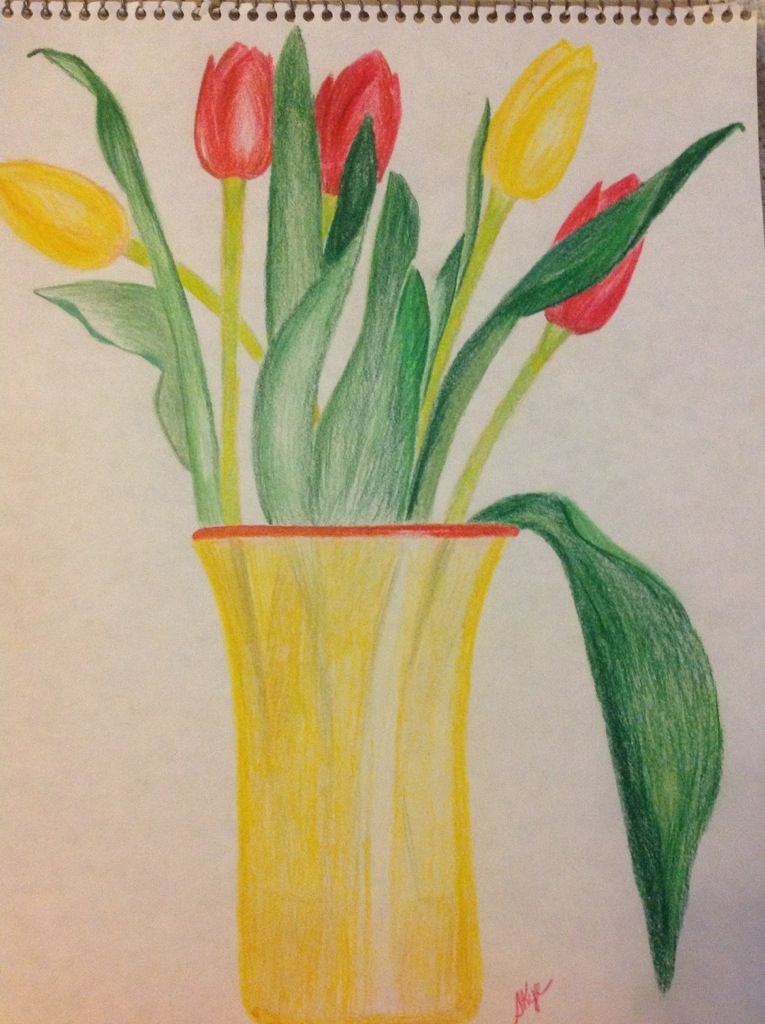
One perfect bunch of red tulips. Hmmmm…no…wait, maybe a bunch of yellow. I dug through my wallet to see how much spare cash was laying around in quarters, dimes, and dollars. Excellent…I had enough to buy one bunch of each. I wrapped them together in one of those long, plastic sleeves and made my purchase. These would be perfect.
My main living space was a bright, sunlit room with French doors that opened onto a stone patio. That room was the highlight of my small apartment. That room was where my futon, my funky wicker and metal chair and my bookshelves framed my reading corner. On the other side of the room, next to my patio, I kept an easel set up with my sketches in progress, and a huge, overflowing basket held my sketch pencils, water colors, pastels, and brushes. Right now, my subject was tulips.
Ironically, I am not an artist. I have always loved art, respected it, admired my artist friends. During the prior year, I had done a brave and daring thing and signed up for an art class. The class ended up being cancelled, but the teacher offered me some private tutoring and we struck up a lovely friendship of art and life and loss and growth. We are still friends across the miles. That year of art lessons opened up for me a love of drawing, and sketching in particular. It didn’t matter whether or not I was “good” by objective standards. Sketching was my therapy, my artistic meditation while the rest of my life was fully engaged in a different…scientific and methodical..process of becoming.
Today, I had taken six hours of classes in statistics and statistical computer programming. I’d then run off to facilitate a grief support group at my place of employment, where I attempted to reconcile the stories of individual loss with my scientific pursuit of generalizable knowledge of the impact of loss on communities, systems of care, and patterns of persistent health disparity. It was a challenge to be fully immersed in both worlds. I had stopped for tulips on my way home from work, responding to a spontaneous request from the muse in my soul for a respite from the relentless intellectual pursuit of knowledge and my mind’s attempts to sort and retain the information.
I walked into my apartment, through the room that held my computer and my files, and into this personal retreat space I had created in the midst of my apartment. There was no sun streaming in, as it had gone down long ago. I turned on some soft light instead, and lit a candle scented with frangipani. I took out a vase I loved, amber colored glass which formed a deep red heart-shaped opening. It was a gift from my artist friend Caroline, and even though the original occasion of its gifting (a wedding present) no longer carried the same meaning, I still cherished the vase. The tulips fell perfectly, and I added just enough water from my sink to keep them fresh without adding a complex water line to my sketch.
I set them on a small nesting table adjacent to my easel. I selected watercolor pencils that night. As I followed form and color and light, my thoughts dissolved into blending reds, yellows, greens, amber. I was lost in the pencil marks, brush strokes and water lines, drawn in to watching the pigment transform when touched by water, bleeding its colors into patterns that were both guided and unpredictable. I have no idea how long my session lasted, but my soul was at peace. My body, mind, and spirit had been unified again and the resulting piece of art was its visceral gift to remind me to stop, breathe, and take in the art and beauty around me.
I still have my sketches. And sometimes, gratefully, I still sketch.
“Art washes away from the soul the dust of everyday life.”
― Pablo Picasso
I was a busy 18 year old college student, trying to balance the new onset of college level education with part-time employment. I had been a nursing assistant over the summer, and scheduled myself for part-time hours over winter break to save up enough money to buy next semester’s textbooks. At the time, I was a pre-med student. My coursework was full of biology, chemistry, biochemistry, calculus. I was attending a religious school, so I had to throw in a biblical literature course for good measure (that may be a story for another day). In actuality, I was spending more time with the fetal pig (named “Ignatz” by my lab partner and I) that we were dissecting in anatomy and physiology than I was with any human beings. I loved the science aspects of my learning. But, I could already tell that I did not love the lab. In fact, I hated it. I am a social being, and I craved connection and conversation. And so, just a few months in, I was beginning to have my doubts about my future in lab science and medicine, although I wasn’t voicing them out loud.
One day over winter break, I walked onto the unit of the skilled nursing facility where I had worked all summer. I reported in and during the crazy, busy rush of things going on at the start of the 3 – 11 shift, I met eyes with a resident who had lived in a double room with her spouse over the summer when I last knew her. She was sitting by herself. I went over and said hello to her and asked her how she was. She teared up and said that Jack had died, she was all alone now. I was being paged to my work day, but I promised her I would come back on my break, and we would talk.
After a quick turn around to getting residents up and dressed, assisting with their dining and feeding along with sundry other personal care duties, it was finally time for my break. I knocked on the door of my widowed resident, and she invited me in. I sat down on the edge of her bed, next to her wheelchair. Her room was dimly lit, with a small light on her nightstand. She got out a small photo album and started reminiscing about her spouse. I was not a trained counselor…or a trained anything for that matter, just a listener. I liked the stories of my residents, and I knew they longed for company.
Just then, my charge nurse walked into the room and I instantly stood up, knowing something was wrong. “Get out here. Now.” she demanded. I excused myself from the conversation and left the room.
She walked me into the kitchenette area behind the nurses station and pulled out a pink sheet of paper and her pen. “I’m writing you up” she said “because no one on my staff is going to be seen sitting around doing nothing while the rest of the staff is working.” I tried to come to my own defense and tell her that I was on break, that I had worked with this resident over the summer, that she had been crying, that I was not “doing nothing.” She looked at me and said, “Let me be clear. If you want to spend your break on the unit, do something productive and scrub the sink. And, if you want to talk with people so god-damn much, then why don’t you go be a social worker.”
The rest, as they say, is history.
I signed up for Introduction to Social Work the next semester. It was like finding the glove that fits, when you didn’t even realize you were shopping for outerwear. I would read my text books and think, “Yes, of course…this makes perfect sense!” and my world began to crystallize into a framework of learning and knowing that extended across the micro to the macro system, all the while wrapping around the core essence of social justice and the centrality of human relationships. It still resonates with me to this day, every day.
I am so grateful, so deeply fortunate that early in my career, the most unlikely situation brought me into contact with my profession, and my avocation. I have continued to explore the nuances of social work across clinical intervention, supervision, community organizing, teaching, research and scholarship. That exploration will continue, undoubtedly, no matter what additional opportunities present themselves over the course of my career.
Sometimes, the small points of light that inspire our journey come from the most unlikely sources. I am grateful today for the grouchy charge nurse that inadvertently illuminated my path, which led me to my passion.
My 3:00 appointment had been referred from the Hospice team. Their patient, a woman in her 40’s with a spouse and two children, was dying at the close of a long battle with cancer. The team was actively working with their patient along with her spouse and children, who were the primary family system. Their patient’s mother was an independent older adult living in the community, and the team was concerned for her and wanted me to see if she could benefit from individual counseling. The referral to me was a way to navigate the complexities of both insurance billing and family dynamics. I anticipated it to be a smooth, supportive session where we talked through many of the challenges of anticipatory grief as an augment to her Hospice team.
Not so much.
My first assessment meeting with her was superficially fine. In fact, everything was fine. Just fine. Her health was fine. Her mental health was fine. Her coping was fine. Her social support was fine. Her family was fine. We whipped through an assessment which can sometimes take 2 hours to complete in 15 minutes, including pleasantries. Everything was just fine. This means, of course, that it was not. I still had a few minutes of session time left, so I pushed a little harder. She had mentioned having a strong faith and a supportive church community. She came back to this repeatedly, actually. I brought this up as a strength, but turned things around a bit to try to open the dialogue, “in what ways do you think your faith may be challenged or changed right now as you care for your daughter, as you and your family face the possibility of her death?” I asked. She sat up in her chair and got a little ruffled, “dear, no one questions God in times like these. You cannot be angry with God”
Well, if that was true, I am fairly sure 99% of my clients (not to mention myself and my own friends) would be shocked at their abnormality. I kept my reaction to myself, but asked her if she would be willing to delve a little deeper into this topic during our next session.
I am a therapist, not a clergy person, so I consulted with my chaplain colleague before the next session. My intent wasn’t to pry open or challenge her faith, but to raise her awareness of the link between spirituality and emotion, and try to move through a stuck point that seemed to be preventing her from having the quality of relationship with her daughter and family that could be meaningful at this crucial time. My chaplain friend was encouraging of this approach, and since he knew my client, provided a specific message for me to take to her, and he was happy to let me deal with it from there. It seemed like an exceptional disciplinary arrangement for both of us.
My client came back for her next session. She likely didn’t want to, but she was compliant. I told her I had spoken with the Hospice chaplain, and that he had a message to relay; it wasn’t my message, but one that he wanted her to hear and that I wanted us to talk about after she heard it. That message was, “God is big enough to understand us and love us through everything. God is even big enough to understand and love us through our anger.”
This would have been a strong and powerful, positive message to many people. But, my client sat there in silence. I waited for her to take it in. She met my eye and said, “Dear, I hate to have to say this but I am going to: Get Thee Behind Me, Satan!”
Instantaneously, my clinical instincts were reaching out to schedule my next supervision session in preparation for malpractice litigation. I was also mentally paging the chaplain, since this was not territory where I wanted to tread alone. Nothing in my professional social work training ever prepared me to be called Satan. I sat there more in stunned silence than clinical intentionality. But something amazing happened, in spite of it all. Or, perhaps, because of it.
My client sat back down in her chair and sobbed. Tears streamed down her face. At one point, she held on to me as she allowed herself, for the first time, to actually feel her feelings. This was my realm again, the place where emotion and cognition meet. The place where we gain insight over our emotional experience and make choices that help us navigate our relationships. That visceral breakthrough changed everything.
We went on to work together throughout her daughter’s end stage illness. Mother and daughter (and partners and grand children) went on to have rich conversations that helped sustain them through grief and dying and mourning. My client grew both psychologically, and spiritually. When it was finally time for our last session, she told me that I had been an angel, not the devil. I told her I frankly didn’t want to be either one. I was simply pleased to be the catalyst for her own authenticity and growth, which transformed her final weeks with her daughter into deep and meaningful memories.
This story, which she has allowed me to share, has stuck with me as a small point of light. It transformed me, too. It spoke to my spirit and has revisited me during times of pain, struggle, and grief when I was tempted to put on a strong face and move forward.
If we can risk the authenticity and vulnerability of feeling our feelings, of being in the present moment as the human beings that we are, we will experience God in an entirely different way.
My daughter has been on pins and needles the past few weeks. She has fallen in love with the idea of attending a particular all girls middle school, and we have gone through all the steps of the application process. Admission is competitive in a non-traditional way: one cohort of 20 girls are accepted each year, and the cohort is constructed around a group of girls who are selected for their diversity and compatibility of learning and growing together across four years. I am excited about this possibility, too, but my daughter is really the driving force. We should know the outcome any day now, but waiting is very hard. Especially for a nine year old.
Last night, she could not get to sleep. I was actually at my wits end, because I was tired from the week and just wanted to go to bed. She had tried everything to calm down, but she remained a ball of uncontrolled and relentless emotion. Sleep was nowhere in sight.
Sometimes it does no earthly good to be a trained therapist because, at the heart of it, you are still a human being complete with all the authentic failings and flaws that parenthood so readily illustrates in all of us. In fact, having been trained in theories of human behavior generally makes me even more keenly aware of how inadequate I am. On this particular night, I was considering whether threats or cash bribes would be a better option for convincing her to sleep. I had nothing left, not a drop of rational energy or creative maternal instinct. And yet, my daughter sat on her bed with huge tears pouring down her face, saying, “please Mom, please help me figure out how to get my feelings under control”
My small point of light came in the form of a visualization exercise that intuitively appeared in my mind. I have no earthly idea where it came from. And so, I can only credit divine intervention.
“Do you remember when we went to see the Chihuly glass exhibit at the art museum? Do you remember the video of how they blew the hot mound of molten glass into those beautiful, giant glass globes? We are going to do that with your feelings…” On we went, choosing various colors for both feelings of hope and optimism as well as feelings of fear and dread that accompany the unknown. We visualized blowing these feelings into the glass, watching it as it expanded. We described the colors appearing, changing, and combining, just like emotions. We progressed color by color and feeling by feeling, together spinning a beautiful figure of multicolored glass that could contain all her emotions. We sealed it off mentally, creating a glass sculpture that reflected her many, swirling emotions. As we finished the visualization, she drifted off to sleep.
I kept that same image in my mind as I drifted off as well. It came from somewhere beyond my human frustration and tiredness. It came from a place where feelings and colors and air and glass and art and science and stories all converged.
I think I would call that a glimpse of heaven.

Friday night is pizza night in our family. About this time of day, at the end of a long week of work, the thought of piping hot pizza accompanied by a glass of red wine is absolute bliss for me. I crave Friday night pizza for a lot of reasons, not only for tangy sauce and melted cheese. It has a meaningful history in my spouse’s side of the family; my mother-in-law would order pizzas every Friday night in later years, and her grown-up children and grandchildren would come to visit over slices of pizza and her homemade oatmeal cookies. It’s become a tradition in our household, too. Sometimes we make fresh, homemade dough and get fairly gourmet in pizza presentation. Other times, it’s trying out a variety of pizza places on a family taste tour for the best in town. Still others times, like tonight, it is carryout freedom at the end of a long work week. Yes, there is a lot to crave about pizza.
Ed craved pizza, too. He was a long-term resident of mine in the residential health care facility where I worked first in the activities department as a student, and then as the Director of Social Services after I graduated with my BSW and MSW degrees. Ed was a big guy, with a big appetite, and a big voice, and a big sense of humor. He had trouble finding words because he had significant impairment from a stroke. But, he always got his point across. He wasn’t fond of the food served from the cafeteria, and he really wasn’t happy that his nightly dinner didn’t come with cold beer. On the last Friday of every month, we hosted a resident happy hour with full service beer, wine, and cocktails (unless contraindicated medically, and even then we had “mocktails” and near-beer). I had served Ed a number of beers when I worked in that facility as an activities assistant. It was now several years later, and I was back working in that facility in my new role. Time had taken a toll on Ed, and he had developed esophageal cancer. Sadly, his small joys in life…pizza and beer…were stripped from him.
The day that I helped Ed and his family sign paperwork to admit him to Hospice was a very emotional one. Ed had some challenges speaking from a stroke, but his indication was quite clear: no feeding tube, no resuscitation, no life prolonging measures. He wanted to live as well as he could, as long as he could. But, that end was approaching for him and we all knew it. He knew it, too.
One of the things I respect most about Hospice is the focus on quality of life, and the active pursuit of comfort. Comfort isn’t simply viewed as the absence of pain. Comfort is the creation of the kind of circumstances that maximize our humanness and give us deep appreciation for the present moment. The doctors and nurses helped Ed be free of pain. I worked on some other areas of comfort. I started with pizza.
“Ed” I said, “what do you want to eat?” He looked at me and grinned. “Pizza. And beer.”
I left the unit and went to see our dietitian. The swallowing evaluation indicated that only pureed foods and thickened liquids, in very small quantities, were safe for Ed at this stage. He hadn’t been eating much of anything they were sending, though. I asked her if we could puree pizza and thicken up beer. She said she thought that was probably possible. So, the plan came together.
That evening, Ed got a plate delivered to his room that surprised his wife. A perfectly formed piece of pizza to look at, just with a very different consistency. We had made a mold, pureed the pizza and fitted it back together to look like the real deal. And next to it, a can of his favorite beer, with a glass in which the right amount of thickening agent had been added to allow small “sips.” We fixed her a tray, too, with the matching non-pureed version. And then we slipped away and gave them time to eat together.
I’m told it was Ed’s favorite meal. He died, very comfortably, a few days later. Comfort maintained, in all ways.
What we crave in life isn’t really just the favorite foods we consume. It is being known, and loved. It is living…and dying…with integrity of who we are. It is the comfort and companionship of those we share with, and the respect of those who know us.
Cheers, Ed. It’s pizza night.
There can be some unintended side effects of living in climates with heavy snow. I learned about many of these climatic idiosyncrasies during the 30 years I spent in upstate New York. To set the background for this story, it is important to know that my little house in Buffalo was built on a double lot. The side yard was simply the absence of a house on the other side of my driveway; it had no drainage or landscaping. Just grass, and in the winter, snow. In fact, the first year that I lived in that house I realized that the side yard actually became a pond during the massive melting of snow that came with the spring thaw. I am not exaggerating.
I learned about the springtime pond’s emergence when I went outside one morning and there was a duck swimming in the melted snow water pooling on my yard. The first day, I chuckled and thought how funny it was that the duck was confused. However, the duck continued to come back day after day as my water soaked yard continued to provide a convenient, urban location for water fowl. The duck attracted some friends, and pretty soon, it seemed that duck romance was in the air as each morning two specific ducks would greet me when I walked out the back door. I would say good morning, and they would quack at me. I eventually named them Ernest and Francine just because those names seemed to fit. “Good Morning, Ernest and Francine”. quack, quack became a welcome morning routine as I tossed some bread their way. This went on for weeks until my “pond” began to shrink. Spring moved on, and the ducks did as well. I didn’t think much of it until the seasons changed again.
Winter came, snow came, and eventually spring emerged, as did my lawn pond. The first spring thaw day, I stepped outside and heard a familiar “quack, quack” and saw two very familiar ducks on my newly re-emerged pond. I decided I was probably making things up, and this was just some other duck pair passing through. But they swam across my lawn, waddled over to me and continued to “quack quack” until I said “good morning, Ernest and Francine.” After that, they contentedly waddled off to swim in the pond.
That spring, Ernest and Francine continued their daily greeting and, a few weeks later, Francine spent several days behind my garage and emerged with a little string of ducklings. They stayed in the yard until my pond dried up, with our daily exchange of quacks, occasional food, and good-mornings.
Ernest and Francine came back every year I lived in that house. They were my harbingers of spring and my comic delight to start the day. They also gave me an odd sense of home during a time of general upheaval in my life. We gave each other something just by being present and attentive. They built a home in an accidental pond, because nature adapts to accommodate surroundings. Sometimes, nature adapts better than we do.
When I think of Ernest and Francine, I smile. I also consider the lesson I learned from within this small point of light during those winter-becoming-spring days: we come back to the places where we are noticed, and welcomed, and called by name. I ponder what this story has to offer, and I have to ask myself some questions. Are there people I pass every day that I don’t recognize or don’t call by name? Are there people who take up residence in physical spaces in my community (like parks, benches, and street corners) who are attempting to find some sense of home in their world that has no stability? Do I notice, welcome, and call by name those whose paths cross my own? What might our communities be like if we took time to notice, to recognize, and to welcome the diversity of people we encounter day by day?
Thank you, Ernest and Francine, for brightening the spring times of my past and offering a reminder for a better way to live and build community in the present.
I was at the lenten program tonight at my church, taking in and reflecting on our current Rector’s story of her spiritual journey. She is retiring soon, so transition is becoming a constant companion for her, and for us. Tonight, she made an important statement in response to the question of what she has been, and may still be, called to do. Her words (as I recall them) were that the experience of being “called” was not a clear and direct voice telling her what she must do. Instead, there were opportunities presented which required her to step up, to take the appropriately titled “leap of faith” in acting on them, and to walk into a new situation in faith, knowing very little about what will actually happen.
Easier said than done, as many of us know.
During the key transitions in my own life, I have reached these points where opportunity seems to knock, and doors open. These are not divine moments of light at the time. More likely, they are moments fraught with both confusion and hope, and sometimes it is only after the fact that we also see these events as the open doors which have a pivotal role in our growth. I think this situation probably rings true for many of us, actually. We are enduring a period of change, something presents itself and then we find ourselves first saying, “what do I do” and only later saying saying “what good luck” or “thank God” or other externalizing yet well intended ways of assuming that the opportunity came seemingly out of nowhere to find us and rescue us from challenging situations. Or, we are still enduring a challenging time, hoping for those moments and wondering if they will ever come.
In 2000, as we celebrated the passing of the millennium, I was at that point. I was impatiently waiting for change that I felt was imminent…or at least, needed to be. I wanted to receive news telling me exactly what was to come, to be reassured of precisely how things would work out. That isn’t necessarily how it happens, though. These were long months of uncertainty while I was living them. Only in retrospect were they the months before a life-changing experience.
In mid-March, I received an acceptance letter to the doctoral program to which I had applied. I had promised myself a no ambivalence situation, so I accepted the offer (filled with fear and anticipation) while I still had absolutely no idea of how I would move from the place I was, to that place I would be going to. But, I had made myself a promise so I moved ahead with it, stubbornly and without telling anyone. I did not think of it as faith. I was not naive. I believed I could just as easily fail miserably. That was a real possibility. But, I stepped through the open door anyhow.
In April, I was scheduled to speak at a national conference and a few days before I left, I was sitting at my desk and it occurred to me that maybe I could check and see if there were conference participants from St. Louis whom I could network with at the conference and get some idea about places to live, etc. I was being planful and resourceful because I am a social worker, and its what I do. I called the conference planners and they gave me the name of someone at an agency in St. Louis who would be at the conference. I did not know the person, or the organization. I picked up the phone and called them anyhow. The conversation went something like this:
“Hi, I was just calling because I heard you were going to be at the conference next week. I am working in New York, but will be moving to St. Louis to go to graduate school. I was wondering if you might have time to talk with me for a few minutes about St. Louis, since I will need to find a place to live…” And the response began with, “Are you, by any chance, looking for a job…” We went on to set up an interview at that conference. I would soon after be hired to replace their staff member…who had just given her notice that same morning I called…in order to take her own leap of faith to go into private practice. I practiced in an area of bereavement support that was highly specialized and deeply meaningful to me, and this position was to do exactly the same work I had been doing, and loving, for the past several years. Within six weeks, I would be living in a new city, taking with me only what earthly belongings could be carefully packed into a minivan. I would have a new job, a new apartment, new colleagues, and a new path unfolding on my life journey. I would simultaneously have to leave and let go of many things I had been clinging to. it was a transition of both grief and hope. It is what happens when you make a choice to walk through the open door.
There are even more details in this story, in retrospect, that make me know beyond the shadow of a doubt that this could not possibly be happening by coincidence. Every time I tell the story and its endless string of serendipity, it seems like a tall tale, or a miracle. It is my real journey, though, as are all our life journeys with their amazing twists and turns, stuck points and open doors. However, open doors are only one part of the equation. The other part of the equation is our willingness and ability to be right here, right now in the present moment, to listen to the inner voice that propels us to action, to take that action, to be willing to walk through the door and take the risk, and to be willing to use our human capacities and strengths to their full potential in the midst of change. Or, as I like to describe it: to show up and be present as our best, authentic self.
These are moments where our humanness touches the divine, and we become aware that we are a part of something larger than we are. We have both free will, and higher purpose.
Our choice to show up, be present, and act are the essential elements in catalyzing serendipity. We have to be willing to say yes, and step forward into the opportunity. Stepping into a door that opens for us is, indeed, an act of faith.

