Remembrance Day

May you know the immensity of divine love, even in the smallest footprint;
May the expectation that holds your longing transform into hope in this present moment;
May the treasure of memory swaddle your sorrow in a blanket of tenderness;
And may our lights of remembrance embrace you with community and support.

Today, October 15, has been designated Pregnancy Loss and Infant Death Awareness Day.  I wrote these words of blessing this morning, hoping they would somehow be carried to all those who would be touched by them.  So, you can help me with that by reading and sharing.

I am writing this blog post today for two groups.  First, I write to my cherished friends who have experienced the loss of a pregnancy or the death of an infant.  I write to remind you that you are loved, understood, supported, and remembered.  I hold you in my heart today, and pray this blessing for you.  I am also writing today for those who have never given any thought to the subject of pregnancy loss or infant death. Please, keep reading and allow yourself to learn something more about an experience that many people avoid talking about, pass judgement on, or simply are oblivious about.  This is important to our communities and to our world, as well as to our individual lives.

Just to share a brief history, Pregnancy Loss and Infant Death Awareness Day is recognized by multiple groups and bereavement support organizations around the globe.  Since 1988, on the 15th of October, people around the world light a candle at 7 p.m. in their respective time zones to recognize and raise awareness regarding these losses which are all too often unseen and unspoken.  This lovely New York Times blog today tells a wonderful story of the commemorative day’s beginnings and describes its meaning for one of many families who grieve and remember.

I write and speak often about reproductive and perinatal loss; I wear this as part of my professional identity.  It’s part of my personal story, too, although that isn’t what drew me to this cause in my professional life.  I, like many women, are part of an unintentional sisterhood of experience.  I came into this work quite serendipitously but I remain because it is important to the fabric of our humanness to be sure to give voice to this experience.  The reason that I try to intentionally bring awareness to pregnancy loss has to do with how much silence, stigma, and misinformation still exists for women, couples, and families who grieve when a pregnancy doesn’t end like they hoped and imagined it would.  I write and speak for families who have had a baby die, and no amount of love, tenderness and effort could have prevented it from happening.  These are sad, tragic losses.  There are also transformative stories of growth within their grief.  I have been companion to many who are grieving, and I am transformed by their experiences as much as my own.

So, today, I want to share a few things I have come to know through my research, my counseling, and my own personal and human encounters with loss.

I want to let people know that 25%…one in every four…women has had a recognized pregnancy loss in her life.

I want you to know that the number is actually larger than that, because of all the pregnancies that end even before they can be officially recognized or acknowledged.

I continue to be amazed that whenever I speak, a woman (or more than one) comes up to tell me her story that hasn’t been shared for years, or possibly ever.  Far too much silence still remains.

I want to talk to everyone about the fact that there is no shame in having a pregnancy begin…and then end…and it doesn’t mean that a woman did anything wrong, that there is something wrong with her or that she could have changed the experience.

I convey to all readers of this blog that some people grieve the loss of a pregnancy as an expectation, some grieve it as a fetal death, some grieve it as the death of a baby…and our individual moral and ethical belief systems are far less important to convey to the grieving than is our compassionate, human response of authentically saying “I’m so sorry this has happened to you, and I’m here for you.”

I want to tell people about the amazing parents I know who care for their babies who will not survive even days or weeks or months.  And, I want to tell people about the amazing parents I know who make the most difficult choice imaginable to terminate a pregnancy for a host of very powerful reasons, all of which require deep thought and emotional turmoil.  And all of these amazing families are worthy of compassionate understanding.

I wish I could tell you about each one of the people I know who hurt so deeply, are misunderstood and judged and questioned, and yet who find the strength to go on and thrive, making valuable contributions to their own families, communities, and the world at large.  Philanthropic foundations, musical tributes, books, fund-raising events, peer support organizations and countless loving gestures to improve the fabric of human kindness all originate from people who have been deeply touched by pregnancy loss and infant death.

I can tell you about amazing resources that exist for information and support.  I spent a lengthy and wonderful time on the board of the Pregnancy Loss and Infant Death Alliance (www.plida.org) and work closely with my dear friends at SHARE Pregnancy and Infant Loss Support (www.nationalshare.org), Bereavement Services (www.bereavementservices.org), the MISS Foundation (www.miss foundation.org), the Association of SIDS and Infant Mortality Programs (www.asip1.org), the CJ Foundation for SIDS (www.cjsids.org) and First Candle (www.first candle.org).  Go visit their websites, and see what helpful information they have to offer for professionals, caregivers, clergy, grieving families, workplace colleagues and caring friends.

I can also share what I have myself written and spoken about, and I’ll do that in a few ways right here.  You can read the full text of a journal article I wrote for Social Workencouraging dialogues on reproductive loss across multiple settings of social work practice to break the silence.  You can listen to an episode of the Social Work Podcast I recorded a few months ago with my friend and colleague Jonathan Singer.  You can send me a note, email me, share your story or ask me what else you want to know.  I am always delighted to have a conversation.

Lastly, you can light a candle.  Tonight.  7:00 p.m., wherever you are.

Remember.

wave of light

Posted in work and life | Tagged , , , , , , , , , , , , , , , , , | 1 Comment

Attitude of Gratitude

I was talking with a friend of mine the other day who remarked, “won’t it be interesting for you to look back at your blog after a full year?” The truth is, it’s rather difficult for me to imagine a time I wasn’t writing this blog, even though it hasn’t yet been a full year. It has been right around 9 months, actually, which is ironically the perfect gestational time frame for a something new to begin to take on a life of its own. I was thinking of her remark earlier today when I was pulling together the final version of this week’s Who is My Neighbor? media blog, the theme of which is gratitude for healing. That particular project is coming to a close in a couple weeks, and I was considering what the next iteration of inspiration would look like for my church community, and how I might integrate that here, in my personal blog space. It occurred to me how grateful I am to have rediscovered writing in my spiritual life. That thought has been percolating in me as I moved through my day. Just now, writing time found me. As, I have come to learn, it always will.

Truthfully, I began this blog serendipitously when the story of sneaking down into a dormitory basement to receive my first Lenten ashes was persistently and relentlessly on my mind last year on Ash Wednesday. I had declared a Lenten intention of nourishing my spirit as often as I nourished my body, but didn’t really have a well thought out plan for exactly what that “spirit feeding” might entail. But, plan or no plan, inspiration appeared and my words began to take form. By the end of that day, I had set up a blog and released the words of that story into the wider world. That “wider world” was probably one or two people on that day, but the point was really to set the story free not to count the numbers. During the nine months since, I have become familiar with the emergent process of my blog-writing as a way in which Spirit speaks through me. Blogging is very much a part of my spiritual practice.

Incidentally, blog-writing is completely different for me than the pattern of my academic writing, which is methodical, logically ordered, and sometimes even painstaking. Writing this blog is different, and inherently spiritual. As I move through my ordinary life, I feel my spirit being stirring to a thought, a memory, a story, a quote. This is my cue to allow myself to move into a time of stillness where that small inspiration takes on form and substance, and builds within me until I can find time (or time finds me) in order to allow the words to flow from me. Sometimes, my words rush faster than my fingers can type. Sometimes I pause, and breathe, and move away for just a bit until I can do a final read through. Sometimes I am so busy…but the story is so relentless…that I have to pause and allow it to flow at crazy, haphazard places or times. Sometimes the path of my story meanders and comes around to something which surprises and delights me, releasing a realization or insight which speaks to my own spirit. Admittedly, everything I write still requires my final editorial review before publishing. After all, I am a human being who likes run-on sentences, and for whom auto-correct cannot be trusted. Some things are a constant in the writing life.

What does all of this have to do with my attitude of gratitude? Everything. I am astounded by what these past months have meant to me in growth spiritually, interpersonally, professionally. When I revisit this blog and the posts I have written, what I feel is gratitude. Deep, overwhelming, life-altering gratitude. I have been through some challenging times over the years, and I have had amazingly beautiful moments, too. I have companioned others through their own difficult moments, and celebrated their successes. I have written down stories and experiences I have shared and also hold in my heart a whole series of stories that have not yet flowed from me but will, when the moment is right. Not a day goes by when there is not a small point of light, or a present and persistent reminder of divine love and grace just waiting for me to take notice. I don’t lead a charmed life, nor do I lead a blighted one. I simply live a life with highs and lows and lots of moments in-between. But, the life I lead is rich with gratitude for lessons learned, gifts bestowed, wisdom outpouring from friends and strangers. The more deeply I live, the more I am called to live deeply.

As I casually browsed my blog archives earlier today, I started to create a list of the people I wanted to thank for their roles on my journey. Then, I considered all the people I have yet to mention, all the stories that have not yet spilled out, and all the small points of light yet to emerge. I realized that saying thanks would be insufficient. This is really a blog about gratitude; gratitude for the ordinary that becomes the extraordinary. Gratitude is different than thanks. When I think about saying thanks, I consider “thank you” my direct response to something specifically done for me; “thank you for the gift”; “thanks for taking care of the hedgehog while I was away.” Thanks is important, necessary, and appreciated. Gratitude is “thanks plus” in my mind. It makes us aware of not only those things of which we are thankful, but also those daily actions which could so easily be dismissed or overlooked. Gratitude brings us directly into to the awareness of the gifts already around us, taking the form of our lives. Gratitude is an attitude to be intentionally cultivated.

What I couldn’t possibly have realized on that day I wrote my first blog entry was how much I would be transformed by this writing and by others’ responses to it. For that, I am grateful beyond words. I have been healed by the conversations that have emerged with people who read this blog, even those who knew me fairly well to begin with. I treasure the fact that my father printed off every one of my Lenten blogs and made a book. I treasure reconnection with friends and family with whom certain stories I write resonate over time. I am grateful for every conversation that begins with, “I was reading your blog….” because those conversations take whatever thoughts I was having and push them even further into another person’s experience. That shared encounter transforms us both. I am grateful there are people I don’t even know who may be inspired by this writing, and that keeps me focused on the role of Spirit as central to my writing process. Not only is divine spirit present when I am writing, but also after I hit “publish” and allow the words to travel freely to other people in other places. I trust Spirit to guide that journey. Last, but not least, from writing and sharing my words and stories, I have experienced healing in places where I had not even realized there were still wounds. I have myself been immersed and transformed by the divine grace of which I so often write.

So, today, I am grateful. I am thankful for the inspiration and healing that has been a gift from my own writing. But more deeply, I am grateful for the journey of life and the spirit which allows and inspires me to write.

My attitude of gratitude, cultivated through this blog, is its own small point of light as I continue my journey.

Posted in Who is My Neighbor?, work and life | Tagged , , , , , , , , , , | Leave a comment

brokenness

There are days when brokenness is palpable.  There is brokenness in my community of friends, several of whom struggle with the pain of loss and have been recently visited by the depths of grief.  There is brokenness in the federal government impasse.  There is brokenness in workplace and work-life tensions.  There is brokenness in letting go, saying good-bye, recognizing unhealed wounds in our own lives and spirit that are activated by the pain we encounter in the world.  This life can be a hard road to travel.

I’ve been thinking about brokenness today for these reasons, and perhaps that is what made me step into a dialogue on Facebook around a Fresh Air interview Terry Gross conducted with Elizabeth Smart.  To me, this story is all about brokenness.  If you haven’t heard it, here is the link.  Listen to all of it, not just the surface.  There is one part I really want to talk about in which I think there is a profound lesson, a small point of light:

Fresh Air Interview with Elizabeth Smart

Now, there are two things that strike me about this interview.  The first is that while Elizabeth Smart may come across as confident, self-assured, and ‘healed” during this interview, I believe that brokenness is still the main theme which comes through in this conversation.  She talks about being so drained of everything by her captors that she couldn’t even fathom telling anyone what her name was.  This level of broken is something that, mercifully, most of us will never have to experience.  But people do.  Some of them are famous, and some of them are known only to themselves.  Some experience hurt by captors who will later pay the price.  Some will be hurt by people who will continue to have power over themselves and others, and who may never come to “justice” in our society.  Some will be so broken that they will hurt others the same way they were hurt, perhaps just trying to touch the face of what it feels like to be human and have identity.  This is a painfully difficult reality to take in.

But, what this story offers for me is the recognition that brokenness is not the end of the story.  Brokenness is a fragile state that empties us.  Maybe, just maybe, the depths of our brokenness empties us and opens us up so that even the smallest acts of grace can seep in.  You’ll notice I didn’t say “fix it” because that could take days, weeks, years, a lifetime or perhaps even more.  Open wounds don’t heal rapidly.  Sometimes our deepest wounds are still healing below the surface even when they begin to pass inspection on the outside.  But all this brokenness leaves room for so much grace.

This brings me to what was, for me, the most lasting and perhaps unsettling aspect of this interview.  At one point mid-way through the interview, Elizabeth describes to Terry how people would notice her in the complete head to toe covered robes that she was wearing.  I painfully listened as Elizabeth described how she would notice people crossing the street in downtown Salt Lake, how they would walk as far away from her and her captors as possible without making eye contact, then they would cross back to pass them.  All the while, she knew this was to avoid having to make contact.

Ouch.  That one hit my heart.

This pained me, because its real.  I see it daily, and I engage in it just like the rest of the world.  Pretending not to see.  Stepping away from something that seems bizarre and out of place.  Defining the world by “us” and “them” and putting up a wall between myself and the world of pain that emerges when I realize how much the other may be going through that I simply don’t know about and perhaps cannot even comprehend.  I do willingly step in to brokenness with my friends, or people with whom I work with in professional and personal helping capacities.  But it is really easy for me to divert away from other widespread brokenness in the world.  We can walk to the other side of the street metaphorically so many times.  Is there a captive, broken young soul that we pass up the opportunity to assist when we do that?  Possibly.  Can we fix everyone we see?  Probably not.  And that juxtaposition between caring but feeling incompetent to fix is one of the things that keeps us from crossing over to the other side.

Let’s for just a moment consider that it isn’t our job to “fix” people, but to simply be present in this world with them as connected, loving human beings.  We cannot in our limited human capacity fix homelessness, poverty, abuse, mental health, death, grief…the list goes on.  We can, however, be present in a broken world to make eye contact.  To say a prayer.  To learn someone’s name.  To offer basic, momentary support.  To advocate.  To give voice to those whose circumstances silence them.  To stand up and say something when power is misused.  These are just simple, daily actions.  But, if we engage in them with intention they transform into acts of radical compassion.

In a broken world, there are enough gaps that our simple acts can find ample opportunity to sink in.  From a faith perspective, this may mean that we allow divine grace to use us exactly as we are, as one of a thousand small moments that could seep in and begin to fill the cracks of brokenness.  From a human perspective, irrespective of whether we believe in a higher power or a greater purpose, we act in ways of human compassion because in those actions the world of this present moment changes, even incrementally.  This bends the arc toward justice, compassionate action after compassionate action.

If we are still enough to take it in, we may also experience the transformative grace that seeps in to cracks of our own brokenness, too.

Posted in quotations and reflections, work and life | Tagged , , , , , , , , , , , , , | 2 Comments

Blessing the Animals

Occasionally, a small point of light makes its way into our lives through all creatures great and small. Tonight, my faith community filled with exactly that…from Greyhounds to hedgehogs and all sizes in between.

The hedgehog is our family pet. My daughter and I decided to bring a hedgehog into the family last year, after great deliberation about what was the best animal companion to join in our family fold. Allergies are a serious issue in our household. We also didn’t need anything else requiring high maintenance. We are all fairly nocturnal. And, heaven knows, we live on the fine edge of eccentricity in other ways. There is something about this sweet, affectionate creature that can also throw up its spines and send large creatures off their attack in a single act of huffiness that appeals to me. And so, Clover was lovingly sought out after much research into care and breeding. And, he has become a bona fide family companion, adding one more layer of zaniness into our family structure.

Tonight, we woke up sweet clover a couple hours early and drove him off to Bluegrass mass and the Blessing of the Animals. My daughter sat like a proud caregiver, showing off sweet Clover to the children, grown ups, and the occasional sniffing dog that wanted to catch a glimpse. I have to admit, I was still caught up in the beautiful intensity of my own weekend, having been away on a very contemplative and introspective retreat until a few hours previously. This scene was an immersion back into the loud, wild, and wonderful world of community which surrounds me. My spirit was singing for joy as I embraced these lovely contrasts.

Clover was on good behavior. Small children were able to pet and dote on him without prickles, and he sniffed around to take in the new surroundings. In a memorable moment of blessing, a little boxwood branch sprinkled little drops of holy water on his nose as he reached up as if to claim his blessing. So did our community dogs and cats and companions small and large. Barks and singing and fantastic bluegrass music from our incredibly talented musicians filled our space. And, we all broke bread together both in holy communion and later, in the parish hall, as we embraced our wild and diverse community. Heaven on Earth.

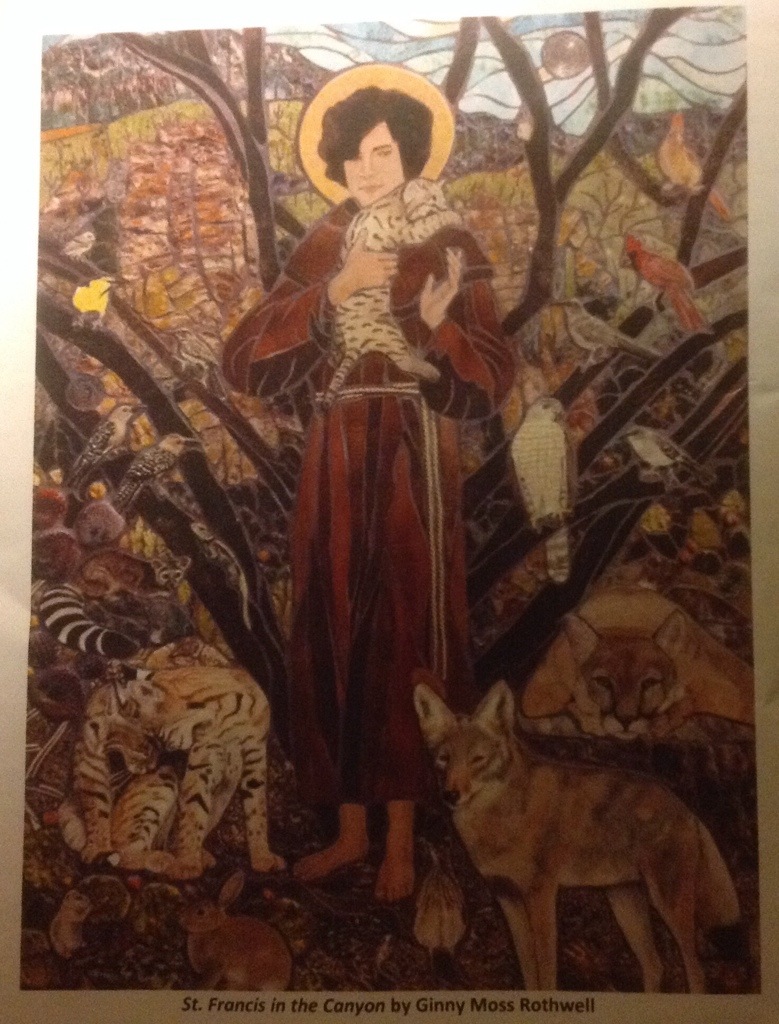
I have so much else I could say tonight, but this scene that would have warmed even the heart of St. Francis himself conveys an image of the light shining on my path tonight. All are welcome and all are blessed…those with quills and barks and purrs and tails. All are welcome and all are blessed, with our own spines of protection, shouts of joy, stillness of soul-searching, and embrace of welcome.

Grateful.

20131006-232156.jpg

Posted in Spiritual journey | Tagged , , , , , , | Leave a comment

what I believe, at this moment…

It is Friday afternoon as I sit at my desk. I am thinking back across my week, from the vantage point of this chair, as I reflect on the question of “what do I believe?” in response to this week’s “Who is My Neighbor?” media.

This week, I have worked (a lot) at my desk, I have cried at my desk, I have laughed at my desk, I have eaten at my desk, and I have thought I might fall asleep at my desk (although ultimately, I did not).  From this chair I have spoken of statistics, social justice, organizational policy, feminism, community engagement, faith, courage, curiosity, administrative policies, my family, curriculum, music, and squirrels (it’s true).  From my fingers, I have typed presentation notes, meeting minutes, countless emails, interview questions, consent forms, blog entries, scholarly article reviews, survey questions, content for my own articles, summaries of concerns, meeting agendas, and words of encouragement to print off and carry on my journey.  In my hands, while at my desk, I have held pens, pencils, calculators, an apple, a Luna bar, prayer beads, my keys, my smartphone, books, and occasionally, the hand of another.

At this moment, I believe that what I experience today is a lesson that moves me step by step into where I am going on the path of life.  This life in progress is one of humility and privilege, of human brokenness and divine grace, of past formation and future emergence.

I believe I am tethered to my words in a way I never realized I would be.  My words reflect my world view, my knowledge, my style and my inner spirit.  My words extend my reach into realms that aren’t within my own command; I set them free and they are given life and meaning by those who receive them, who pick them up, who take them in.  And my words carry me to places otherwise unfamiliar, and make me known to friend and stranger.

P.S.  This is a response to this week’s Who is My Neighbor blog at St. Thomas’ Episcopal Church.  Whether you are following that “blogging through ordinary time” adventure with me or not, some of you might enjoy taking a peek at thisibelieve.org, which is a forum for diverse expressions of faith and belief for people from all walks of life.  I picked out seven “neighbors” who shared a brief reflection on that site.  Feel free to take a peek at these divergent ways of coming to know and experience what faith means amid daily life to some ordinary and extraordinary people.

John Updike: http://thisibelieve.org/essay/14/

Alaa El-Saad: http://thisibelieve.org/essay/42798/

Joel Engardio:  http://thisibelieve.org/essay/27932/

Eve Ensler: http://thisibelieve.org/essay/17/

John Fountain: http://thisibelieve.org/essay/35/

Susan Cosio:  http://thisibelieve.org/essay/23042/

Andrew Brodsky: http://thisibelieve.org/essay/49378/

Posted in Who is My Neighbor? | Tagged , , | Leave a comment

Showing up

I woke this morning with one intention: showing up to my life. I also woke, as did those of you reading this, to the shut-down of the government after a stalemate impasse around legislation and budget and social policy. Similarly, I woke up to workplace frustration, ego, overload of work-related tasks in which the forest is often lost amid the trees. People around me are experiencing illness, transition, loss, sadness, marginalization. And, I woke up to my own inner world, a growing sense of emergence mixed with confinement…or as my friend Susan once alluded to in a sermon she preached: lobsters molting.

This is the world into which I am showing up this morning.

Let me back up to my weekend, because in it there is a really beautiful showing up moment that brings light to my path today. This weekend, I joined 135 or so members of my faith community at a retreat in the mountains. We did many lovely activities from hiking to candlelit compline at the labyrinth, to karaoke to hay-less wagon rides along country roads. We also welcomed the newest member of our community through Holy Baptism, celebrating the birth (and adoption) of a small, six week old child of God into the faith and life that we practice. Presiding at this lovely ritual of new beginning was the final of four beloved pastoral leaders who will depart our parish this year, along with our interim rector who is leading us through this year of transition, getting to know us in a way that helps us let go and move through our process of transition keeping God in the midst. We gathered around, children and grown-ups with hearts completely full and admittedly, overwhelmed by a mix of saying good-bye while wishing amazing things to each person’s new calling, and rising into awareness about our own community’s collective opportunity for growth. If there was an emotional barometer in that outdoor shrine, it would have burst from our collective emotion.

In the midst of this gathering, the six week old dressed all in white was sleeping. And then, she woke and we watched as she took big deep breaths of mountain air, taking in all that surrounded her. At one priceless moment, as we joined in welcoming her to community, she stretched out her small hand and rose it up to the sky and outwardly toward us, seemingly blessing us all with her own innocence and hopeful expectation of life.

She showed up, exactly as she was.

I am thinking back this morning to this small moment of showing up. Was it planned on her part? No, I don’t believe it was. Was she aware of our mixed emotions, our exhausted good-byes, our loving sending forth of leaders to new congregations, our growing sense of all that we offer to each other in community even in the midst of change? No, she was oblivious. Did she know her own story, or the story of her parents that brought everyone into this space? Nope, there are details and heart-stories that may only become known and shared over time, even though she is the key figure in the narrative. She showed up because that is what we do when we are cared for by those who love us, when we are embraced by community. She showed up in the midst of divine love and grace. Family, friends, community bring us where we need to be. And, our spirits stir in response to something far greater than we can ask or imagine.

I remember and reflect on this story as I greet this particular day, in this world filled with so much angst and frustration. Circumstances are clearly outside my control. I fight the urge to leap ahead into what I think I want to see happen (there is a lot of “I” in that statement!) But, planning for an uncertain future doesn’t keep us present and aware of what is happening in this moment, amid the chaos and sadness…and love and community…that is happening all around in connection with us. Someone who doesn’t know it yet is awaiting my reach out to them, and my restless spirit is awaiting the arrival of something I cannot yet know or describe in detail. I catch glimpses of it, though, just as I did this weekend. These moments remind me to pay attention, to be open to seeing the smallest points of light along the journey as they emerge, to experience divine love and grace.

So, on this day, I will show up to my life.

Posted in work and life | Tagged , , , , , , , , , , , | Leave a comment

Learning from the Divide

For a significant part of my career, I was a grief therapist affiliated with a Hospice program. People came to our agency for a range of reasons, all having something to do with loss. We also provided grief support as a routine part of Hospice care to the entire family system. One of my most important life lessons has been grounded in the universality of our encounters with death and grief.  Rich or poor, educated or not, any shade of the rainbow of cultural diversity…we will all encounter grief and loss in our lives.  Crossing the chasm of grief companioning multiple people, however, sometimes provided an exercise in learning from the social situations that divide us even in the midst of this most universal and challenging of life experiences.

I was working as a Hospice bereavement social worker at the time of this story.  My morning did not get off to a good beginning.  It was snowing out, and my car wouldn’t start. It was not just being stubborn in the cold.  It was dead, with no hope of revival. That morning, I wished I had an automotive grief counselor, or better yet, an on-call mechanic. I had two home visits scheduled that morning. The only thing I could think of to do at that moment was borrow a readily available car. My relationship was on the rocks and my partner at the time had a beat up wreck of a car that had even more issues than my car did. But, that morning, that wreck of a car started, while mine did not. In a spirit mixed with anger and humility, I borrowed the car in desparation and went off to work.

After a quick check in at the office, I looked at my two scheduled visits. Each was a a bereavement counseling visit with a woman whose spouse had died on the Hospice program during the past month. This was before the time of the GPS, so I looked up the address in my indexed map book of the county. The first address was in an incredibly affluent area of town. As I drove, the homes grew larger and my insecurities grew exponentially. By the time I reached my destination, I concluded that I looked more like a pizza delivery person than a social worker. I felt small and insignificant and horribly out of place. The woman I was visiting was lovely and dignified, as stately as her home.  She also seemed unable to be present with her own emotions, and certainly not comfortable expressing them in front of me. I kept thinking we would soon get to a real place of feeling showing through, but she would instantly excuse herself when any hint of emotion emerged.  When she returned, she was free of any outward expression of feeling and our plodding conversation resumed. My awkwardness and her awkwardness seemed to co-exist, each oblivious of the other. I took care to be present with her in spite of the looming elephant I could see in the room. She took care to be present until I had gone over all the factual information on grief, stammering with my own sense of inferiority.  She thanked me for making the visit politely, as I wrapped up my professional conversation politely. So much could have been different, for each of us. But neither of us seemed able to cross the divide.

My second visit took me into the depths of the city, into an area where I knew I should only be with a really good reason, and even then only at certain times of the day. It was a neighborhood not far from where I had lived in college, in an Italian now mostly Puerto Rican neighborhood which had recently experienced heavy gang activity. The street address to which I was headed was in the center of that activity.  Suddenly, my transportation situation of the day seemed irrelevant. I had planned my meeting in advance (note: reason to be there) and my client’s son was standing out in front of the house to meet me. He motioned and two of his friends came over, with lawn chairs. They sat down next to my beat up wreck of a car. My client’s son said, “they’ll make sure your car is OK. I’ll make sure you’re OK. Mamma’s inside and she really wants to talk to you.” I chuckled (and they smiled) when I thanked them and noted that I was fairly sure no one would want the car even if I left the keys inside, but that I was deeply appreciative of their protection, and of their concern for their beloved matriarch.

During the next hour, I met with a deeply spiritual woman who was longing for someone to whom to pour out her soul and tell her stories. This was a family that wept and cried, shared pictures and stories with me openly as if I was an old family friend. They lit candles and told me of the rituals they put into place to mark their loss together and collectively remember. It was a home barren in possessions and rich in feeling, faith, and family. I felt myself tearing up several times from the gratitude I felt to be a part of their collective mourning for a short while. We connected deeply and meaningfully, and we put a plan in place for three more visits where I could companion her in her own process of mourning and healing, and in her facilitation of that healing for her own family. When we finished, my escort walked me to my car, and the guardians of my beat up vehicle nodded to me and showed me where to turn around safely to leave the neighborhood the same way I came. I watched them watch me until I was safely out of site.

In my beat up car after a day of many contrasts, I felt several palpable lessons. Grief knows no socioeconomic strata. Loss knows no ethnicity. Richness of spirit is not measured by wealth. Recognition of who we are…the beat up parts of our selves as well as our dignity…these are the fabric of our collective humanness. We all are ashamed of something, fearful of something, protective of something, grateful for something.

We can learn a lot when we are willing to learn from the divide.

[Posted as a personal response to Week 12 of Who is My Neighbor at St. Thomas’ Episcopal Church]

Posted in work and life | Tagged , , , , , , , , | Leave a comment

Unruly Rules

I have an interesting relationship with rules. By my nature, I am not adversarial or oppositional. I am basically a nice, lovable nerd. But I also dislike the nature of rules…especially when rules are used as a proxy for power. I will willingly adhere to rules that make sense and keep my personal, communal, or societal life running smoothly. I would admittedly prefer for no one to be in my business about the aforementioned rules, simply allowing me the respect of good citizenship. If rules are arbitrary, ill conceived, or meant to create or maintain the power and privilege of any group or person over another…well, that is an entirely different story. That is when my relationship with rules tends to shift. I become a rule breaker, a rule shaker, and someone who will, in a heartbeat, follow her own unruly rules first. I would rather ask forgiveness than permission.

Given that this is who I am, and that I am curating media along this theme for this week’s Who is My Neighbor blog for my faith community, there are more than a few stories that come to mind. Today, I will reflect on two simultaneous events where leaving some rules in the dust provided me unexpected sustenance for my lifelong journey.

I was studying as a pre-med student at a conservative Christian College that I first attended after high school. I was following the academic rules, taking a series of required courses in my major, along with core courses that included “Biblical Literature” and “Christian Ethics.” My first year, I went to mandatory chapel every day, like a good rule follower. I had an assigned seat, which I sat in, and attendance taking was loosely enforced by a woman a few years older than I was who also turned a blind eye when I occasionally read a book or wrote a letter when the topic or sermon of the day was less appealing. I was still a good girl that year, with a steadily growing inner frustration related to the wielding of power and privilege between groups both in that community and in the larger world around me.

It was the first semester of my sophomore year when things began to change. I had shifted my major from pre-med to social work. I had finished my first year pre-reqs in biblical history and moved on to Christian Ethics. I was sitting in the dining hall with people who started the amnesty international chapter and squished up garbanzo beans from the salad bar to make hummus on days where there wasn’t a vegetarian option. We were radicals in that world. I had an assigned seat in chapel in front of the Dean for Academic Affairs who took attendance on a clipboard. Every day.

In retrospect, I would soon have a profound parting of ways with my Christian faith tradition, although I was completely unaware of that in the moment I am writing about today. What is even more radical and grace-filled is the fact that eventually I came back.

I was assigned Carol Gilligan’s In a Different Voice in my social work class. This seeped into my core and hit a place of resonance as I struggled during this formative time of emerging adulthood as a strong woman with tendencies toward leadership but no self-confidence. The book set me off into the library stacks where I sat one afternoon with a pile of feminist classics around me just seeping in a different kind of learning, steeping like a tea bag in the words of the women who would come to feel like my feminist mothers. In the stacks, I picked up Elisabeth Schüssler Fiorenza’s In Memory of Her which was only a few years post-publication at that time. I teared up as she named something I had felt since my youth in the exclusively male God-language in which I had been raised. I suddenly knew what I would be writing about for my upcoming Christian Ethics term paper. My typewriter and I had a busy and enlightening semester together.

Two things happened in fairly close proximity to each other relevant to my relationship with “the rules.” The first was that my ethics paper was returned to me with an “A” grade along with a personal note from the instructor that he disagreed with my position but could not fault my logic; I had given him reason to think differently. The ink on that grade was barely dried when my instructor called me out. “Ms. Kye, would you open today’s class in prayer for us, please.” He tossed me bait, and I took it. I opened the class in prayer using full on inclusive God-language even though my voice was trembling and my stomach was filled with butterflies. The class debate centered on the role of women in the Christian church and I realized that while my logical arguments were rock-solid and my spirit felt free for the first time, I was clearly in the minority amid my assertions that gender inclusive God-language was essential to contemporary Christian theology. In fact, a couple loud and powerful men in the class literally told me to sit down and mind my place when the words of my prayer made them uncomfortable. They chuckled in a way that I now recognize people with social power do when they feel like the status quo might shift against them if they don’t choke down on the rules. I continued to voice the logical arguments set forth in my paper. They guys decided to let their inner 19 year olds rule the day by reverting to “fat” insults aimed indirectly at me when they didn’t have a logical point left to argue. There was no point in responding to something without any intellectual merit and my instructor wisely closed down the discussion and moved on to the day’s lecture. After class, I slumped off to chapel to take my assigned seat.

I flipped down my assigned auditorium seat, near the front of the John and Charles Wesley Chapel, and was dutifully marked present. Rule follower. I whipped open my Schüssler Fiorenza book and read for a few minutes before the service began. My shoulder was tapped, “No reading during chapel,” reminded my administrative chapel monitor. I sighed and put it away. Rule follower. We sang a hymn, we prayed, and some other white man whose name I still cannot recall stood up to preach a sermon that probably made the guys in my Ethics class grin from ear to ear. It was a message against the ordination of women. At one point, there was a theological misattribution of scripture regarding the role of women in the church, misattributing references to prove a position steeped in male privilege. The speaker concluded that in the bible Jesus said, “women have a role in the church but it is to be seen and not heard.” Apparently, I had steeped myself in the tea of feminism long enough to have gotten it under my skin and into my backbone. The quiet, round, nerdy sophomore had had enough, and particularly when scholarly mistakes were tossed about as truth in order to preserve privilege. I stood up and announced, clearly and looking directly at the Academic Dean, “Well, that isn’t actually anything Jesus said, but this woman has seen and heard enough.” And I walked out.

This act of grandiosity and my subsequent refusal to attend chapel in my assigned seat landed me on academic probation all year. I actually went to chapel of my own intention sometimes, but would sit in the visitor section in the back rather than in my assigned seat. This was not a popular stand, and I secured myself outcast status, except sometimes among my hummus-making dining hall companions. Even my dorm mates shunned me, preferring not to upset an angry, male version of divine authority. I spent lots of time in the library stacks with my feminist mothers. I also learned about civil disobedience. I took on the role of social worker, advocate and feminist and embraced both my body image and my academic nerd status. I learned how to be unassuming, but inwardly powerful. I learned to follow different rules, and I follow them with integrity to this day.

And so, when I spend time reflecting on today’s gospel lesson and media, I think Jesus has something to say about all this. Advancing oneself by means of dishonest wealth may be seen as the way in which we build (or retain) power by aligning ourselves with privilege and comfort. Serving the divine in all persons means making choices to follow the “unruly rules” that speak to the heart of justice, inclusion, and radical compassion towards all the children of God, including ourselves. If we can learn to see our neighbors through the same lens as we are seen and loved by God, we would have very little need for rigid rules, dogma, or policies that control. Try the thought of that world on for size. It will give you a glimpse into the Realm of God.

Written in response to Week 11 of Who is My Neighbor which I curate for St. Thomas Episcopal Church.

Posted in Who is My Neighbor? | Tagged , , , , , , , , , , , , , | Leave a comment

Book review: Pastrix

I haven’t reviewed any books here before, but there’s a first time for everything. If you’ve read this blog, you know that I find the presence of the divine in all the small, ordinary moments of daily life: the small points of light. I read this book after hearing Nadia Bolz-Weber interviewed by Krista Tippett for On Being and it is a treasure of seeing the presence of God’s grace amid a broken and messy world. I wrote this on Goodreads and decided to share here as well.

Happy Reading…

Pastrix: The Cranky, Beautiful Faith of a Sinner & SaintPastrix: The Cranky, Beautiful Faith of a Sinner & Saint by Nadia Bolz-Weber
My rating: 5 of 5 stars

Things I love about this book: authenticity, integrity, and poignancy on every page. If Christianity is going to take root in our modern world, and God is going to reach into our own modern, cranky hearts then it is going to be channeled through the language, experience, and reflections of spiritual leaders and writers like Nadia Bolz-Weber.

This is an important and inspiring read even for those who think they may get put off by blunt language (and they will know who they are on page one). The point of this book is to see our lives in all their messiness as the embodiment of God’s real presence within community. The stories Bolz-Weber shares in this book illustrate her humanness and her divine calling…something that is desperately needed in a broken world awaiting the grace of God to fill in the cracks of our brokenness.

As Nadia Bolz-Weber states in her book, that grace is too beautiful to miss. Don’t miss it.

And don’t miss her book, either.

View all my reviews

Posted in quotations and reflections | Tagged , , , , , | Leave a comment

Equinox

I woke this morning with the words “equilibrium” and “equinox” literally fusing together in my waking mind. It was 5:15. My spouse was already awake, evidently motivated to curate media and build a Quia lesson related to the Equinox. My daughter was passed out asleep and likely will be until the very last minute before we leave for school when I drag her (perhaps literally) into the last day of the school week. We were up together sitting outside under the moon at midnight as she sleeplessly lamented the academic and social challenges of middle school and I tried to just listen and be present to hear the experience of being 10 again. What I wanted to do was fall asleep in a heap amid my own emotional exhaustion. The words from the John O’Donohue blessing “For Equilibrium” were still percolating in my subconscious mind after a day filled with work-life extremes from the sacred to the profane. Literally. Yet, all I wanted to do at 5:15 on this particular morning was go sit under the heavy moon hanging on the horizon and write.

I realize this admission of my inner circles of personal and family eccentricity…and the fact that I want to blog about it…plummets me even deeper into the realm of the geek. Guilty as charged. Try to embrace it long enough to run with me a moment on this.

Most all of our lives are spent trying to get out of a state of disequilibrium and into the illusive state of “balance.” I would be rich if I had a dollar for every person I have talked with who is beating her or himself up with a big stick for not having achieved “work-life balance.” And so, I say to you this morning, even the forces of nature tell us we are full of BS in our futile quest for a blissful state of balance. And the reason is, we have convinced ourselves that “balance” is an outcome to strive for, instead of a working state of tension between polarized extremes. Equinox is momentary; solstice is extreme; most of life gets lived in the vast amount of time in between.

Let me detail just a few recent experiences I have come to consider “equinox moments”…

Sitting around a table with Friday night ordered out pizza, two glasses of wine (for the grown ups) and sighing deeply that we made it through the work/school week and are still here together. Equinox.

Stepping into my office amid a barrage of intense meetings, calls, and emails to grasp my prayer beads and focus for 10 whole seconds on being a healing presence in the world. Equinox.

Kneeling between my daughter bursting with life and energy and the aging adult home resident to receive communion. Equinox.

Hearing genuine laughter emerge in the midst of a tense conversation and feeling the balance shift away from impasse. Equinox.

A big salad followed by a slice of fresh peach pie with ice cream. Equinox.

Finding time to write this between waking and rushing off to school and work. Equinox.

I urge us all to take a lesson from the sun and the moon as together they approach this one fleeting time of year where there is perfect balance between the length of day and the length of night. There will be uneasiness and disequilibrium present in the moments before, and again in the moments afterwards. But, sun and moon work it out. Day and night don’t beat each other up for control of the skies. Nature finds a way for each to shine and create a rhythm…not necessarily a balance…in the passing of the days. The diversity of seasons, the ebb and flow of tides, the blessing of sunrises and sunsets of equal but different beauty…these are showcases for our lives.

Embrace the moments of equinox, as you allow the ebb and flow through this process of daily motions we call our lives.

20130920-072238.jpg

Posted in work and life | Tagged , , , , , , , , , , | Leave a comment