My Spiritual Journey in Three Acts

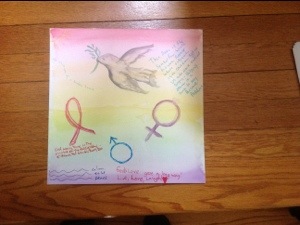
This was written for, and shared with, the congregation of St. Thomas’ Episcopal Church on May 5, 2013, as a part of our Coffee and Conversation series. The three pieces of art created during our conversation are featured at the end.

Act I: A Good Little Christian Girl

Sunday School began at 8:45, followed immediately by Sunday Morning Worship at 11 a.m. which extended well into early afternoon. We went home for dinner and were back out the door at 6 for evening service which began at 7 and extended until around 9 p.m., after which the altar call and prayer service lasted until the last tongues were spoken and the the organ could play no more. I rarely saw my bed before 11 p.m. Sunday nights, which was made up for by strictly enforced bedtimes during the week. Mid-week bible study and prayer meeting (later, youth group) met each Wednesday evening and Missionettes and Royal Rangers on Friday evenings. We had many sleepovers and service projects on Saturdays, along with bridal and baby showers, bake sales, revivals, and missionary visits. Strictly forbidden activities included not only drinking and smoking, but also dancing of any kind, card playing, and movies. All this made me a Good Little Christian Girl. This was religion in my childhood, for as far back as I can remember.

My early life was defined by being part of a charismatic, Pentecostal church into which I was born and devoutly raised. My mother was a convert to this faith tradition in her teenage years, and had met and converted the man who soon became her husband and my father. My Mom’s family was Lutheran, the country church variety, where God and community mingled in pragmatic sensibility in a small farming community. Who is to say why my Mother took such a different path than her parents or siblings…that is her journey. But, I was always quite happy when I had a chance to go to church with Gramma and the rest of my extended family. I was frequently reminded that while we loved them, they were not “saved.” It was clear from a young age that there was one and only one option for me: to be a born again Christian, a “good little Christian girl” who was filled with the spirit, overflowing in tongues of fire and embodying a prescriptive understanding of her godly biblical womanhood.

It didn’t take.

Truthfully friends, I tried hard. I tried very, very hard. I often responded to altar calls and prayed the sinners prayer on numerous occasions at my own church, or at revival meetings. I acted in kindness to others, trying to be like Jesus. I witnessed to my “worldly” friends (much to their discomfort) and my friend Kelly and I even tried to practice “falling out” or as we would say, “being slain by the spirit” and we made a vow to catch each other, knowing what was expected of us. I prayed. I begged. I cried. I attempted, as they did, to make utterances that seemed possibly like some divine inner voice was whispering them to me, but I ended up just coughing or sputtering or pretending to sneeze. One by one, my friends would have an experience deemed authentic when tongues was followed by interpretation. I asked people I knew…my Sunday School teacher, our pastor, my youth leader, why it was that I couldn’t seem to speak in tongues. I was told, repeatedly, the words that would scar my soul like a branding iron:

If the gifts of the spirit don’t come to you, it means you may not really be a child of God.

To me, this meant that when the Lord returned, the trumpet sounded and the dead rose along with the living saints of God, I would be one of the ones left behind. I began to have nightmares about having “the mark of the beast” branded onto my skin, to imagine all the saintly people I knew being swept up to heaven, hands raised and their voices speaking in tongues while I stood there in horror, knowing that I would then be living under the rule of the antichrist. This was my world, these were my early faith stories and experiences. I was 12 years old and terrified of the future.

These teachings burned inside me one night as I walked the circular driveway around the church while others were inside praying. I looked up into the stars and begged God to have mercy on me, to let me be a child of God, to show that to me through a real experience of the spirit. But it never happened. I started to withdraw in subtle ways. I volunteered for the nursery and avoided the service. I would have too much homework to finish in time for Wednesday evening services. I snuck out more often for walks by myself while my mother was praying in tongues in the building inside. I felt very, very alone and wondered why God didn’t want me. Singing “Jesus loves me” in Sunday School seemed to be a lie, too. But expressing doubt further condemned me, so I pressed on publicly as a Good Little Christian Girl while my inner spirituality began to fade away.

In high school, I experienced some renewed hope, a possible second chance. For a host of reasons that I won’t go into, my family began attending a still evangelical but not Pentecostal church in another town. This church had an active youth group and I didn’t feel the internal dread and pressure I once did. I leapt in with both feet, in the hopes that I could experience God, something I had longed for. I became a volunteer youth leader, a camp counselor, a fill in evening service musician, and a regular choir member. I had friends and felt comforted, although I still had unresolved questions. The main one had to do with salvation, and why there was such a focus on us discussing who was or was not saved, who was or was not worthy among this group of people. I was well regarded, so I came across as worthy. Then, as I transitioned off to college, I befriended someone who was a devout and faithful convert. He and I started up a local Christian youth theatre together. Our relationship was deep friendship, a soul connection and we loved each other deeply. And so it was that I was the first person he told when he learned he had AIDS. It was 1987. The prognosis was not good. Only one other person knew, this other person he trusted who was a pillar in our church. She immediately let the so-called prayer chain know his diagnosis and other life details. In this action, she incited such stigma and judgement and discrimination that he lost his job, his apartment, his community, and his trust. People told me that I had to walk away from him, too, because God had judged him by this illness and would judge me, too. Once again, I found myself informed that I was on the other side of love and acceptance by God.

One evening, in the midst of this tumultuous time, I went out walking in an attempt to sort through these chaotic emotions and attempt to find peace in the spiritual disconnect between what my heart experienced, and what my family and my community of faith were telling me. Standing alone, outside on a dark road on a hill overlooking the Christian College I had started attending that Fall, I looked up into the night sky, crying out to God. If this was the God of Christianity…judgement, hatred, fear, bigotry, hypocrisy…I didn’t want to be a part of it anymore. “So Be It” I said out loud. I turned around and I kept walking, without looking back.

Act II: Spiritual but not Religious

I realize this term gets bantered about these days and has even taken some heat with people I love and respect. But, what happened during the 15 year stand-off between the Christian Church and I is actually, in retrospect, nothing short of miraculous. Every minute of this time was vital to my journey. My vocation turned to Social Justice and I threw myself into a career in Social Work where I worked first with cognitively and memory impaired older adults in residential care, then in both in-patient and in-home Hospice. I became a grief counselor specializing in complex and challenging loss events, many of which were socially stigmatized. I worked daily with those in emotional, psychological, and spiritual pain and walked beside them to facilitate their healing. Dignity, worth, and compassion were the virtues I regarded. I read Rumi, the Qu’aran, Paulo Coelho, Joan Borsenko, Joseph Campbell, Carl Jung, Thomas Moore, Sogyal Rinpoche, the Dalai Lama, and countless other spiritual writers. I learned to be still, and to meditate. I sometimes used Tarot cards, not to foretell the future, but to tap into the collective unconscious that binds humans together as spiritual beings. I visited a spiritualist retreat center with some frequency, and meditation and reiki helped me work through my own pain and move toward healing. I did art, sang, and nourished my soul through the music of the spheres, particularly in classical symphonies. I took undergraduate and graduate classes in World Religions, and immersed myself intellectually in understanding the role of religion and spirituality in human history. One particularly memorable course was a seminar with an Islamic Studies scholar where we studied the philosophical understandings of Soul, Self, and Person across Judaism, Christianity, and Islam. I was enrolled in that class in Fall 2001, so the spiritual poignancy of the tragic events of September 11 have taken on a deep meaning for me in that context. In so many ways, my spiritual journey continued richly for me, opening my eyes to the many paths toward the divine. My heart and spirit grew more open.

But, I was not religious.

It’s not that I never stepped foot in a Christian church during these years. I was a paid chorister for several years in a lovely and welcoming Episcopal church and I occasionally filled in for a musician or did some solo singing for Presbyterian and United Church of Christ (UCC) clergy members whom I had befriended over the years. But, I attended as an observer, someone who was only passing through. The spiritual pain of my youth allowed me to intellectually understand many religious traditions, including Christianity, and to see beauty in the writings, prayers, and practices of a wide range of believers. But spiritually, I considered myself an outsider to religion. I contributed to the fabric of this life as positively as I could and believed that a life lived with purpose and intentionality could actually make a difference in the world. But, I didn’t believe…I couldn’t believe…that I had a place at God’s table. I couldn’t believe that I could be authentically included in religious community with all my baggage, and all my doubts. It was just lovely and reassuring to me that other people were able to have that experience.

Act III: The Journey in Community

After finishing my PhD, I moved to Richmond in 2006 with my spouse Michael and our daughter, Cassie. We were actually joking when, after living here for about a year, we said we might as well go to a church since nothing else was open Sunday mornings in the south. But, one Sunday, I actually did. My prior knowledge of the Episcopal church as welcoming, coupled with people saying great things about the parish in our neighborhood, made it easier to take that first step. I stepped foot into St. Thomas skeptically. I have described my slow process of sticking my toe in the water of this faith community as slowly allowing myself to step through doors that open, leading me from a solitary spiritual path and into community. Each step that I have taken into this community has been a gift. I have learned to trust, to open a bit more, to become more vulnerable, to be able to give a bit more deeply. This journey of living my faith in community…in this community…has continued my process of spiritual healing. Eventually, I began to feel a sense of belonging.
It took a full four years of active participation in St. Thomas’ until I was willing and ready to take a Faith Exploration class. I thought my questions and my experiences would be so different than most. That first class, where we wrote our questions on post-it notes, I put my questions out there, hoping no one would know to whom those questions belonged. To my amazement, many people had similar questions, voiced many doubts, and were travelling familiar journeys. I was welcome, exactly as I was.

It was actually in the midst of a quiet Compline at the close of one Sunday evening with my community of the journeying faithful that I felt something shift in me. I realized in the quiet, contemplative stillness that God was with me, and that God had always been with me. I realized that even at my darkest moments when I had been spiritually wounded, or when I was angry and walked away that God was still with me. God was present in music. God was present in my pursuit for social justice. When peace emerged between people and the dignity of stigmatized persons was restored, God was there. In my questioning and search of meaning in mystery and myth across spiritual traditions, God was there. I was not then, nor now, nor would I ever be alone. And, I was sharing this journey with amazing and diverse people who were and are a part of this faith community. What amazing gifts: presence, acceptance, community.

What I have realized is that while this journey is unique for every single person of God, and we are, all of us, people of God. There is something to be learned in every encounter. Doors open, and we step through…or we walk around that opportunity and other doors will open at other times. The journey of the faithful is full of authentic moments of laughter, tears, singing, listening, doubting, embracing, learning, and understanding. It has become a joyful and hopeful adventure, the dance between our human spirits and divine love and grace. Recently, I have started publicly blogging about encountering the spirit in everyday life…or as I have named it “small points of light”…and this has opened the doors to many meaningful conversations about faith and spirituality with friends, family, and strangers that I never imagined I would be having.

So, here in community, I want to take the rest of this time to field your questions and comments as I ask you to do something for me. These three water colors that I made a few weeks ago represent the three ways I have come to know the presence of God in my daily life over the course of my spiritual journey: music, myth and mystery, and the quest for justice and peace on the earth. I want to pass them around and ask you to add to them….through a word, a phrase, a scribble, a name, a song, a quote…whatever comes to mind. It adds so much when we share the journey with others, which is what my lesson is on this particular time in my journey. I am grateful for the ways that each of you embellish my journey in your own unique and personal ways…
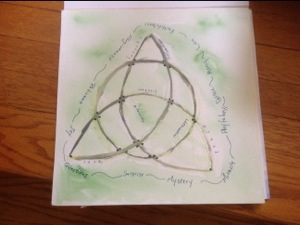
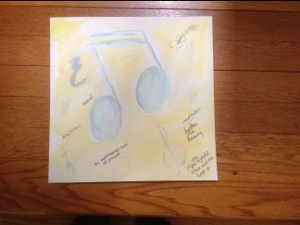
20130505-134152.jpg

20130505-134314.jpg

20130505-134337.jpg

Posted in Spiritual journey | Tagged , , , , , , , , , , , , , | 3 Comments

Walking the Labyrinth

Labyrinths have taken on deep meaning in my life over the years. The first labyrinth I ever walked was one I constructed in the field next to our friend Peg’s cabin house. We had rope and a paper printed with the labyrinth image, which we traced with rope into the freshly mown grass. Later that night, during the full moon, we would walk the labyrinth from oldest to youngest…the youngest being my daughter who, just shy of her first birthday, would ride in a carrier on my back around our journey to the center and back. That was the night of her Christening to the Universe, where we would say blessings and splash holy water (which Peg had brought back from her recent trip to Ireland) onto each other with laughter and gratitude for life and love and birth. The labyrinth has taken on deep and special meaning since that night, and now I often seek out a labyrinth during my travels, and during times of contemplation.

Today, I took off my shoes and proceeded into the conference great room in silence. My colleagues in PLIDA take great care in planning our biennial conference to be filled with cutting edge research, best practice information, policy and advocacy awareness and, unlike many conferences, self-care and contemplative remembrance of what draws us to our work. Every person at this conference provides care and support to grieving families…through direct bereavement support, hospital nursing and medical care, grief counseling, pastoral care, research, writing, art and music therapy, program administration, doula companioning, or other venues of being present and supportive in the lives of those who experience the unexpected loss of a pregnancy or the death of a baby. This is emotional work many people do not wish to discuss or acknowledge. But, we walk this path each day of our professional lives. For many people in the room, we have walked this path in our personal lives as well.

Our commemoration today found us in a banquet room where the tables had been removed. Spread across the floor, surrounded by a circle of chairs, was a 36 foot canvas labyrinth. A tree made of bare branches stood in the center, next to a small table with a prayer bowl chime. The group was invited, one by one, to enter the labyrinth carrying a colorful ribbon which symbolized an intention, a memory, a person, or an experience. Once in the center, we were to place it on a tree branch and when ready, sound the prayer bowl chime as a presentation of our intention within the center of the group.

I carried “vocation” with me, laying a bright green ribbon across my fingertips as I walked.

As I walked the labyrinth journey today, I became deeply aware of and grateful for those who walked with me. There were many more people walking this labyrinth together than one usually experiences. At times, we stepped aside to allow someone to pass alongside us, or they did the same for us. We slowed down when needed, or paused to reflect and give another person space. Occasionally, a ribbon would fall and someone would pick it up lightly and return it to its owner. Some passed each other almost unknowingly as we focused on the path of our individual journeys. Others met my eye and we would softly smile in awareness and acknowledgement of each other.

In silence we moved, and I watched those who passed me with great admiration and respect. Even when my journey was complete…my color added to the tree, my intention announced in the gentle and resounding ring of the prayer bowl…I watched in contemplative wonder those who walked their own paths after me. I was taken in by those who stepped with the lightness and intentionality of a dancer, and those who felt unsure of their steps. Some ribbons were worn across their bodies, resting lovingly in their hands, or clutched tightly. Everyone moved in silence, only the haunting sound of a flutist drifting through the room. The barren tree began to fill with color. The intention, passion, emotion, and dedication of those sharing the sacred space with me was palpable. It was a sacred dance, in a sacred space.

Walking this journey of vocation for me is interwoven with gratitude for those who share the path with me. I have, and continue to, meet amazing people who are as different and diverse from each other as one can imagine. And yet, we share something in common. We do what we do, we study what we study, we counsel and care and interview and support others when grief shakes the foundation of their lives and assumptive worlds. We do not walk for them, but do walk with them. We cry and we laugh and we grow, all of us. There is a shared recognition of humanness, and a shared respect for the power of the journey on which we each travel and in which we all share.

Gratitude for the journey, and for those who journey with me.

20130421-175946.jpg

20130421-175303.jpg

20130421-175228.jpg

Posted in work and life | Tagged , , , , , , , , | 3 Comments

For Sue and Lindon, with Gratitude

This morning my faith community celebrated and said good-bye to our retiring rector and her spouse, our priest-in-residence. There were moments of joy and tears and good-wishes and overwhelming gratitude for our shared experiences on this journey together. Because transition is so much as part of who I am, I wanted to write and share my own reflection on what each of these amazing people has meant to me on my journey of faith during this chapter of my life. I will hold each of them close to my heart while wishing them many blessings on their new chapter of life.

Sue Eaves, you have been a rock and an inspiration on my journey of faith. I did not walk into the door of St. Thomas anticipating that I would welcome the knowledge and experience of God in my life. But in this place, and within this community, you cultivated the ground for the seeds that had been planted along my journey to take root and grow. You were receptive to my questions, and honest and authentic in responding to my challenges. You have held my hands and prayed with me both during times of great loss, and in times when I was stepping forward to lead and share my own journey with others. Your genuine spirituality and caring shone through especially in those moments, the deep spirituality of daily life. You have offered up opportunities that allowed me to step out in faith, and welcomed leadership that you saw emerging in so many of the good people of St. Thomas. You have led this flock of sheep with calmness, grace, hospitality, courage, and humor. We will miss you, but you have opened the door for this congregation to continue to grow and flourish, and have instilled in us the confidence to step forward boldly in faith, allowing us to discover what we can become, with God’s help. Alleluia! Alleluia!

Lindon Eaves, you are an inspiration for embracing the duality of spirituality and science in my life. I have known you both in the University academy, and in this spiritual community. Sometimes, my academic colleagues mention you with well-deserved admiration, and I get to picture you preaching a sermon on the theme of Monty Python, or wearing the wildest socks the children of the parish bequeath to you. Or, I hear our St. Thomas’ friends speak of you fondly as one of their clergy and infer that you have some other job at VCU, and I smile because I know you also as a brilliant scientist who has mentored those who now mentor me. You are renown in your field as a geneticist, you have been respected as a leader and teacher and researcher in this University long before I had even an inkling of being an academic. I am grateful to know you in two parts of my world, both of which are new to me in this chapter of my life, and I am even more grateful for the unspoken role model you have been in allowing both academic and spiritual aspects of the self to inform each other. Religion and science are not incompatible, and often the brilliance of both can be found in the comedic serendipity of human life.

Bless you both on your journey, as you have truly blessed my journey with your presence.

Posted in Spiritual journey, Who is My Neighbor? | Tagged , , , , , | 3 Comments

Impostors

It was 7:45 a.m. as I walked toward the table, balancing my breakfast plate and glass of orange juice along with my work bag filled with conference materials, and my head overflowing with new knowledge, inspired ideas, and a growing to-do list. I was cautious about not spilling food, juice, or inexperience all over myself as I sat down amid the group of well known doctoral program directors in my field. I sat at a table with Kia, the former doctoral program director whose shoes I will be endeavoring to fill; she is also my professional mentor and chair of this conference. Next to her was our colleague Patti, her long-time friend and our new field education director at the University where I work. Patti had come from Houston, where she had completed her PhD a few years back with a dissertation committee that included Kia, as well as this morning’s keynote speaker, Brene Brown, whom Patti was soon to introduce. I was grateful for the comfort of their familiarity at this breakfast, along with the other 80 or so doctoral program directors in the room, most of whom had years of experience and professional notoriety behind them. Although I was now an invited participant into this group, and had been welcomed with open arms by the other doctoral program directors attending, I was experiencing that gnawing sense of insecurity, the vulnerability of newness, the worry that I would be found out as an inexperienced novitiate among the well-known and respected of my profession. An impostor.

This past Monday morning, the day after Easter, began with a meeting with my Dean where I was appointed the next PhD Program Director for our School of Social Work. I am grateful and thrilled for this opportunity, and delighted to work with faculty and doctoral student colleagues in this leadership role. I am also nervous as hell about taking on this position at the start of my early post tenure years, and about balancing an administrative role with my other valued professional activities and personal life commitments. I have been very well mentored for this position, I have amazing and supportive colleagues, and I have wonderful doctoral students and invested relationships with alumni even before this formal leadership appointment. I also am a human being deeply aware of how different life in the academy is from life on a farm, in a small town, as a social worker in tiny non-profits where staff hold yard sales to generate sufficient funds to buy office supplies. Humble beginnings, for sure. Being humble in the academy is a way of life, too, though. Someone is always more experienced, better funded, higher ranked, more widely cited. Peer reviews can cut you off at the knees or make you feel relieved to have earned a thumbs-up in a forum to which you wondered if you could even submit. Academia is an institution of hierarchy, even among social work academics for whom empathy, self-determination, and professional helping are at the core of our value system.

As I sat there at the breakfast table making professional small talk and attempting to keep my impostor feelings at bay, I heard my colleague say, “isn’t that Brene?” and she stood up to welcome her and escort her to our table.

Because I am a fan of Brene’s work in my everyday life and world view, as well as recognize her as a professional colleague, this announcement offered a mix of awesomeness and further humility for me. I am keenly aware, and was even more aware at that moment, that I haven’t written any well known textbooks, nor do I have a TED talk, nor have I appeared on Oprah. Brene walked over, sat down, looked over at me and said, “I am so incredibly nervous being in this group!” and I realized at that moment that she was completely serious. She even waved off breakfast or coffee saying she can’t eat before she speaks. I absolutely know that feeling.

We go on, the small group of us, chatting about our kids, our jobs, the coming of spring. Then, Brene says again, “seriously, I am so nervous!” and I start to become aware that we are all nervous. We all harbor the impostor instinct. We are all judging ourselves in the face of who we are not. Brene goes on to talk casually about the challenges of traveling too much, being away from her kids, figuring out how to be connected…yet not connected…to the academy. Her path is circuitous, just like many of ours. We take in our best intentions to make a difference in the world and try to embrace that. Sometimes doors open and we step through, and sometimes amazing opportunities appear. Sometimes, we sit with a student or colleague and unpack the details of their journey with them, and a small light bulb goes off or a seed is planted which may later bloom into something of stellar beauty. Either way, a path emerges and in faith, we step through the open door.

We all feel like impostors in a world where we are striving to be something bigger than what we are. It doesn’t matter if we have a high school diploma or a doctorate…we are still keenly aware of what we lack, what we haven’t yet accomplished. Yet, we might actually do these very things some day, and may surpass our own self-expectations in doing things we cannot at this moment imagine. The impostor instinct is pure humanity, but left untamed it can also breed fear, and keep us from courageously living.

There is only one way to stop being an impostor: to show up as our authentic self. To stop being an impostor, we have to be vulnerable and authentically human and live. We put our best self forward, take a step back from ourselves, and see what happens from there.

On this day, Patti stands up in front of the group and acknowledges that giving this introduction is like a nightmare where you have to give a speech and two members of your dissertation committee are there staring at you…because they actually were…but she gives a beautiful introductory speech anyhow to which we all applaud. Brene stands up to give her talk and the first thing she does is acknowledge how inferior she feels in this group, because she is not a traditional academic and doesn’t have the same standing in the academy as those in this room. I stand up when it is time to introduce myself to the group and acknowledge that, unlike their collective years of experience, I am exactly 72 hours into my new academic appointment. I add that I am grateful to be in a room full of people from whom I can learn, and the woman next to me reminds me that this is true for all of us. Later, after Brene’s inspirational keynote on this subject of storytelling and vulnerability, one of my students, volunteering her time to scribe notes for the group, tearfully tells me how meaningful it is for her to be there and how Brene’s talk resonated with her. We all go on to be ourselves this day, with occasional moments of both egoism and vulnerability, but we all learn something, share something, and realize we have a common goal in advancing doctoral education. No one with a that goal is an impostor.

Another open door, another opportunity. And into it I step….

Posted in work and life | Tagged , , , , , , , , | 3 Comments

Confirmation

I sat in the front of my church, along with people I had come to know well and care for deeply. Bishop Gulick was presiding, and for this I was grateful because I had met him before when I sang for his granddaughter’s baptism. He had seemed authentically human and deeply kind, exuding the kind of radical compassion that has drawn me in to this Episcopalian faith community. I had friends present to encourage me, clergy I deeply respected who supported and challenged me, and a congregation filled with amazingly interesting and diverse people around me. This community was an amazing place, and I was deeply grateful to be a part of it. But, as I imagine the followers of Jesus who wandered in the garden felt that first Easter morning, I was also there filled with a sense of anticipation accented by twinges of fear, looking for something that I was not entirely sure I would recognize even if I found it.

It was after I settled in to another chapter of my life that I considered rejoining a faith community. I had moved from the mid-west to Virginia with my spouse and daughter, who was still a toddler at the time. We spent weekends driving around and getting situated in our new state of residence. We began to joke that we may as well start going to church, because everything was closed on Sunday mornings in the south. But, in all seriousness, there was a growing desire for community and belonging that extended beyond my immediate family and my work-place. I had heard good things about the Episcopal church in my neighborhood. It was relatively easy for me to open that door, considering the radically loving and open experiences I had encountered both working in, and singing in, this faith tradition over the years.

One Easter Sunday, I wandered skeptically into St. Thomas’ and stuck my toe into the water of this faith community. Soon, my body was in a pew. Then, my voice in the choir. My hands started serving in a ministry to homeless persons, and my feet hiked up a mountain at a parish retreat. I held my daughter’s hand as she joyfully ran to children’s time each week. Pretty soon my heart even began to trust again. But, I struggled immensely with the idea of confirmation. I passed on the invitation to attend faith formation classes several times. I felt a wall between myself and commitment to organized religion. I envied the people for whom it was easy, and I felt the weight of the baggage I carried (and I hadn’t yet come to realize my parting gifts). I had open and meaningful conversations with clergy about whether it was necessary…or helpful…to go through confirmation. I alternated between “what’s the big deal?” and feeling like, “this is a huge, big, massive deal.”

One spring, after being an active congregational participant for many years, I received yet another invitation to attend Explorer’s classes from one of my clergy. Maybe the time was right, or perhaps her persistent yet open-ended invitation spoke to my soul. This time, I said yes. During this time, I learned my own questions that I thought were so far out there, so reflective of my own baggage, were actually the same questions and struggles shared by many others. I began to realize that there was a still, small voice that had been with me all along my journey. I heard this voice in music, in myth, in childhood wonder, in acts of compassion and social justice, in my forgiveness of others and their forgiveness of me, in my own quest for belonging. One evening, in the midst of a contemplative, candlelit Compline, I realized this persistent and patient presence was God. And I knew that I never had, nor would I ever be, alone.

At my confirmation, I thought about that quiet realization. Not every faith journey has a dramatic moment of conversion. The presence of the divine may be felt more like the wind rustling the trees than the fire of a burning bush. The most joyful moment of the Christian faith…resurrection…was by all accounts a quiet resumption of life, an event of great mystery between human and divine. The first people to notice the risen Jesus were quiet, beloved mourners seeking solace in memory, making an early morning visit to his tomb. Even after the resurrection, there were still doubts amid belief, and uncertainty alongside miracles. Such is the journey of the faithful, and this journey can be filled with great joy and light if we walk with our minds and our eyes open.

Confirmation for me, like Easter, was a walk through a door held open. The invitation is extended, and the journey will continue whether we take that direction or another. Walking through the door to see what opportunities present on the other side is an act of faith. But it is an act of faith performed in community, where we are all learners and teachers, the weak and the strong, the faithful and the doubting.

And so, the journey of faith goes on for me. The small points of light illuminate my path and create waves of light rippling through those that I know all along this journey with me. It really is our human journey, with many paths and many turns that bring us into relationship with amazing people and serendipitous events encountered along the way. I have enjoyed taking time to write about many of them deliberately during this Lenten season, although there are also many more stories which will still find voice in this forum from time to time, I am sure.

I am grateful for my journey, for the persistent and loving presence of God, and for all the diverse community of the faithful in this world, and in my life.

May the first light of Easter illuminate your soul and sustain you on your own journey of faith.

Sarah

Posted in lent blog 2013 | Tagged , , , , , , | 2 Comments

Good Friday

It had been 40 days since my first ashes. Well, almost 40 days. It was Good Friday and I was home from college for a long Easter weekend. My clandestine basement foray into lenten ashes was still gnawing at my soul. I was not in the custom of celebrating Good Friday, but when my dear friend Carlos called and asked me to have lunch with him, I eagerly said yes and wondered if we could go to Good Friday service together afterwards, a community ecumenical service that was going to be held in a local theatre.

I loved any opportunity to see Carlos. He had appeared in my life unexpectedly, through the church I attended with my parents. He had been in jail, had befriended another family in our congregation through prison ministry, and now released had come to live and worship in the community. He was older than I was, which drew me in even more…I was, after all, nineteen. We had an instantaneous and soulful connection that grew over time. I was mighty attracted to him, I must admit, but we weren’t involved romantically. In my mind, that seemed destined for the future, somehow, but not actualized in the present. What we did was talk for long hours into the night on the phone in my dorm or occasionally in person over long walks or endless cups of coffee. We spoke of God and poetry and theatre. But on this particular day, I was just excited for the opportunity to lunch with him, to share space and conversation.

He picked me up and we drove to a little diner the next town over. I ordered a tuna sandwich…it’s funny what detail sticks with you and how vivid that memory can be. He was quieter than usual. I look a bite and looked over at him, and it looked as if he had a tear in his eye. My tuna sandwich became a lump in my throat. “What’s wrong?” I asked, because obviously something was wrong. He shook his head. Being a teenager, I thought I was about to be dumped, or informed that he had fallen in love with someone other than me. As these adolescent thoughts were racing through my mind, he reached across the table and took my hand. “I have to tell you something. I am sick. I just went to the doctor. I had the tests. They told me I have AIDS. I am dying.” The tuna sandwich lump in my throat now seized my soul. It was the 1980’s. I was young and blissfully falling in love, or perhaps just trying to figure out what “love” really was. This was small town America and I was a naive pedestrian in it, strolling carefree toward adulthood. Then, suddenly, the world of grown-ups, of sickness and death and pain, that world was becoming my world. And I rose to the occasion, as best I could. “I want to know everything. And I want you to know I am not going anywhere.”

I learned the whole story that day, and we walked to the church-in-a-theatre and sat together, listening to the narrative of Good Friday. We held each other’s hand as if clinging to life itself…and perhaps we were. That day, like the ashes of lent placed on my brow 40 days earlier, was burned into my soul. Death was suddenly not a foreign concept to be avoided until a long way down the road. The shadow of death was present, and real.

But death is not the end.

Ironically, I was playing Mrs. Gibbs in a production of Thornton Wilder’s Our Town at that time. I spent many rehearsals of Act III as the deceased Mrs. Gibbs, “detached but not maudlin” (Wilder’s specifically written stage direction) looking out onto the life still happening around her, the scenes of love and life and loss continuing to play on. I worked out a lot of inner monologue during this accidental drama therapy. Some lines from that play remain with me to this day: “Do any human beings ever realize life while they live it…every, every minute.” And, of course, my beloved friend Carlos came to watch every performance. Life becomes the drama, and the drama becomes life.

Every Good Friday, I go viscerally back to these moments in time, and I relive these stories. The passion narrative seems inextricably linked with my own life narrative. The words of Jesus take on personal and symbolic meaning…perhaps exactly as they are meant to.

We all have a time where our own mortality comes into clarity. It is one of the most frightening, yet most formative, moments of growing up. But, I also learned that looking death in the face was deeply liberating. The core of forming one’s soul, one’s sense of self means looking squarely at the fragile nature of human life, and choosing to live within that risk. It transformed everything about my daily life, it altered my perspective on life and living. It allowed me to choose to move forward into a life that could include death. It caused me to struggle and figure out by trial and error how to live…and love…in that world. It has not always been a smooth journey. But it has been filled with many, many lessons. And, as I have come to realize this Lenten season as I write these stories, many points of light.

Perhaps the ashes at the beginning of that first Lenten season were an anointing of my body and soul for what was to come. It was an invitation to grow, to live deeply and soulfully, even through the shadow of death.

Perhaps our time in the shadows of life allows us to see even faint rays of light more clearly.

And perhaps, that is the lesson within Good Friday.

“We all know that something is eternal. And it ain’t houses and it ain’t names, and it ain’t earth, and it ain’t even the stars . . . everybody knows in their bones that something is eternal, and that something has to do with human beings. All the greatest people ever lived have been telling us that for five thousand years and yet you’d be surprised how people are always losing hold of it. There’s something way down deep that’s eternal about every human being.

-stage manager, in the play OUR TOWN”
― Thornton Wilder, Our Town

Posted in lent blog 2013 | Tagged , , , , , , , , | 2 Comments

Music of the heart

My cousin, Jenny Trometer, is my point of light today. Her talent and her gentleness and kindness of spirit make me know that there is light in the world. Jenny brings her own gift of music and affection to all those she meets, especially the residents of a local nursing home where she plays her music to brighten their day. Thank you Jenny and congratulations on this television debut. You are a shining light in the lives of so many people. Please watch and listen:

Sharing her Musical Gifts | Wingingit.tv.

Posted in work and life | Tagged , , , , , , | 2 Comments

Strong Women and Little Children

I have been thinking a lot about my Gramma today. Viola Mae Hauber Hudson, mother, grandmother, great-grandmother, matriarch, farmer. Gramma and I bonded from an early age over an identical left leg birth mark. One round, small spot on our left leg we shared that seemed to mark us indelibly as kindred spirits. I still see her puzzling over her crossword puzzle as I catch glimpses of myself pondering over the precise selection of words when I write. I still hear her barking orders to the cows, the milkmen, the barn cats (scat!) and as I age, my voice takes on her deep tone and wistful humor, particularly with my students. I still smell her cooking, and taste her apple pies, baked in her own well aged pie pan. I often say, “It takes all kinds…” when I agree to disagree with the many kinds of people who pass my way and push my buttons. This strong woman, my Gramma, is always close in spirit.

In my spiritual journey, I am grateful to my Gramma for her pragmatism, inspiring faith formation within ordinary, daily activities of life. She was one of the women always hosting the church bizarre, planning the strawberry festival and dolling out fresh berries over home-made biscuits and ice cream. She cooked nearly every after-funeral gathering, except for her own. She probably would have done that, too, if she could have. She would speak her mind to any clergy person, not in the lofty language of abstract theology but in the practical, everyday reality of how to live in harmony and respect each other. She lived for each day, and focused on the needs of the present moment. She attended church whenever she wanted, and didn’t attend when she didn’t want to. We said grace before big family meals, and she meant it when she thanked God for harvests, crops, weather, and health. We had what we needed, but often little more than that. And, for what we had, we were grateful.

Did she pray? Did she doubt? She was a young widow who had to raise a family and run a farm. You could argue she didn’t have time. But you could argue that her daily steps forward to live and work in stubborn strength were, in themselves, both prayers and acts of faith.

I am sure that my Gramma cried sometimes, although we didn’t see it…well, other than when she fried strong onions, perhaps. Those were the only tears I saw for years. Until she was dying. I remember that time vividly, turbulently. My Mom and my Aunts, especially Joyce with whom she lived, were caring for her to the very end. They were doing everything possible to maintain her strength and integrity. Cancer was making their job harder by the day. I was visiting from out of town, along with my daughter who was, at that time, a playful and oblivious 18 month old with chubby cheeks and mischievousness oozing from every pore. She would play peek-a-boo around the walker and oxygen tanks. Gramma, in a haze of pain medicines, would moo like a cow and send her little great-grandchild into peals of laughter.

But, it eventually came time for me to leave. My flight was scheduled, but I didn’t want to say good-bye. I sat on Gramma’s bed and held her hand. I promised her I would live true to our shared birth-mark. I assured her I was raising the next generation of strong women, present there at bedside full of her clumsy and lavish unconditional toddler love. Gramma cried, big tears. So did I. My Mom and Aunt Joyce had to leave the room. But all of our spirits stayed and lingered there together, strong women of four generations. All struggling to put something beyond words into words. We never did find the words. But we shared those moments.

A few hours after our flight returned us safely home, Gramma died. We returned for her funeral barely 48 hours after we had left her bedside. In the meantime, it had snowed and there was ample toddler playtime in the midst of funeral preparations. It was like a vintage picture, the whole family walking from small church to the cemetery down the road through swirling snows and moist eyes. What I remember the most from all the blurry funeral moments, though, was my little daughter in the old country church, waving and playing peek-a-boo toward the casket. She didn’t see the death. She saw the life, just as she had seen it around the bedside and the oxygen tanks. I actually have no doubt (nor did my spouse) that she was seeing what we could not that day: the loving, present, playing spirits of the strong woman and the little child. The archetype of mother, grandmother, strength, family. The eyes of the young are open even when ours are closed.

During this Holy Week, we are challenged to walk through the last days of the passion narrative, to hear Jesus ask for the cup to pass from him. I imagine the words of Jesus reflecting the human desire to live and avoid death, the same way my Gramma’s tears showed her desire to cling to life. Jesus became more real for me during my spiritual journey when I began to stop heading in a bee-line of expectation for Easter. Instead, Lent and in particular, Holy Week ask us to take in the doubt, the denial, the struggle, the pain, the mockery, all wrapped together in the the deep and abiding love present in this narrative.

In my readings and meditations this week, I began to notice the strong women, the women of faith who were at the last supper, at the cross, at the tomb. Were there children in that scene, too, whose stories and experiences were not able to be fully captured by the words of the grown-ups? Were they able to see past the suffering and death, and seeing, instead, light and life?

I believe they were there. And they saw something the adult disciples could not. And they still do.

Strong women and little children are profound sources of light in my life, and in the world. In them, we see the Kingdom of God present here and now in the everyday wonder of living.

“Truly I tell you, anyone who will not receive the kingdom of God like a little child will never enter it.” (Luke 18:17)

Posted in lent blog 2013 | Tagged , , , , , , , | 8 Comments

Parting gifts

I have been reflecting on my spiritual journey as Holy Week begins. At times in my life it has been easier to consider what faith traditions I am NOT than to articulate what I am, what I do believe. That is my current challenge, actually, which perhaps is what inspired my blogging during this season. So, as I have been blogging these stories of light I have brought to mind those paths I have started down, the identities I have tried on, the places of worship I have visited, the boxes into which I have been placed or into which I have crawled for comfort. As I start on this final stretch of Lent, I pause to reflect not on the reasons I left or what didn’t fit. I want to describe what went with me from these experiences, the parting gifts to my spirit along my spiritual journey.

My earliest memories of church are a small congregation that called each other “brother” and “sister” and in which the code of belief and behavior was highly prescribed and strictly enforced. There was a freedom of expression in spirit…and that is a gift in Pentecostal worship, even if the beliefs and practices themselves did not take with me. Music was my solace, my own personal expression and I took this with me as my own parting gift which has brought lifelong spiritual connection. When my family left this church as an adolescent, I believe in retrospect that my mother felt sadness, my father felt anger, and I felt relief. The parting gift in that experience, though, was that I realized a family could be in different places spiritually and yet still be together and support one another’s growth. So, it became OK to question, to move, to try to find one’s fit, to see God in multiple expressions of worship. This has made me a different kind of person in my relationships, and in my own parenting. These may not have been intentional gifts, but they have been instrumental on my path nonetheless.

The second church of my youth had active youth ministry, music, and drama which resonated with my spirit. This time allowed me to explore being a church musician, a camp counselor, a youth leader, a young but involved church participant. I jumped into membership. I began to recognize the gifts of leadership, and of service. And then, I became disillusioned. This seemingly living, growing faith could only be framed as acceptable within a particular ideology. This period of my spiritual life aligned largely with both my high school and early years of college, which were at a similar religiously affiliated school. My parting gifts emerged from within profound challenges between beliefs of the soul and practices of the people. I learned that faith for me was radical. If I was going to believe in the stories of Jesus on which I had been raised, these stories had to become real through uncomfortable, mind-stretching, consciousness raising transformative love.

Unfortunately, I did not find many people who shared this view. So, in my next chapter of spiritual life, I was a wandering spirit. I took the term “spiritual but not religious” very seriously. I took classes in world religion. I read the Torah and the Qur’an for myself to understand these sacred texts. I studied Buddhist thought and meditated. I practiced incantations with pagans, and took in the stories and myths of nature-based religions. I went to spiritualist meetings, and humanist lectures. I got over the ideology that any of these traditions were “bad” or “evil” and stopped allowing others to pontificate on perhaps well-intended, but ignorant, misrepresentations of the many faith traditions in this vast and amazing world. I received a parting blessing of peace, understanding, and radical tolerance during this time of wandering. I learned, to the core of my being, that we all share an authentic human quest for knowledge and experience of the divine. What an amazing gift.

In my wanderings, I had stepped foot in several progressive Christian churches. I sang in a choir for many years, and was employed by a Health Care facility with deep ties to the Episcopal church and particularly transformative and radically loving clergy. I had stuck my toe into those waters of something familiar to my upbringing, yet different in acceptance and inclusion; but I couldn’t jump in. I couldn’t see my parting gifts at that time. I could only feel the frustration and take a self protective stance where formal religion needed to be kept an arms length away. So, I became deeply cause oriented, and found spiritual growth in advocacy and social justice, aligned with my profession. I sang music I had loved and played piano to center my spirit. Music, myth and mystery, and social justice. These gifts sustained me, and remained with me.

They remained through times of darkness. They illuminated my path with points of light.

Eventually, I would recognize these parting gifts as parts of my journey, and I would begin to reclaim my faith. But, this too is a journey. Perhaps one that begins with the waving of palm branches, and leads to a cross. The small flicker of faith and hope barely visible on the horizon. And yet, I keep moving forward.

Posted in lent blog 2013 | Tagged , , , , , | 4 Comments

Peace. Bubbles. Light.

When I stood in my assigned space in the alto section of the choir loft, across from the organ, it was Michael’s tenor voice that I heard behind me. The choir at St. John’s-Grace was an eclectic combination of people: old, young, gay, straight, questioning, sober, never sober, dignified, unkempt, and ever changing. Most of the people were in the choir because they were in the church and liked to sing. I was in the church because I was in the choir, and I got paid to sing. To clarify, I was paid very little, and sometimes I was not paid at all. But, the job I had been recruited to do, whether paid or voluntary, was to sing and to teach the alto members of our choir their respective parts. That duty kept me coming back week after week, even though I didn’t necessarily consider myself a worshipper. I am reliable and social, a true Gemini-Dog in Western and Eastern astrological assignment. My voice and body were there every week. My spirit still wandered.

Michael, who stood and sang tenor behind me, was there to worship not only with his voice but with his whole spirit.

Choir is a good place to get to know people. I knew that Michael was gay, and that there was some unrequited love with another person in our musical group. This I learned when I asked why he seemed so sullen at our early choir gatherings. But, time passed and Michael fell in love with another wonderful man, Kim, and the two of them created delightful conversation and a life together that was a joy to behold. We celebrated their union and committed some well meaning deviance by openly blessing their union years before the Episcopal church sanctioned…or even allowed…these decent, human and divine blessings. Our priest, nearing retirement, had decided not to ask permission and in this case, found it unacceptable to ask forgiveness. He and the church took heat for this, and being the rebellious and non-aligned person I was, I took delight in the whole thing. I attended the ceremony, sang, and danced at their reception, and I felt true joy in my spirit.

Each week during the service, I turned at the passing of the peace and hugged Michael. He was always thin, but seemed to be getting thinner and frail. His gentle spirit began to show signs of being worn and weary. He didn’t openly discuss his HIV status, because the early 1990’s were a difficult and challenging time for HIV positive people. I knew that familiar story, and that disease progression, all too well from both my personal and professional life. One Sunday, I hugged Michael at the peace and he held me just a little closer, a little longer. He felt like skin and bones. He smiled, but his gaze seemed far away. By our mid-week choir practice, Michael had ended his life. I knew from the first moment I heard, and I felt to my core of my being, that his suicide was not an act of hopelessness. It was an enancted choice in when and how to move from this world to the next.

Michael’s funeral was a time of great sadness, and great joy. We wept and people wondered “Why?” Some tried to judge or question, which made me angry. Who among us felt they had the right to question or to judge? It was an emotional, raw and authentically human memorial service. Again, we held a ceremony. We held a reception. We embraced Kim and wished we could still embrace Michael. Kim invited us to dance. And, we did. Before the night closed, Kim also produced several cases of bubbles: little jars of soap bubbles with a wand inside. He asked each of us to take one with us, to live our lives and travel to beautiful places. To blow bubbles while we were there, and to think of Michael when we set each bubble off on its journey, knowing he would be with us and delight with us in those moments. I still have bubbles with me in my sketch bag, which comes with me to beautiful places where I travel. And I still blow bubbles and think of Michael.

But, the bubbles are not the only point of light in this story. As I said, I knew in my spirit from moment one exactly why Michael left when he did, as he did. At first, I kept it to myself because I simply thought it was my way of coping. In retrospect, he and I had shared several end-of-life conversations. He knew I had lost people I loved to AIDS. He was a pharmacist, and had extensive medical training. He knew. But the next few Sundays at the passing of the peace, when I would viscerally miss the embrace of my friend, my own internal sense of knowing would grow as well. It couldn’t be silenced. I just didn’t know how to give it voice.

Then, one choir practice evening, a member of the choir made a disparaging remark when our director told us that Michael’s ashes were going to be placed in the columbarium at the entrance to the church, and we were invited to join in a final prayer of committal. Someone made a dogmatic statement about suicide being an unforgivable sin and questioned the sanctity of church burial. As happens when I get righteously angry, words trapped inside tend to find their way out very quickly. My eyes flared, my voice shook and I spoke with some authority that wasn’t entirely my own about Michael’s choices, his perhaps desperate…but not selfish, heartbreaking…but entirely realistic, desire to keep control of his living and his dying. The debate went on for entirely too long. But, in the end, consensus was reached to lovingly commit Michael’s remains within our church walls. I went to the committal, and I prayed. Shortly after, life took me away from that choir and that church, but our parting was with peace and love and understanding.

Several days after Michael’s remains were committed, I had a vivid dream. I dreamed that I turned around in my choir stall and Michael was there. He was radiant, and filled with light that reflected divine love from within and from beyond. He smiled his gentle smile, and embraced me. I felt his embrace and his body, flesh and bones, as I whispered “peace be with you” and then, in my dream, he became a dove that flew away into the light. I awoke in the night, the light bringing me sharply into full consciousness. That dream has remained vivid even after many years.

Sometimes, even now, I see a dove, or I hear its coo, and I return to that dream image of light. Other times, I release a soap bubble and watch its iridescent radiance grow, and shrink, and drift, and float away, finally dissipating into the air.

And, I think of my friend. And I feel peace and faith and love.

And there is light.

Posted in lent blog 2013 | Tagged , , , , , , , , , , , , , | Leave a comment