Good Samaritans and Great Neighbors

(Week 1 of a 16 week “Who is My Neighbor?” faith formation series at St. Thomas Episcopal Church)

The Master Story: The Parable of the Good Samaritan

Lectionary Gospel Reading: Luke 10:25-37

The Gospel reading for this week provides us with one answer to this question of who is my neighbor: “the one who showed him [the traveler] mercy”.

Unexpected mercy does happen in today’s world, too. This week’s first media link gives us a glimpse into a photo memory. Through this image, we see a bystander’s reflection on viewing unexpected mercy in the midst of racial conflict:

Unexpected Mercy Photo Memory

Who has offered unexpected mercy to you? Did that change your relationship with that person, or with others?

Our challenge this week is to hear the parable of the Good Samaritan through today’s eyes. Here is another lens to consider, helping us to ponder how we can be good…or perhaps great…neighbors in today’s diverse and sometimes challenging world:

Good Samaritan or Great Samaritan?

How do we show mercy to our neighbors in the world…and community…we live in?

As for me, I had selected these media links and framed these questions several weeks ago. But, as I prepare to post this discussion on this particular Sunday morning, I can only reflect on the vast difference in being a “Good Samaritan” as described in the gospel (and illustrated in the media links) and our public discourse around a current “neighborhood conflict” which resulted in the death of Trayvon Martin and the trial of George Zimmerman. What I hear in the news media and last night’s verdict is not anything to do with being a good neighbor. Nor is it about showing mercy. What I hear is “how much violence can we legally get away with in the name of self-defense?” Unfortunately, the verdict may have acquitted Zimmerman, but it simultaneously indicts us…the American public…and our tolerance for violence and fear over mercy and tolerance. I have a strong opinion that this verdict was tragic, and I am upset about the verdict because of its implications for both racial and social injustice. But, like everything, there is a lesson within even this tragic story that needs to come forward so we learn. So, I have another question to pose:

What would be different about our interactions with our neighbors if we demonstrated mercy over fear, indifference, or even hatred?

Would being the great neighbor…the one who shows mercy…inspire us to make different choices in our neighborhoods and community? To promote and actively seek out the dignity and worth of every human being? To tolerate difference more and tolerate violence less? To trust instead of fear? To initiate conversations and really get to know those whose paths cross our own? Would being a great neighbor mean that Trayvon would still be alive today? We can’t know for sure of course. But, I suspect, choosing to show mercy in the face of fear would have saved at least one life. And it can possibly save many, many more.

Feel free to comment and share your own thoughts…

Posted in Who is My Neighbor? | Tagged , , , , , , , , , , , , , , , , , | Leave a comment

Briefly it Enters

One of the joys of being on vacation is the blissful leisure of reading. Often, I have a stack of novels in my vacation queue, but on this particular week of break from my professional life, poems are what seems to be drawing me in.

This morning, Jane Kenyon’s poem was echoing in my mind, so I flipped through my books until I found it. This imagery haunts me every time I read it. It is filled with moments of recognition…small points of light…the ordinary, daily touches of the divine.

I thought I would share it here…

Briefly It Enters, and Briefly Speaks

I am the blossom pressed in a book,
found again after two hundred years… .

I am the maker, the lover, and the keeper… .

When the young girl who starves
sits down to a table
she will sit beside me… .

I am food on the prisoner’s plate… .

I am water rushing to the wellhead,
filling the pitcher until it spills… .

I am the patient gardener
of the dry and weedy garden… .

I am the stone step,
the latch, and the working hinge… .

I am the heart contracted by joy… .
the longest hair, white
before the rest… .
I am there in the basket of fruit
presented to the widow… .

I am the musk rose opening
unattended, the fern on the boggy summit… .

I am the one whose love
overcomes you, already with you
when you think to call my name… .

–Jane Kenyon

Posted in quotations and reflections | Tagged , , , , , , , | 2 Comments

Who is My Neighbor: Introduction

This blog, small points of light, has been (and continues to be) my forum to chronicle the daily moments along the journey of life where clarity or inspiration appear. I originally started this blog as a time-limited undertaking during lent as part of my daily intention to nourish my spirit, but I have found social media taking on an important role in my faith journey beyond that first intention. I love the serendipity of seeing what opportunities come along when we open the door and allow ourselves to step through into new experiences.

I was sharing about my social media immersion with the new interim rector at my parish a couple weeks ago over a casual lunch shortly after her arrival. Between bites of salad, divine inspiration brought together an idea to explore the theme of “Who is My Neighbor” during the remaining 16 weeks of what we call “Ordinary Time” on the church calendar, the time between Pentecost and Advent. This is the liturgical season of the people, the time in which our thoughts and reflections turn to living out our lives through the ordinary moments of everyday being and finding the divine reflected in the everyday.

Or, as I have grown fond of calling them: small points of light.

And so, a new idea came to life during that conversation. Sixteen weeks of Ordinary Time. Sixteen weeks of gospel readings from Luke that begin with a familiar story to many: The Good Samaritan. Sixteen weeks where the questions that emerge from the readings prompt us to look into our lives and communities to see the divine presence of God in ordinary life, which can lead to extraordinary opportunities for love, service, and social justice. Sixteen weeks of social media, podcasts, TED talks and other cyber inspiration that help bring those themes into our everyday lives and work. I want to say up front that it has been a truly amazing experience so far, just in the reflective work of bringing this together.

While this is a conversation highly relevant to my own faith community (St. Thomas Episcopal Church) it is really a life conversation for everyone, irrespective of our faith traditions or humanistic views on life. My own expressions of faith have been diverse and free ranging over the years, but it always comes back to this: love your neighbor as yourself. This project is 16 weeks of reflecting on how we might go about doing that…meaningfully…in today’s diverse world.

Since my role on the project has involved curating social media links and questions for my faith community in response to each week’s readings, I decided I wanted to co-host a conversation here on my blog each week as well for the larger cyber-neighborhood in which I write and share inspiration. I hope people of all walks of faith and life will participate; this is a conversation about the neighborhood of the world we live in and how to bridge the divides of ordinary life in order to know and love our neighbors and each other in ways that are rich and full.

Perhaps we will encounter the divine spirit of love and grace in new ways as well, as we converse together on this ordinary…but extraordinary…theme of “Who is My Neighbor”

“Who is my neighbor?”

It is a question asked of Jesus by a lawyer wanting both to test Jesus and to justify himself. It is a question to which we are all seeking answers. We only have to glance at our lives, divided into groups of the like-minded, the hostility of our social and political conversations to know how important this question is to us right now. How do we reach past what divides us to love our neighbors as ourselves?

Over the next 16 weeks, as we move through what we call “Ordinary Time” we will reflect on answers to the question, “who is my neighbor?” using the Gospel of Luke and its account of Jesus’ teaching, story-telling and miracle-working as one reflective lens. At the same time, we recognize there is a conversation about knowing and responding to our neighbors happening in the public media. Perhaps in walking through the lessons that speak to us about neighboring, in exploring social media through links to blogs, podcasts, TED talks and video reflections…and in talking with each other through all these outlets…we will begin to experience God’s presence more fully in our own neighborhood.

Introduction:

Before delving into each week’s theme, let’s pause for a moment to consider where each of us begins on the subject of “who is our neighbor?” For those of us (and we know who we are) for whom “neighbor” makes an immediate association with a certain warm and loving, sweater wearing television personality, this opening story is for you…

Attempting to be a good neighbor, in Mr. Roger’s Neighborhood :
Tune in to Act I from an episode of This American Life with Ira Glass

And, since I’m the one curating some of our social media along this journey, I thought I’d start by putting my own reflection out there. In a blog post I wrote last winter, I realized that sometimes we are reminded by the least likely sources that neighbors come in all shapes, sizes, and forms…and all of us seek to be known, loved, and called by name:

Ernest and Francine

What about you? Where are you starting from in this conversation about “Who is My Neighbor?”

20130708-083127.jpg

Posted in Who is My Neighbor? | Tagged , , , , , , , , , , , , , , , , , , , , , , , | Leave a comment

Have the Conversation

In this week where we are about to celebrate the Fourth of July, we the people of the United States have finally started having a conversation. Granted, we are still firing up our grills and bantering about whether air shows should be funded in spite of sequestration. But, there is a different conversation emerging that cannot be drowned out. We are finally starting to talk about the hidden, insidious lines of demarcation that persist in our beloved country. Racism. Heterosexism. Gender bias. We are not quite ready to apply those words yet, but we’re getting closer. Let me help this conversation along in my own way, considering three stories on the national front page that offer the opportunity for us to engage in open, learning-centered dialogue.

First, let me start with a relevant disquieting point of light from my own past about having the uncomfortable, but necessary, conversation.

I was 19 years old and naive when I moved from my protected, country upbringing into the city. I grew up talking about civil rights as if they were a historical event, something only relevant in the south. Our silence about race was solidarity and protection. Racial slurs were commonplace, and generally accepted. No one talked about being gay and if they did, it was in hushed tones demeaning “those people” or louder joking, effectively separating “us” and “them.”  Even people I loved constantly belittled the role and status of women in the work-force with statements like, “just let me talk to a man so we can fix this.” I rode that silence through an all-white high school, a mostly all white but certainly all Christian first two years at college, and yet sang “Jesus loves the little children, all the children of the world…” on Sunday as though the world was colorblind and blissfully accepting of all groups. As I emerged into adulthood, including becoming a social worker, I became radically aware of my privilege and my ignorance.  This was due in no small way to one professor willing to put the uncomfortable conversation on race, ethnicity, gender and privilege out there, as we do in our social work curriculum. Suddenly, the silence was deafening and the privileges I experienced felt oppressive. Thank you, Larry.

My life lesson in initiating the conversation came during my 19 year old naïveté when I moved to the city to finish my social work training, took a job as an Activities Assistant at an urban nursing home, and worked side by side with people who looked entirely different from me as my co-workers, and my supervisors. It was a union shop, and I joined. I was on the lowest rung of wage earners. I worked hard for every dime, which went to pay my portion of rent in the two bedroom apartment shared with three, sometimes four, others. I am a kind soul by nature, so I detest the thought of inflicting pain on another human being. But, I am also a self-protective human and I know when I am faced with a heap of trouble.

That was the situation the day I backed the facility’s brand new wheelchair van into a gate, pulling off the back bumper, with a van full of seniors. I avoided swearing, and I remained calm until I got to the office and all passengers were unloaded. I surveyed the damage and thought, “Oh Shit. I am in so much trouble.”

It was a Saturday and I was the only one working in my department. I wrote a note to my supervisor explaining the bumper-bending incident, avoiding filling out an incident report since no people came to harm, and asked her to “calm the savages” in the transportation department so that I wouldn’t get into trouble or have to pay damages with money I didn’t have.

I meant nothing by that statement other than self-protectiveness of my low wage status with those who had the power to dock my meager pay. I was ignorant…and ridiculously naive…of how it would be received by the African-American head of the transportation department. What happened Monday morning will linger with me for the rest of my life, though. I wasn’t allowed to clock in until I reported to transportation, where I was greeted by the director (and the Assistant Administrator) who held the letter I had written in his hands. They asked me to describe the vehicle accident, and I did. Then the transportation director took off his glasses, held my letter between us, and said to me: “Tell me to my face that I am a savage.” My heart was in my throat. I realized in that instant the awful power of careless words. I realized my own self-protection. I realized my privilege and yes, my racism. I said, “You are not. But my words were. I am so sorry.”

In that moment, I didn’t care if my pay was docked for a year or if I got a formal write up. I received neither, incidentally.  I cared about the human being I had offended, and all that could be inferred upon my careless, thoughtless words. We went on to have a conversation about historical racism that radically altered my world-view. We put our individual and collective histories on the table that morning. We had the conversation and engaged in reconciliation. Thank you, Gene.

Why does this small point of light shine in my mind this week? Because we need to have the uncomfortable conversation.

The Paula Deen story begs us to converse about what motivates our racial slurs, stereotypes, and acceptance of derogatory humor. It begs us to have the kind of high integrity, reconciling conversations that were had with me in a basement office in the ignorance of my youth, privilege, and self-protectiveness. It is not about whether we blame her or stand by her, but how this story changes our dialogue on race, and forces us to confront our own racism and privilege.

The Supreme Court over-rule of the so-called Defense of Marriage Act begs us to converse about why one group privileges their religious or moral convictions over the experiences of another group. It is so much easier to take away rights than to step in and know people, to experience the real and poignant relationships between people of the same and the opposite sex. This story is not about waving flags of morality, it is about having the conversation around privilege and justice.

And let’s converse about Texas. The controversy over Wendy Davis’ filibuster isn’t simply around a political issue, but around our comfort with women taking a stand, and people standing with her. This story begs a conversation not just about policy governing the provision of abortion services, but around why women must use clinics in general to access reproductive care, or why women are forced into unwanted pregnancies through coerced sex, or why we legislate away difficult decisions between individuals and health care providers. It begs us to converse about why it is “OK” for a white man to filibuster the House of Representatives, but not OK for a woman. We need to have the conversation.

Let’s have the conversation this week. With those who think like we do, and those who do not. Have the difficult conversation. Listen. Reconcile.

But whatever we do, let’s start by having the conversation.

Posted in work and life | Tagged , , , , , , , , , , , , , , , , , | Leave a comment

Guided by Spirit

When I was cleaning my office in preparation for our move to a new building, I decided it was time to go through my binders full of paper (no prior election puns intended) and recycle the many articles, notes, and manuscript drafts that had accompanied me from doctoral student to faculty status. I significantly thinned my office files, mostly of things that I now also have at electronic access or those that have become outdated. During my targeted purging, I came across three term papers that I saved. One wasn’t that great and earned a “B” from someone who knew I could do better and said so repeatedly in the feedback; I saved that as a reminder to strive high. The second I worked on thoroughly and had a breakthrough in the midst of writing it, really “getting” psychometrics in a way that has helped me vastly in my career; it earned an “A” from someone who rarely gave that grade so I retained it as a badge of honor. The third paper I saved was from an elective class I signed up for that arguably had little directly to do with my dissertation, but I was drawn to take by something deeper in my spirit. Even in the midst of doctoral studies, I listened to that voice, probably much to my advisor’s chagrin.

The course I signed up to take in Fall 2001 was in the religious studies department, and was a topical seminar on Soul, Self, and Person from the framework of Judaism, Christianity, and Islam. It was taught by an Islamic Studies professor and was deeply rooted in both original source religious documents as well as readings from the Western philosophers Plato and Aristotle. I remember that class vividly, and those memories are interwoven with the political and social landscape of that time in history, including September 11, 2001. I found myself in my office, more than 10 years after taking the class, holding a term paper in my hands titled, “The Breath of Life and the Good Death” which sourced itself in Plato’s Phaedo. In my essay, I situated the religious origins of when life begins, and when it ends, in the concept of the Ruah, the Breath of Life.

Generally speaking, this is not territory we tread in social work. It is my territory, though, in so many ways. Spirit has remained with me across my exploration of religious traditions, my spiritual but not religious meanderings, my professional work and caregiving at the beginning…and end…of life, my moments of solitude, and my serendipitous connections with others on the journey. I deeply respect spirit as a human construct, as well as a religious one. After all, isn’t a PhD a Doctorate of Philosophy? My diploma says that. This is my area of philosophy, and like spirit, it has never left me.

Back in 2001, after the course ended, I tucked the term paper away in a notebook knowing that it may resurface at some later date, after my PhD, post tenure, when the time was right. That time is 2013, apparently. I have left it out on my desk, to be read and thought over and contemplated upon. Ideas need time to percolate.

Today, as if a little divine prod never hurts, I sat in my final morning of contemplative prayer with this week’s lectionary readings. I heard and held the words from the epistle reading from Galatians 5:25 “If we live by the Spirit, let us also be guided by the Spirit.”

Exactly.

I love it when work and life come together in the divine harmony of spirit. Thanks be to God.

Posted in work and life | Tagged , , , , , , , , , , , , | Leave a comment

Bending toward Justice

Somewhere we must come to see that human progress never rolls in on the wheels of inevitability. It comes through the tireless efforts and the persistent work of dedicated individuals who are willing to be co-workers with God. And without this hard work, time itself becomes an ally of the primitive forces of social stagnation. So we must help time and realize that the time is always ripe to do right…

We’re going to win our freedom because both the sacred heritage of our nation and the eternal will of the almighty God are embodied in our echoing demands. And so, however dark it is, however deep the angry feelings are, and however violent explosions are, I can still sing “We Shall Overcome.”

We shall overcome because the arc of the moral universe is long, but it bends toward justice.

–Martin Luther King, Jr. Delivered at the National Cathedral, Washington, D.C., on 31 March 1968. Congressional Record, 9 April 1968.

I am pausing on this rainy night to take in the language of justice spoken with the elegance and spirit of Rev. Dr. Martin Luther King, Jr.

Today is historic, not just for the group of people sometimes defined as those who live together in same sex relationships. Today is historic for people everywhere, who love in relationship to each other and fight a fight for equality, respect, and justice. On this day, the Supreme Court of the United States once again reaffirmed that legal rights cannot be restricted to one privileged group over another. This ruling, which struck down the so-called “defense of marriage act” asserts that limiting legal rights to apply only to one group not only privileges that group, but actually undermines the very standard of equality which we believe underscores a just society.

I pause today not only because marriage equality is an issue I value…for my friends, my family, my beloved companions on this earth…but because there is a deep urge within today’s ruling to refocus our attention on justice as a moral imperative. Justice speaks in a voice that beckons us to know that our differences reflect the miracle of human diversity, which gives meaning to our days and helps us continue to know and to grow and to thrive as a species because of the very important fact that we are not all alike. The “primitive forces of social stagnation” keep human beings from growth. Indeed, the very survival of the human race depends upon our diversity, our intermingling and co-existence with each other, and our ability to adapt by being ever-changing beings. Humanity itself thrives on our ability to transform, to grow, and to accommodate differences in the system. This is a divine gift, part of the unfolding story of God’s love for humanity.

Justice emanates from the core of the divine where it meets each human soul, creating a spectrum of individuality, diversity, and connection with each other that can advance the human condition even over the course of our own lifetime. We need only see beyond ourselves to experience the deep love God has for humanity reflected in the beauty of human diversity. When we see this with our eyes open, we will be compelled to work for justice and the time will always be ripe to do right.

Today, I see justice waving in flags that are both red, white, and blue…and rainbow…in their hues. I hear it in the chimes ringing at our National Cathedral, I see it in the status updates of people I love, the toasts of champagne, the calls of “I love you” and congratulations that abound. I also feel it in renewed calmness and unwarranted optimism for the future, and in the detailed legal language that distills and explains justice. I will explain today’s further embrace of justice to my child, perhaps in simpler terms than the legal proceedings, but just as real. And we will all…all of humanity…live and experience life more richly because we have taken a deeper stride into the experience of justice on this day.

Posted in quotations and reflections | Tagged , , , , , , , , , | Leave a comment

Spiritual and Religious

20130628-233551.jpg

It was a thunderstorm induced plane delay in Wisconsin that set the wheels in motion. My colleague texted me Friday, worried that her forced rebooking would interfere with my plans to pick her up at the airport to drive together to our Board retreat. But, a schedule adjustment was quickly worked out and plans were modified without any major stressors. In the course of our texting, she worried that we wouldn’t get one of the nice bedrooms and would be stuck sleeping in the basement of the retreat house. I immediately texted her back, “Maybe I will camp out in the meditation room instead!”

I had been half joking. But as soon as I sent that text, I realized that truly was where I wanted to be.

I have been to this venue several times over the years because of the property owner’s generous support of our professional grief support organization’s mission. During those visits, I fell in love with the setting, the mountains, and the company of my colleagues. I felt spiritually centered in the way I do when the vocation of professional helping is supported by a nourishing and nurturing community. I have always valued ritual, so in previous trips I took time to walk the labyrinth at least once, and I rose early enough to breathe deeply and take in the spectacular sunrise views even though my time was mostly spent leading the working retreat, creating agendas, and attending to business. I had peeked into the meditation/prayer room in the tower during those prior visits only long enough to check it out and think, “great view from all those windows…lots of Jesus items around…what a lovely space for religious people.”

Translation: Not for me. At least, not at that time.

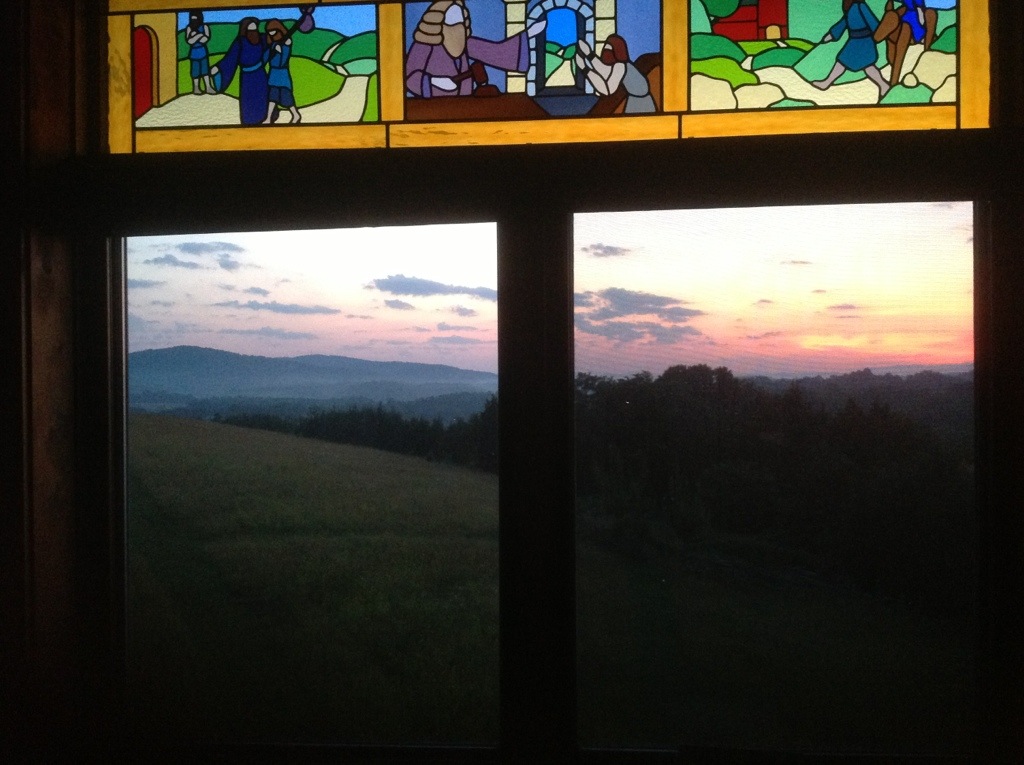
That memory was vividly on my mind when I arrived on this trip to claim “my” room. I opened the half-hidden door, took off my shoes and climbed up the steep staircase. I reached the room, set down my suitcase, and looked around. The windows…and the view…were still breathtaking. An amazing peace wrapped around me like the arms of an old friend. The stained glass beatitudes welcomed me with vivid colors and familiar words. The candle next to a prayer bowl begged to be lit; the incense burner next to a bell topped with a cross would soon fill the air with sounds and scents; the icons and statues drew me in like welcoming hosts. On the small table, between two chairs, was “my” prayer book, a leather bound Book of Common Prayer. This surprised me at first, because the Episcopal/Anglican tradition is not the particular expression of Christian faith of the property owners. But there it was, like an old friend, awaiting my arrival. The sun was setting over the beautiful mountain views, so I picked it up and as has become my habit, said Compline, before rejoining my colleagues.

Hours later, as I climbed the stairs again after dinner and conversation, I stood in awe as the full solstice moon beamed its light throughout the room. I spread prayer cushions on the floor and knelt in deep meditation as the light from the moon illuminated the mountains and recharged me with the energy of the earth and sky. I would eventually sleep, laying across the cushions with the moon watching over me like a loving mother watching over a child, still praying the words I had recited earlier,

Keep watch, dear Lord, with those who work, or watch, or weep this night, and give your angels charge over those who sleep. Tend the sick, Lord Christ; give rest to the weary, bless the dying, soothe the suffering, pity the afflicted, shield the joyous, and all for your love’s sake. Amen.

I awoke as if my name was being called by the first rays of the sun emerging over the mountains to the East. I pulled on a sweatshirt over my pajamas and silently crept down the stairs and out of the house, hiking over the hills through the mown path to the labyrinth. My feet were dew soaked, and I slipped off my shoes as I greeted the dawn and began my labyrinth walk, the rough and cool grasses beneath my feet marking every step and colors filling the skies around me and waking my spirit to full awareness of this day, this present moment, this remarkable time in my remarkable life. I sang, for no one but God and the Universe to hear, the first song that passed spontaneously from my lips which was the Gloria we sing in Ordinary Time in my community of faith.

The blending of spirituality, faith, nature, church, work, life, past, present, ordinary, divine flowed freely across this weekend. I hold dear many, many thoughts and visceral memories from this retreat, more than just what found their way into words tonight. I write these small points of light to remember, to acknowledge, to graciously give thanks, and to express gratitude from the core of my being that I know I am both Spiritual and Religious. Blessed Be. Alleluia.

May the journey continue, wherever it will lead…

Posted in quotations and reflections, work and life | Tagged , , , , , , , , , , , , | 2 Comments

Blogging in Narnia

I am in Narnia as I write this morning. I literally opened the wardrobe, parted the thick, furry coats, and stepped through the door onto a little ledge among the mountain top vista which surrounds me as I write. It is an incredible place of solitude, and offers me a small point of light to start my day simply by being present in this space, somewhere between worlds of flesh and spirit. A thin place, as my Celtic ancestors would call it.

I am on retreat, and this Narnia Closet is just one feature of this amazing place (the Bellfry) which was so deeply and thoughtfully constructed. The Narnia closet can be found in the meditation room, which is where I spent the night in blissful solitude before rising at dawn to walk the labyrinth at sunrise, mountains surrounding me on all sides. I lack words to convey how deeply meaningful, resonant, and transformative this sequence of contemplative opportunities has been for me, especially on this Summer Solstice.

This particular retreat offers me a mix of community and solitude. I am the outgoing Past President of PLIDA and our members have gathered from across the U.S. and Canada to spend the weekend connecting, planning, supporting, and working. As I transition away from formal leadership, I have carved out time to be present and connected with this amazing community of healers and leaders. I have also carved out time for solitude as my own personal and professional journey continues to wind me through new paths and allows new doors to open. I am intentionally relishing each step. It is intentionality that propels me to chronicle my journey here and now.

Back to Narnia, though. I grew up loving each and every book in the Chronicles of Narnia. Lucy, Tumnus the faun, Aslan, Peter, Edmund, Susan, the White Witch filled my summer days of childhood. I still have my well read boxed set of paperbacks. I still have my favorite plot points and quotes. I still think so much human yearning and divine trust is summed up in these simple conversations and characters. I read, and read, and re-read the poignant moments in particular. Aslan’s words and the children’s authentic quest to understand them spoke to my young spirit:

“It isn’t Narnia, you know,” sobbed Lucy. “It’s you. We shan’t meet you there. And how can we live, never meeting you?”
“But you shall meet me, dear one,” said Aslan.
“Are -are you there too, Sir?” said Edmund.
“I am,” said Aslan. “But there I have another name. You must learn to know me by that name. This was the very reason why you were brought to Narnia, that by knowing me here for a little, you may know me better there.”
― C.S. Lewis, The Voyage of the Dawn Treader

In my first semester of college, I was exposed to more of the literary writings of C.S. Lewis and began to view the tales in new ways as I moved through childhood and adolescence into adulthood. I recall The Great Divorce was required reading in one of my classes, and I took away from that particular reading Lewis’ concept of the journey not only through Narnia, but through life and death as beckoning us to journey further up and further in. Although I have meandered greatly in my spiritual journey, that core concept is one that has retained throughout my path, and this morning as I journeyed the mown path toward the labyrinth, it was that same concept, retained across years and miles and spiritual meandering that caught my mind and drew my attention Inward. Upward. Onward. And so, I find myself perched in Narnia now following that walk, finding light and solitude in this thin place before rejoining my colleagues.

Befitting this venue, I will close with a few more words from C.S. Lewis before joining my colleagues for our day of togetherness. In both solitude, and in community, there is light. May we be attentive to the light and miracles that cross our paths on each step of the journey.

Miracles are a retelling in small letters of the very same story which is written across the whole world in letters too large for some of us to see.

. — C. S. Lewis

20130622-093701.jpg 20130622-093713.jpg

Posted in quotations and reflections | Tagged , , , , , , , , , , , | Leave a comment

Both Feet

I have had a favorite family story on my mind all weekend. Maybe it is because of the media barrage of “father” images on this greeting-card holiday, or maybe it has more to do with the lessons I am learning on this particular point on my spiritual journey. Either way, the story is begging to be told this morning so I will set it free…

I was about three years old when my father and I had our first foray into “solo parenting” with each other. My Mom needed gall bladder surgery, and that meant caring for me was left in the hands of my father. Although I was very young, I do have some very vivid memories of this event, including going to the hospital to see my Mom while she was recovering (it was the 70’s, long before same day surgery). But the most memorable event from our family lore happened later that night when Dad and I were home by ourselves.

I woke up in the middle of the night, and I needed to use the bathroom. The bathroom was on the other side of the house, and I was not about to venture there alone in the dark. So, I went to wake up my Dad in the bedroom next to mine. “Dad” I whispered. And I waited. “DAD!” I yelled. He woke up, startled. “I have to go to the bathroom.” I remember he sort of grunted, mostly asleep, but lovingly scooped me up and carried me to the bathroom. He sleepily set me down, presumably on the toilet as I had asked him to do, and started to close the door and walk away

“Dad”…. I was very hesitant at first. Nighttime help was Mom territory. Maybe Dads did this different, I thought. But something was definitely not right.

“DAD!” I yelled. He turned around.

“My foot is in the toilet!”

Still groggy, Dad rubbed his eyes and asked (as if it mattered), “Which one??”

Crying, I called out:

“BOTH OF THEM!”

We still laugh together at this story, the memory of which likely has become more vivid with retelling over the years. I had a full, two foot and most of my lower half immersion in toilet water that night, and there was a whole lot of cleaning up to do. My Dad embellishes the story now by stating that his punishment was that after he got me dried off and changed, I immediately crawled into bed next to him and put my cold, clammy little toilet water feet all over his legs.

The funniest part of this story, from my perspective, is that I am still a both-feet-in-the-water kind of girl. Maybe this early childhood experience was a baptism of sorts, having two feet stuck firmly into the toilet bowl of life and coming out with laughter and a great story. I have most certainly spent some time waist deep in some pretty unpleasant waters. Thankfully, my feet haven’t always been aimed toward a toilet bowl, though. I am often plunged into amazing situations, serendipitous opportunities, and richly rewarding experiences. I also have learned that some situations are not what I anticipated they would be and there is no easy way out, even when I call for help. Over time, I have learned to trust that when I call for help, strong arms will lift me up, dry me off, and set both feet firmly back on solid ground. I will be wet, and the aftermath may require a lot of cleaning-up. But, when all is said and done, there will be a story worth telling and retelling about the experience. There will be a lesson…a small point of light…within the immersion.

I also know from my own journey that there are times when all we can manage to do is stick one toe in the water, especially when we are learning (or re-learning) to trust. Cleaning up and drying off can take its toll on us, and we need time to heal. But there is joyful abandon in recognizing within ourselves a return to the child-like willingness to jump in with both feet, to be fully immersed but not washed away…or perhaps in my case, flushed away…by the experience. I have come to learn that water can be life-giving, even when it provides an opportunity for a shared story that keeps us laughing together through all the ups and downs of life.

May we be willing to jump with both feet into the waters of life, always trusting in the arms that are present to guide and protect us on our journey.

Posted in quotations and reflections | Tagged , , , , , , | Leave a comment

Being Still

I am not naturally inclined toward being still. If I am truly honest about my nature, motion and action are central to my daily living and to the trajectory of my personal and professional growth. I have been described across my life as a hard worker, a person who acts on my words, someone for whom no grass grows beneath my feet. Ideas need to be accompanied by an action plan in order for me to take them seriously, and if I like the idea but don’t see an action plan, I generally take it upon myself to set one in motion, for better or for worse. I would rather ask for forgiveness than permission. I will take risk over regret any day. Five hours of sleep is plenty for me.

Have I mentioned, I am not naturally inclined to be still?

So, when I reflect on being still…which has now become a central component of my daily life and spiritual practice…it is from this place of understanding my own nature and reclaiming the value of stillness within it.

I set up my first meditation space in a tiny room in my tiny house. I was in the midst of major life transition…relationship, career, geography. I craved stillness and didn’t know how to find it. So, of course, my action plan was to redecorate a room as a meditation space in the hope that stillness would appear. The Universe is benevolent and God does meet us exactly where we are at, so I did find moments of stillness in that small, freshly painted space, even if they were only a few minutes long. I also began to do other painting…watercolor…in that space and realized this also had a centering effect on my spirit if I could let go of producing a product and simply lose my thoughts in the process. Stillness and action could be an intricate dance, I was learning. The stillness of that space kept me centered during that particular time of life transition, and I established a similar space in a new city on the other side of that transition in hopes that stillness would follow me. I hadn’t yet claimed stillness as my own, though.

New practices need to be nurtured in order to survive. In subsequent years, the intensity of my professional and personal life created other patterns of action, and my experiences of stillness were relegated to a few moments here and there when I chose to find them or as I would say, “when I could find the time.” I never regretted finding the time to be still when I did, though. But, action was garnering me more accolades, frankly, so my busy nature thrived. But then, something changed.

When I look back on what I have written in this blog, I recognize that I began to deliberately carve out time for being still not in response to something external, but after my simple but decidedly real encounter with God as always present in my life. I wanted stillness to become aware of that Presence. Learning to be still happened slowly and deliberately, a response to my desire to be present in my daily reality, to experience the Presence of God in my daily reality, in an intentional and mindful way. I have allowed myself the freedom to experiment with being still…solitary stillness, walking meditation, artistic exploration, walking the labyrinth, visual meditation, centering prayer, and yes…even blogging my spiritual journey. I admittedly find it more challenging to be still in a communal setting because of my natural level of distraction, but I am experimenting with that, too. Being still with another (or others) has its own gift of communal presence.

Ironically, the more intention I put into being still, the more time presents itself for stillness. While this makes no logical sense, I accept it as truth in a different way. I have come to know that being still is an active state, not a passive one. It is growth producing and life giving.

Yesterday, I came across this brief meditation from Richard Rohr in my daily email, written as an introduction to centering prayer. It spoke to me in its simplicity and truth and I thought it summed up well the inner knowledge I have gained about being still. If you are reading this and have not practiced a contemplative path, or if you are experimenting with actively embracing the stillness of being, maybe this is a good start:

When we’re doing life right, it means nothing more than it is right now, because God is always in this moment in an accepting and non-blaming way. When we are able to experience that, taste it, and enjoy it, we don’t need to hold on to it nor are we afraid to let go of it. The next moment will have its own taste and enjoyment.

Because our moments are not tasted—or full—or real—or in the Presence—we are never fulfilled and there is never enough. We then create artificial fullness and distractions and try to pass time or empty time with that. Perhaps this quote from Psalm 46:10 can be your entranceway into the now, if you slow down in this way:

Be still and know that I am God.

Be still and know that I am.

Be still and know.

Be still.

Be.

Adapted from Everything Belongs:
The Gift of Contemplative Prayer, pp. 60-62

Posted in quotations and reflections | Tagged , , , , , , , , , , | Leave a comment