How to be a Social Worker Everywhere You Go

Commencement Address for VCU School of Social Work (December 2023)

The first day I realized that I might be a social worker, I hadn’t even taken a class yet. I was working as a CNA in a skilled nursing facility, which I’d started to do right after high school. I enjoyed taking care of the residents but I wasn’t particularly fast at my tasks, which means I wasn’t considered “good” at my job. Often I found myself at the receiving end of an unhappy glance from my charge nurse. During the fall, I started taking some classes intending to find my career in the medical field. But let’s just say that I wasn’t feeling optimistic about that career path after a semester of anatomy and physiology. One day over winter break, I went into work and learned that one of the residents I often cared for had experienced the death of her spouse. She wasn’t on my assignment that day, but I decided to go visit her on my break. So, later that afternoon, I knocked on her door and she welcomed me in. We sat together, looking at her old photos. She reminisced, I listened. I remember feeling comfortable, just being present.

Suddenly, my charge nurse was at the door. She grabbed my arm and pulled me out to the hallway. With a stern look on her face, she began to lecture me about sitting around on the job, and I reminded her: I was on my break. She immediately said, “if you’re going to waste your break sitting around, at least do something productive like scrub the sink.” Then, she added: “If you want to talk with people so damn much, why don’t you go be a social worker!”

I know she meant it as an insult. And believe me, I felt it. But little did she know, she had just changed my world. 

That next semester, I signed up to take “Intro to Social Work.” And that’s where I learned to apply terminology, theory and strategy around this part of my identity that longed to center relationships, to foster people’s ability to create changes in their own lives within the systems that impact their everyday experiences, and to advocate for just policies and systems that protected the fundamental rights and responsibilities of our collective care for one another.  

During my BSW program and my MSW program there were ups and downs, and challenges, and papers and tests and more papers and tests. I know you all know something about that! Eventually, there was a PhD in my future with a really, really big paper…and there have been many more classes and papers since then. All along the way, I have met people who have challenged me and mentors who have inspired me by giving me examples of how they put their social work skills into practice: in health care, in child welfare, in mental health, in government, in academia, as organizational leaders, as candidates for elected office, with their clients, colleagues, co-workers and community partners.  

I hope that it’s been the same for you during your studies: My hope is that social work learning took place not only within your textbooks and lectures and discussion boards and assignments, but also with your peers, your professors, your mentors and most importantly, with your clients.

From the clients, classes and mentors I encountered on my own journey, I learned to nurture social work not just as a field of study, but as vocation: that place where my deep fulfillment meets the world’s deep needs.  My vocational identity as a social worker has been front and center when I worked in health care, hospice, education, community practice, non-profits, in a school of social work and now within the organizational structure of a religious institution. In all the settings where we live and work, the values and ethics of our vocation are more than just professional guidelines: we have the opportunity to live into them every single day.

And that’s what I really want to talk with you about: How do we choose, each and every day, to embody what it means to be social workers?  

I’m going to suggest three ways: Commitment, Colleagues and Community

Commitment: Social workers commit to ethics and values every day and keep pushing our profession forward. It isn’t good enough to have skimmed through the NASW Code of Ethics like a one-and-done assignment. It also isn’t good enough to assume that the historic context of social work contained in that statement offers us everything we need in 2023, or 2024 or 2035. Instead, if we understand the core and continuing values of our profession as emerging from the intersecting movements of social casework, the settlement house movement and mutual aid among members of oppressed groups then we can continue to ask critical questions that guide our actions where systems, communities and the voices of those marginalized by social structures come together. If we intentionally center the voices of those sidelined by society then we can make a counter-cultural impact in this divisive and stratified society. If we commit to center human relationships then we will make tangible changes in our own lives, as well as effectively broker and advocate for change with our clients. A value-driven profession is not “less than” scientific: A value-driven profession participates in the great experiment and rises to the grand challenge of believing that change is not only possible, but imperative.

Colleagues: Social workers center human relationships. We are our best professional selves with colleagues who share our values; who can support and challenge us when we hit rough patches; who can call us in with love to be sure that we aren’t becoming jaded, burned-out or overwhelmed by systems of oppression. We need diverse colleagues who can see things from different vantage points and social locations so that we are not lulled into thinking that our way of thinking is the only perspective. Maybe we’re lucky and we find our social work colleagues in the same place as our social work employment. But, we may be practicing social workers in interdisciplinary settings, or we may apply our social work skills and values in paid and voluntary settings outside of traditional social services altogether. In every setting where we work and every job title we hold, we are social workers. Being a relationship-centered social worker compels us to intentionally build colleague networks that reinforce our values and build each other up. Make and keep up the relationships that you have forged here; change jobs if you want, but keep the colleagues who help you be the best social worker that you can be! A cherished colleague group is the best prevention for burnout and the first ingredient in professional self-care.

Community: Social workers create community. Community is bigger than family, friends, or even colleagues. Some communities are place- or system-defined: where we live, where we went to school, where others see us “fitting” ideologically, politically or demographically. We may find communities of identity who help us build up strength in numbers, especially if we are a minority group in a larger system. As social workers, we can also create community. Creating social work community means intentionally expanding our circle to include those who are different from us because we see strength in diversity. Creating social work community means practicing affirmation and inclusion because we value what everyone brings to the table exactly as they are. Creating social work community means setting extra places at the table or pulling up a whole other table to make sure that there are plentiful seats. Creating social work community means noticing exclusivity then acting on our discomfort to create inclusive opportunities. Living in social work community means it’s not all about us: it’s about ALL of US.

Today, we’re marking the threshold of a new beginning: the commencement of something you’ve been working for not only for several years of formal education, but for your whole lifetime. Commitment, colleagues and community: These are three essentials to living out the vocation of social work with each step that you take, wherever you choose to go in this world. The world needs us. This world needs YOU to be a social worker, wherever you are. Each of you is a unique gift to this profession and you will help social work shift, change and adapt to the needs of an ever changing world in ways uniquely suited to you. Congratulations, social workers. You have earned this day. Now, let’s go change the world!

Posted in work and life | Tagged , , , , , | Leave a comment

Trimmed and Burning

Proper 27, Year A
Homily for St. Andrew’s Episcopal Church, Burke VA

Gospel Lesson: Matthew 25:1-13

It’s only been a few weeks now since I came back from our diocesan pilgrimage for Racial Justice and Healing. During that time we journeyed first to Memphis, then to Birmingham and on to Selma and Montgomery. In each place we stood in hard and holy places in which we had to face the depth of oppression, violence and dehumanization that has occurred in the history of this country as well as in our continued struggles for racial justice. And in each place, we felt the holy and life-giving presence of God who was, and is and ever shall be present.

To say that I felt God’s presence in places like the 16th Street Baptist Church and the national memorial for peace and justice isn’t just a trite expression. It was palpable…and most easily seen, for me, in the faces of my fellow pilgrims and sojourners as we walked together.

Each of us brought our own “stuff” to this pilgrimage…and by that I mean the literal as well as metaphorical baggage of our lives. Every person on that journey brought our knowledge, our history, our wisdom, our ancestors, our privilege, our oppression, our frustrations, our yearning for beloved community. Sometimes we had enough for a particular stretch of the journey, and sometimes we did not. Sometimes I found myself sobbing and someone holding me up. Sometimes my arms were wide enough to support someone else. In all these things, we found ourselves growing together in Christ as well as in beloved community over the six days and 60+ hours of bus-riding that we engaged together. Most of us, myself included, haven’t really been able to find the words yet to convey the depth of our experiences. So, there will be more sharing on that to come.

But there was one portion of that pilgrimage that has been a constant companion in my thoughts as I sat with this week’s Gospel lesson and prayed about my time with all of you. On the second day of our pilgrimage, we drove to the outskirts of Memphis to a place that was described as a museum of the underground railroad. It was someone’s actual house until 1997 when the then-owner recognized that some of the peculiarities of the house might have far more historical significance than she initially realized. It had been the estate of Jacob Berkle, a German immigrant and stockyard owner. In addition to the quaint house and barn with meadows for cattle to graze, it became increasingly evident by the holes in the basement, the strangely positioned doors and half-doorways and the re-discovered oral histories of formerly enslaved people who described the location of safe stations on the underground railroad that this place was instrumental to the anti-slavery and abolitionist movements of the late 19th Century.

On the tour, we saw the tiny corridors through which people passed unnoticed to safety. We walked into the basement and stood in the damp darkness where small crawl spaces to and from the outdoors…out of sight of passers by…came into view. We heard stories, and listened to oral histories that told of instructions being given through the patterns of quilts set out to air and the drumming and singing of spiritual songs in the fields worked by enslaved people that held meanings beyond what could be seen on the surface. One of the songs noted by our tour guide was the spiritual “Keep your lamps trimmed and burning.”

This spiritual is accompanied with steady drum beats, the kind that keep you working and moving as a group. The lyrics reflect the Christianity with which those who had been enslaved had also been indoctrinated and the scriptures of our Holy Bible turned into song would have been acceptable when heard sung by the laboring. But this song is also believed to have emerged as an encoded spiritual of the underground railroad: keep your lamps trimmed and burning, children don’t grow weary, the time is drawing nigh.

Entering into today’s Gospel in this way gives us a unique vantage point. Standing in that home made me confront the lyrics of a spiritual that was sung by enslaved persons whose reserve supply of faith and community was so strong that it fueled their lamps of liberation, whether for themselves or for their children and generations yet to come. We encounter history retrospectively, seeing what was and having to acknowledge that it doesn’t often hold the whole story. I could see these singing people, beloved of God yet enslaved by human hands. I could imagine them moving about their journey with their eyes open, seeing where and how there were means to reach freedom, to reunite with family, to boldly hope for tomorrows that would hold the possibility of salvation in this world or at least, in the next.

The holy oil of liberation that they carried with them is a tribute to their strength and their wisdom. The light they carried still burns on in their ancestors and generations that have come after them. That light of their presence on this earth and their resistance to oppression can be seen, if we have our eyes open to look. And God was with them, profoundly. The light of Christ that they sang into their daily motions was sustaining and keeping them in a way that the false and fleeting light of the self-righteous security of their oppressors never could.

Standing in this history is hard. Christianity has been weaponized in many ways and most especially during this horrific history of enslavement…and yet Christ’s presence was also there not in dominance but in love and liberation. To the foolish, freedom was a possession, a material thing that could be bought and sold. But the liberating power of Christ’s love isn’t like that. The liberating power of Jesus Christ doesn’t demand social place or position and it isn’t available for a price to those who have means; that liberating love thrives in relationship, that liberating love lives and grows when we are emptied. The wise ones sang, together. And their lamps were ablaze in ways that could not be bought or sold.

We begin to see this Good News emerging from Matthew’s Gospel when we realize that the wise are not the powerful or the wealthy; the wise are the ones who align with the liberating love of God which is carried with them in a way that cannot be possessed in this world. Like the words of Mary’s prayer, the Magnificat, our eyes begin to open to the ways in which our loving, liberating God moves to topple the oppressive hierarchies of this world and replace them with the humility, love and grace that is fueled by the liberating love of Christ’s presence. As our liturgical calendar moves towards advent, it is this urgency of staying awake and remaining in relationship that we are called upon to do, so that the liberating love of God brings a whole new realm of God into being:

He has mercy on those who fear him in every generation.
He has shown the strength of his arm, he has scattered the proud in their conceit.
He has cast down the mighty from their thrones, and has lifted up the lowly.
He has filled the hungry with good things,
and the rich he has sent away empty.

This parable gives us just another glimpse into the upside-down nature of the realm of God, where we grow by giving away and are filled by emptying our hearts. The one who is coming asks us to have our eyes and our hearts open, to be fueled with the liberating love that is available in and through community with each other. Wisdom reminds us to do what our logic fails to recognize: pay attention, keep watch, don’t grow weary.

My work at the Diocese is all about discernment and formation. I realize that on the surface, I haven’t offered a lot in this homily about the work I do ministering with those who are called to serve the Church and the world as lay people, deacons and priests. In other ways, I’ve given away the two best lessons of it all, though: God has us, and we are people called to be community. God invites us not to cling to our lives or to think that we personally have all the reserves that we need for our work and ministry. God invites us to wait with prayer and patience, filling our reserves through the relationships where Christ’s liberating love is revealed. God invites us to share in a life of giving in order to receive; to empty in order to be filled. God invites us to understand the Gospel not as a hammer to be weaponized, but as a tool that breaks us open to make room for God to do the work in us that the world needs. It isn’t easy, and it isn’t about being privileged. It is hard, and holy and humble work. And if God is speaking to you in that place, whether you are called to lay ministry or the ministry of a deacon or a priest then I’ll accompany you as you listen and prepare with open eyes and open heart to do whatever work God has called you to do.

So, for all of us, the reminder is clear: keep your eyes and hearts open for God’s movement: in your life, in this parish, in the diocese, in your community, in the world. There are safe places along the way, and messages that your open eyes and heart can see that will guide you. And God will be with you, as you are with each other. There are others on the journey who help to share the load and spread the wisdom. The light of Christ that we carry and see in one another is not for the taking or the buying. But together, in community, we will find that we are filled with the liberating light of Christ and in that beloved community, we will always have enough.

Posted in sermons | Tagged , , , , | Leave a comment

Question behind the Question

Homily for Proper 20, Year A

St. Mark’s Episcopal Church

With thanks to many of you who have checked in with me about how I’m doing this first year outside of academia, I will acknowledge that it is both strange and wonderful to be living life beyond a syllabus-driven academic calendar.  I don’t miss having a stack of papers to grade every night.  I do miss my students, particularly the newness and enthusiasm of my doctoral students who were always eager to dig deeply into the questions they had come to this program to explore.  Many of them, like me, had spent time in social work practice and what drew them towards a research career was a nagging question that couldn’t be put to rest. They would come to their first research classes hoping to study and find The Answer.  I was always there to reassure them, with love, that the best kinds of research questions actually don’t lead to answers, but to more questions.  Hopefully, the initial questions lead to what I refer to as “The Question Behind the Question” which I’d term the “QBQ”  Getting to the QBQ is like striking gold: it helps us move beyond to the superficial, to get to the heart of what is important and meaningful that often stands in the way of the status quo that we’ve been observing.

Nothing goes to waste with God, so this week it was those memories of past fall semester research class lectures and discussions about the QBQ that seemed to come up for me again and again.  And as I read this portion of Jonah that comes after the famous whale incident, and then again as I listened to the parable that Jesus conveyed, I began to see a pattern emerging.  So, I invite you to a journey to the question behind the questions offered up in today’s readings.

Let’s start with Jonah.  Oh my friend Jonah.  The story most of us remember is that the prophet Jonah was called by God to go to Nineveh, a city that was at enmity with the Hebrew people. Instead of going to Nineveh, though, Jonah bought himself passage on a ship to Tarshish, hoping to be “away from the presence of the Lord.” Good luck with that, Jonah. God makes it known through wind, sea, storm, sailors who try to turn the boat around and eventually through a giant fish that Jonah needs to pay attention to this call from God. Perhaps grudgingly, Jonah goes to Nineveh after God calls to him a second time after the whale adventure, and he delivers the message of rebuke and repentance. The people and leaders respond to the message: they repent, they change their ways and they look to God.

All this brings us to today’s reading: God, who was the One who called the prophet Jonah to them out of love, sees their actions and removes the calamity that was to befall them. God recognized with love even the enemies of God’s chosen people; God sent a messenger and a message; when invited, they responded with open hearts. 

But Jonah is MAD.  In his anger, he directs a string of questions to God: “Didn’t you hear me when I told you from the beginning I didn’t want to go? Don’t you understand that these are evil people and that’s why I fled?” Jonah’s unspoken question to God is: “why don’t you just destroy them?”

And God responds to Jonah with a divine QBQ: “Is it right for you to be angry?”

Jonah doesn’t answer that question.  He is still angry.  And so, the process repeats: Jonah goes to a hill outside the city and builds himself a booth, still hoping to see God smite the people he loathes.  While he sulks, God provides a bush for shade and Jonah is happy, at least for the moment. He becomes angry again when a worm attacks the bush and a hot wind unsettles his front-row view of anticipated retribution.  In response, God poses the Question behind the Question more specifically to Jonah, “Is it right for you to be angry about the bush?” And Jonah answers with a toddler-tantrum reply that is funny because my friends, we’ve been there too: “Yes, angry enough to die!”

God, the loving, patient teacher sees hope not only for the people of Nineveh but also with this prophet who has fled and failed in so many ways. And thanks be to God, that means God the patient and loving teacher sees us beyond our own angry utterances, too. I see what comes next as God handing Jonah the answer key as a study guide instead of marking his failure with a red pen: if you care so much about a bush you didn’t even plant as to be angry about it withering, then why wouldn’t I care about this city filled with the lives of people and animals? 

Jonah never responds to that question in the Biblical text.  Perhaps it’s because God’s question gets to the heart of the matter which he cannot escape: God’s mercy and grace extend far beyond our human capacity to love and understand. True for Nineveh. True for Jonah. True for us, even when we’re at our angry worst.

Our Gospel lesson offers us a second case study in the divine QBQ, in the form of a parable.  If I were taking an anonymous poll at the end of this parable of the Laborers in the Vineyard, I might force a response by asking a yes/no question, “was the vineyard owner just in his actions?” I won’t ask for a show of hands. Instead, I might invite us to listen to the discord that we feel in our bodies and minds when forced to answer “yes” or “no” to that question, especially when the parable begins by saying, “the Kingdom of God is like…”  Of course God is just so we want to say “yes.” But this parable, as it lands on our ears, doesn’t seem like an example of justice as we know it.  Instead of tossing out the question or passing over this parable, sitting in our discomfort helps us to see the QBQ emerging: How have we come to understand “justice?” Is our sense of justice based on a theology of God’s abundance? Or is our sense of justice derived through the culture in which we live?  Maybe that brings up yet another question: are there assumptions within our culture that are so much a part of the water that we swim in that like fish, we don’t even recognize it?

Perhaps speaking some of those cultural assumptions out loud will help us here: does longer, harder work make us more worthy? Are people who do less work less worthy than people who do more work? Should all wages be based on labor? Is observed idleness the fault of the people who aren’t working?  Are we right to be angry and feel  wronged if someone who does less than us makes more than us? 

These cultural assumptions lead to deeper questions, too:  Does money define our value, and should it?  Is what we earn really “ours”?  Are merit and deservedness the best ways to determine how we distribute money entrusted to us, either through work or through charity?

Sometimes seeing the water we swim in makes our eyes sting a little.  

What if, like Jonah, we’re so busy swimming in the water of who-deserves-what that we find ourselves fleeing away from God’s mercy and grace because it is so lavishly generous that it seems unfair?

We don’t always see like God sees: we see from our own perspectives and our own vantage points and our own cultural norms.  If we’ve been working hard, we want to see hard work valued.  If we see ourselves as one of the good ones, we want to see the bad ones…often, the ones not like us…punished.  We can quickly assign our daily frustrations with a person’s actions to a group to which that person belongs or an identity that they hold which is how prejudice forms.  We can begin to see the world through a series of binaries: yes/no; good/bad; deserving/undeserving and fail to see the beauty and complexity in every human being.

What if the Vineyard owner knows something we don’t?  What if the laborers in the marketplace at mid-day tend to be those who were caring for family members and couldn’t get there first thing in the morning?  What if those at the end of day were the ones who never got offered work because they weren’t the “right” gender, or age, or size, or shape or color or personality?  What if the end of day had some particular tasks that were just right for those whose neurodiversity or uniqueness helped them see what others had missed?  What if we had never even noticed the pitifully low wages of day laborers in the first place, let alone the differences between their daily wages? What if and what if? 

At the end of his parabolic lesson, Jesus also gives those who are listening the answer key for further study.  It begins with the Vineyard owner’s question to the upset laborer: “Am I not allowed to do what I choose with what belongs to me?” which the hearers and all the rest of us can shrug off with a superficial, “sure, of course…that’s what money and power gets you.” 

Astutely, Jesus the teacher moves the story from that superficial question to the Question behind the Question: Or are you envious because I am generous?

That is the question on which we’re invited to study, too. An encounter with the realm of God knocks apart the cultural assumptions of worthiness and possession that we carry like burdens in this world. God who is generous with grace and abundant with mercy sees us in the fullness of our potential rather than the limitations of our lives.

God’s generosity cuts across the divisions that we draw, the limitations that we see, the biases and prejudices with which we are inundated and which keep us from seeing the fullness of God through the fullness of all of God’s people. Being present  in the realm of God makes our cultural assumptions irrelevant, because there is no room for that kind of division in an economy of abundant love and grace.

Whenever we celebrate the sacrament of baptism, we get a chance to put our study guide into practice in a kind of group oral exam: Will you seek and serve Christ in all persons, loving your neighbor as yourself? Will you strive for justice and peace among all people, and respect the dignity of every human being? The answers that we are invited to give…you can even pick up the BCP and find them on pp. 304-305…are the foundations of our new life in Christ: “I will, with God’s help.”

And each time we come together for this holy meal, our Holy Eucharist of transformation from our individual selves to becoming the Body of Christ, we are brought into the realm of God’s abundant grace, mercy and love. We are not the owners but rather the caretakers of our lives, our work, our possessions, our neighborhoods, our communities, our world: with God’s help

God’s vision is beyond our own; God’s mercy exceeds our judgmentalism; God’s grace is so lavish and abundant that we ourselves and all others are seen and loved far beyond our faults or the worst thing we’ve ever done, to paraphrase activist and Just Mercy author Bryan Stevenson.  If we’re still at the end of the lesson asking who is worthy…or even who is right…we are still stuck on the superficial questions. But we have the study guide, the lessons, the Holy Word. We are invited through these stories and many others to be transformed by our loving God’s ultimate QBQ, our invitation to life in Christ: will we open our hearts to the unfathomable magnitude of God’s love and grace poured out for us, and for all?

We’re invited to that table, and to that holy transformation.

Posted in sermons | Tagged , , , | Leave a comment

What kind of test?

Homily for Proper 8, Year A

St. Mark’s Episcopal Church, Richmond VA

Lectionary Texts:

I have a pretty vivid memory of young school-aged Sarah in the church basement classroom with my friends where our Sunday School teacher would enact bible stories on a felt board with cut-out figures.  I liked the stories about Abraham and Sarah, especially the one when the three visitors come by the tent by the oaks of Mamre and Sarah fixes them cakes made of flour and water, then laughs when she hears she will bear a child in her old age.  My friends would snicker a little about “old Sarah” but I liked the hospitality and the humor of that story. Then, there was the story of Sarah and Hagar, details of which were brushed over for adult content on our childish ears, but the point of the story as my young mind remembers first hearing it was that God was honoring a promise to Sarah and also taking care of Hagar and Ishmael.  I seem to recall a palm tree and a well of water appearing around them on the felt board, and we talked about what a cold drink would feel like when we were thirsty, and how this kind of thirst was beyond any of that.  I took away the recognition that we sometimes do some not great things, but God always cares for us, and for those we hurt..

And then, there was the story of Abraham and Isaac.  There isn’t a pleasant, felt-board kind of way to tell this story.  It was shocking and horrible.  I think my teacher tried to move the bushes and the ram quickly into the picture before we really had a fully formed picture in our minds of Isaac bound on the pile of wood he’d been carrying, but honestly I felt pretty bad for the ram, too. My teacher tried to make a direct connection to Jesus, but that didn’t take for me, either.  I just remember thinking, “why would God tell Abraham to do that?”

I’m not sure I’ve ever stopped wrestling with that question, honestly.  And when I saw that the lesson appointed from the Hebrew Scriptures for this day on which I was appointed to preach here at St. Mark’s, with this group of people I also knew I could wrestle with it here.  You aren’t afraid to wrestle with scripture, and that’s a good thing. So,  I decided to take up the challenge.and wrestle with this story a bit from the pulpit.  

I don’t have a felt board with me today, and spoiler alert: there isn’t anything that I can offer up that makes this story any less jarring.  But what I did come away with after a week of rabbit hole diving into religious studies perspectives and academic sense-making is the realization that I am not alone in my wrestling. Jewish, Islamic and Christian scholars all struggle with the same core fundamental questions that this pivotal narrative from the Pentateuch raises for us.  The scholars I read raised some questions and observations about the text that have helped me name my struggles…and most importantly my search has reinforced that this text says what it says, and it raises important questions for us to ask, even if they don’t have easy answers.  

In Jewish life and literature this story, referred to as the Akedah הָדֵקֲע, or the “binding of Isaac” becomes a central story of self-sacrifice and obedience to God’s will. In the prayers of the high holy day of Rosh Ha-Shanah, there is an appeal to God to remember the Akedah: “Remember unto us, O Lord our God, the covenant and the lovingkindness and the oath which Thou swore unto Abraham our father on Mount Moriah: and consider the binding with which Abraham our father bound his son Isaac on the altar, how he suppressed his compassion in order to perform Thy will with a perfect heart. So may Thy compassion overbear Thine anger against us; in Thy great goodness may Thy great wrath turn aside from Thy people, Thy city, and Thine inheritance.”  In this prayer, Abraham, Isaac and all of God’s people are bound together.

Even with the centrality of this story within Jewish faith, rabbinic literature questions the meaning and intent, particularly around the opening phrase, “God tested Abraham.” Considerable attention is paid to the ways in which Isaac is either centered as the victim or the hero…or perhaps both. I learned through the writings of medieval rabbinic scholar Nacḥmanides,who  in the 12th Century wrestled with this story and within it the problem of reconciling God’s presumed omniscient foreknowledge with the gift of human free will.

Putting that more clearly: how is it that an all-knowing God can both know what is to happen, and allow us to choose with perfect freedom?  And what is the nature of this “test?”

It has made me wonder what the real test is here between God and Abraham.  Was it a test of loyalty and obedience, the way that the story might be read in an archetypal way?  That’s sort of like giving a “true/false” test: are you obedient, or not?  That seems like a very high priced test for what, as a teacher, I think of as a pretty shallow form of assessment.  

I think we often treat this story as if it was a multiple choice test, a sort of logic puzzle of God’s intent and Abraham’s actions: what if Abraham protested on moral grounds and a love of God evident in his child?  What if Isaac had bolted or had himself called out to God for help?  What if the timing was just off and the ram hadn’t caught Abraham’s eye, or the angel was just a second too late urging Abraham to hold forth and Isaac was already sacrificed…would God have brought him back to life?  It turns out that scholars have been wrestling with those questions for years, too.  

And maybe, just maybe, the answer could be “D”: God would have been with them, in all of the above.

So, I have to conclude after a lot of reading and wrestling this week that this story isn’t a true/false test of obedience, nor is it a multiple choice test of which path was the right path for Abraham and Isaac that would lead to a gold star from God.  I’m choosing to believe that it was an open-ended essay, the kind of test that we give when we aren’t looking for one right answer and instead, we want to see how the lessons being taught are being taken up and applied.  It helps us know where and when and how we need to keep reshaping the kind of care and teaching we provide as we seek to produce people who can carry out their mission with integrity.  In other words, maybe the test wasn’t about the actions of Abraham and Isaac at all.  Maybe it was God’s way of more fully understanding God’s creation.

If we keep wrestling with these ideas, our own eyes are opened to a few things: blind obedience isn’t always the right answer.  In the way this story has been conveyed through the years, Abraham was being obedient, and so was Isaac. That obedience looks like silent submission and it would have led to a tragedy unless divine intervention had not taken place.  

It makes me wonder if through this encounter, God could foresee the need for humanity to be able to question more, to allow for us…God’s creation…to ask God hard questions, and to be open to hearing God’s response.  That is the way that relationships evolve and deepen.  As the narratives of the descendents of Abraham continues through Genesis, we do see evidence of Jacob’s wrestling with an angel…or perhaps with God…even tangibly.  Jacob is marked from it, but not destroyed.  And in the great sacrificial story of our Christian lives, God-made-human Jesus who takes on the ultimate role of the perfect self-sacrifice first prays in the Garden at Gethsemane for this cup to pass from him before his betrayal.  And he is betrayed by humans and our free will to destroy.  But he is not abandoned, not even in death. Death no longer has the victory.

There is a welcome questioning that becomes evident in God’s self-giving, every bit as much as there is a desire for God to have a loving and trusting covenant with humankind as God’s creation.  And maybe that means there is more than one way for the story of God’s providential love to play out, not only in history but in our lives. We aren’t pawns living a scripted life, puppets dancing on the end of God’s strings. It becomes more of a “choose your own adventure” story, where the journey emerges as we are writing it with our lives.  But that story isn’t complete without God’s participation, either, which is the relationship God desires of us.

I don’t think we need to reach a peace with this story. We can still wrestle with it, and we can have permission to raise questions about it, even really hard ones.  Some of us can find comfort that the horror was stopped before it happened.  Some will see it as a historical morality tale, moving from sacrifice to symbolism. Some of us can stand bewildered as to why this seemed necessary in the first place, whether it was fact or myth.  We can also use our discomfort to generate empathy and be present in solidarity with those who live with human inflicted horror in this world every single day, including violence inflicted in the name of God.  We can remind them that they are not abandoned by God, even when the circumstances seem incomprehensible to us.  The best way to show that is by showing up and remaining present in their lives.  I picture that loving presence like walking back towards home, down the mountain, after this story comes to its conclusion.  I can’t imagine that Abraham and Isaac had words.  Sometimes we don’t need words, just presence.

If I did have a felt board, and I had only one figure that I could place on it at the end of this lesson, it would be this: a broken heart, fit together. Still broken, but together.

I choose to believe that everyone in this story was tested and broken open: Abraham, Isaac, the servants…and yes, perhaps even God.  We might need to retell the story because it doesn’t all tie up nicely.  Even our broken heart, fit together, still has evidence of being rent open after we stand in the presence of this ancient narrative.  And perhaps that is the nature of the test: not trying to get all the answers right.  But being willing to ask the hard questions, to sit with the unknowing, to accompany each other, and to be open to the learning that continues to emerge step by step through our lives.

Fresco from the National Basilica of the Immaculate Conception (Washington, DC)

Posted in sermons | Tagged , , , , , | Leave a comment

Lessons We Keep Learning

Homily for Proper 7, Year A

Grace and Holy Trinity Episcopal Church

Lectionary Texts:

Jeremiah 20:7-13

Psalm 69: 8-11, (12-17), 18-20

Romans 6:1b-11

Matthew 10:24-39

[Contextual Note: Grace and Holy Trinity was the parish that I served in seminary; they are part of my own formation. Many people hearing this know that I was a practicing social worker for many years, who became a Professor of Social Work and during that time, I was called to the priesthood and went to seminary as part of my own vocational formation for ministry. Four years later, I now serve as the Vocations Minister for the Episcopal Diocese of Virginia.]

When I was in social work graduate school, every social worker in training had to take two classes in our first semester.  The first one was a course on Family Systems Theory, where we delved into an understanding of the ways that not only individuals but also families tend to relate to each other: the way we form relationships, deal with conflict, and create functional…and sometimes dysfunctional…ways of coping with the challenges of life.  At the same time, we had to take a course called the “Therapist’s Own Family” (you’ll note, it’s abbreviation TOF is best pronounced, “TOUGH”) in which all those erudite things we learned in the theory course got applied to our own family systems.  Yikes.  The word around campus when I started the program was that one had to do a tremendous amount of studying to get an “A” in the theory course, and one had to break down sobbing to get an A in the other.  I can verify both of those things were true!

I learned a few really important things from that experience, though.  First, it made me realize that learning about something is not the same as applying those lessons to oneself.  It’s very easy to keep knowledge at a head level: intellectualizing the challenges of family life, in this case.  It’s another thing to apply that knowledge at a heart level.  I had to go to class every week and speak out loud about things that I didn’t want to speak about.  And at the same time, I learned to listen with empathy and compassion to my class colleagues doing exactly the same thing. Through that process, I learned that I was not better or worse than anyone else.  We were different: each of our families had challenges, and each of our families had resilience.  We all learned that there were secrets that our families wanted to keep hidden: that the family system protects itself by not letting anyone else see or know the challenges, especially where there is stigma or shame around particular experiences.  My mind wrapped around the why and how in theory class.  But in TOF class, the lessons became real: it was like shining a light into all the shadowy places of my own heart.  In doing so, I learned compassion for myself and for others which gave me the tools I needed to do the work of social work I’d been called to do.

Our Gospel lesson today drops us into the middle of Jesus’ mentoring of his disciples to do the work he had called them to do: not just theoretically but with real implications.  Keep in mind that the word “disciple” means “learner” and some lessons are tough.  Jesus was preparing his disciples as learners sent to do God’s work in the world and to see people as God sees them: “nothing is covered up that will not be uncovered, and nothing secret that will not become known.”  He keeps right on going with this tough-teaching to his disciples: “don’t be afraid” he tells them, even when their own safety and well-being seem to be on the line: the ultimate value is one’s soul to God, not playing it safe in this life.  

The disciples were not being called to easy work.  No.  They were being called to get their hands dirty, to get their hearts involved, and to see themselves as no greater than or lesser than anyone else.  Jesus was giving them some lessons in tough love.  

This Gospel is giving us some tough love, too, especially in this final portion.  When our lessons are challenging, we need to sit with them.  So, this week, I’ve been sitting with these jarring words and I’d like to offer up a few lessons that have emerged for me.  

First: peace isn’t always what we think it is.  It’s easy for us to confuse the comfort of the familiar with the true peace that emanates from God. Like the disciples, we can let the familiar become an escape from our fears.  We keep secrets; we don’t rock the boat; we keep everything calm and under control even when we see the world hurting and broken. We can be tempted to smooth things over so things look smooth and perfect.  But we aren’t asked to attain perfection before we follow Christ. We aren’t better than or worse than anyone else.  We are ourselves. We are asked to bring our strengths and our challenges; our shame and our resilience. And in this journey of discipleship, we too will be broken open.

I go back to the lesson of my first semester of social work graduate school: you can’t learn to do the healing work, without first recognizing your own need for healing. Or, to put it into theological language: in order to do the kingdom work of helping to heal the brokenness we see in this world, we need to make room for the healing Grace of God in our own lives.

These words of Jesus, “I have come not to bring peace, but a sword” are jarring.  And maybe that’s the point.  Maybe the jarring nature of Jesus’ love and grace are what shakes us out of our perfection paralysis and shame-induced status quo, and reveals wounds in need of healing.  Maybe the superficial peace of the ways things always have been gets in the way of the healing work that still needs to happen.  That’s true beyond our own selves and families, too. Our silence in the face of the injustice and hurt we see inflicted on others in this world keeps us from acting in the very ways that discipleship demands of us.  It reminds me of a famous quote from Bishop Desmond Tutu:

“If you are neutral in situations of injustice, you have chosen the side of the oppressor.”  -Desmond Tutu

This opens us up to the next lesson: the hard work of discipleship always starts with our own hearts first. Are there areas of discipleship that we’ve closed ourselves off to?  What are the fears that keep us paralyzed from standing up for the kind of justice, compassion and mercy that Jesus demonstrates in his miracles of healing and his profound compassion for those at the social margins of this world?  What makes it so hard for us to speak up about the good news? 

The Good News, friends, is that these questions we struggle with today are the same lessons that Jesus is holding out to his disciples for their learning.  They are lessons for the church, which is why we worship, we confess, we pray and we support and encourage each other to do the work that we are called to do, even when it is hard.

A third lesson: we are all disciples; that means that we are all learners.  My learning as a social worker never stopped after those classes. And my learning as a priest didn’t stop with seminary: it continues, too. Our Epistle lesson caught my attention this week, speaking of being united with Christ in Baptism, in death and in resurrection. It took me to one of the prayers in our prayer book that has most impacted me: the Prayer of Commendation prayed when ministering to someone at the time of death, or as part of the funeral liturgy: Acknowledge, we humbly beseech you, a sheep of your own fold, a lamb of your own flock, a sinner of your own redeeming.  

The first time I offered that prayer, I was sitting with my Dad during his final hours.  I was and I still am profoundly aware that the prayer applies not only to the person with whom I am pastoring; it also applies to me.  It applies to each and every one of you, too. The power of that prayer isn’t just for the benefit of the dying and bereaved: that prayer breaks us open and links us to our Baptism.  It serves to remind us at all times that even at our most vulnerable state we are loved, we are known, we are welcomed by our Good Shepherd, and we are…all of us…redeemed and transformed by that love.  

That brings me to the final lesson I’d like to share with you today: praying…truly and honestly praying…is not a passive act.  It is an act of vulnerability and an act of healing. That’s because prayer isn’t only for the recipients…prayer changes us. Through that Prayer of Commendation I am reminded…not just in my mind but in my heart…that all the beloved sheep of God’s fold are held in that same transforming and redemptive love.  Yes, those who are beloved to us.  But also, the people we don’t like very much, that we don’t agree with, that have harmed us, that we ourselves have harmed through our action, or our inaction.  It applies inwardly, too…God sees even the most hidden places of our lives where we’d rather not have a light shine, thank you very much. And God loves us.  We are the sheep of God’s fold, lambs of the flock of the Good Shepherd, sinners who have been redeemed by grace.

Prayer pierces our hearts with vulnerability. Through prayer, we come to know that we are loved, broken open, transformed a little more every time we pray so that we can truly live into the vision of discipleship that Jesus holds out not just to the named apostles in today’s lesson, but also to all of us.  Discipleship is our lesson to be learned.  Relationship is God’s desire for us.  The Sword of the Spirit which is the Word of God cuts through the complacency so that we, and the world around us, can be transformed and made new.  And our prayers open a space for God to speak, and move and transform us. We aren’t meant to stay the same.  We are meant to change, to learn, to heal…and in doing so, to heal others and this world in which we live.

Posted in sermons | Tagged , , , , , , | Leave a comment

Laughing in Solidarity

Homily for Proper 6, Year A

St. John’s Episcopal Church, Richmond VA

Lectionary Texts:

Genesis 18:1-15, (21:1-7)
Psalm 116:1, 10-17
Romans 5:1-8
Matthew 9:35-10:8(9-23)

I come from a family of people who laugh.  I wasn’t necessarily raised to have a stiff upper lip, nor was I encouraged to let my feelings spill out freely for all to see.  But I was taught in word and example that there was nothing that could happen in this lifetime that could separate us from the love of God, and there was nothing that couldn’t be made more bearable through laughter.

We are that family who tells jokes at funerals. Tears of sorrow often mingle with tears of laughter. I have a bittersweet but beautiful memory of my Dad finding enough strength during his final hours of life to whisper a joke, a rhyming “punny” Dad joke at that.  These times of laughter aren’t ways to escape the hard realities of life.  From these moments, I’ve learned that laughter can be a doorway that helps us welcome unexpected joy in the midst of encountering the sobering realities of life. 

So, as you can imagine, the story of Sarah, Abraham and three messengers of God resonates with me in ways both human and holy.  My parents chose my namesake well. I can actually imagine myself in solidarity with Sarah listening in to this conversation, hearing repeated a prophecy which my heart still wants to believe while my mind and body wrestle with the unshakable realities of aging.  Sarah could have been angry, bitter, hopeless or despondent.  Instead, she hears spoken once again the promise God has made: not only to Abraham, but to HER.  I can imagine that she rolled those words over and over in her mind hundreds of times over the years.  Even when she lost confidence in herself and made short-sighted choices to control the situation.  God didn’t abandon her.  But standing there in her tent, listening in to this conversation she heard that prophecy again and, our story tells us, she laughed at the core of herself.

I’ve been imagining this story and thinking about Sarah’s laughter all week.  It feels like grief marinated in hope, the kind of hope that cannot be spoken out loud for fear of ridicule.  It feels like the kind of dream that we only dare to dream of in solitude, when no one will accuse us of being too naïve, too out-of-touch, too self-centered. I think it is revealing that the words we are told that she said as she laughed to herself were, “After I have grown old, and my husband is old, shall I have pleasure?” and to know that Hebrew word for “pleasure” implies a luxury and a delight.  Sarah wrestled with her worthiness  and capacity to bear God’s promise.  And yet, there was a space of hope in Sarah’s soul that never dissipated.  And I imagine that her laughter was as much filled with the possibility of delight as it was with doubt.  If God saw Abraham’s seed of faith and reckoned it to him as righteousness, God heard Sarah’s laughter and honored it as an ember of hope that would soon ignite into holy delight.

This story of God’s steadfast providence through the harsh realities of our lives repeats over and over again through our Holy Scriptures.  We humans don’t always get it right.  We try to figure out how to manipulate the situations of our lives to get to that thing that we believe God wants for us, rather than opening ourselves vulnerably to the unfolding of our journey with God wherever it may lead.  We become disappointed and disillusioned, and we can begin to doubt whether God is present with us on the journey at all.  And out of nowhere, God shows up for us in the faces of strangers and we find ourselves entertaining messengers of God’s redemptive love even when we least expect it.  It might make us laugh, like Sarah.  It might give us hope even in the midst of our sufferings as we hear in today’s lesson from the Epistle to the Romans, “knowing that suffering produces endurance, and endurance produces character, and character produces hope, and hope does not disappoint us, because God’s love has been poured into our hearts through the Holy Spirit that has been given to us.”

At all times and in all places, God is showing up to us in ways that are bewildering, ridiculous and unexpected.  And sometimes we ourselves are the agents of God’s gifts and messengers of unexpected delight.

Let me repeat that so we can open our hearts to really hear it:

Sometimes we ourselves are the agents of God’s gifts and messengers of unexpected delight. 

Maybe that statement makes you laugh, like Sarah.  It often feels like we are burdened by the needs of the world; we have enormous amounts of work to do and the needs and concerns of the world in which we live overwhelm us.  And that may be true.  But what if God is asking us to show up and be present to the lives that we lead and the people that we encounter exactly as we are? What if God is working through not only our gifts, but also our struggles and confusions to be present to others in this world, through our own willingness to be agents of God’s mercy, love and grace in a hurting world. 

The disciples in today’s Gospel lesson didn’t accomplish the miracles of curing the sick, raising the dead, cleansing the lepers, and casting out demons on their own merits, strengths or authority.  They went out to the people of God to whom they were sent and were charged with sharing the Good News with them: “the kingdom of heaven has come near.”  The disciples offered faithfully the message and reminder of God’s steadfast promise. All that healing flowed from God’s redemptive and transforming love, not their personal merits.  And I am positive that in the alleviation of pain, suffering and death there was also laughter and a great giving of thanks and returning to hope.

Sarah’s laughter was a human response to the surprising and overwhelming nature of God’s steadfast love, even when it seemed all hope was gone.  This is holy laughter, not bitterness.  She is invited by the messengers to own her laughter, but she once again becomes afraid.  She tries to deny it; but they note to her that she did indeed laugh. 

God sees us. 

God notices us. 

God loves us.

Exactly as we are.

I’ve read a few commentaries suggesting that Sarah was being chastised for her laughter.  But I think that interpretation emphasizes our fears, not God’s abundant love.  What this lesson goes on to tell us is, “The Lord dealt with Sarah as he had said, and the Lord did for Sarah as he had promised” and we know the rest of that story: Isaac is born to Sarah and Abraham, and the lineage of the chosen and beloved people of God continued.  And Sarah responded with her faith renewed and her delight evident, “God has brought laughter for me; everyone who hears will laugh with me.”

This week, I have held this image of Sarah’s laughter and pondered the ways in which it demonstrates a sort of holy defiance to the limitations placed on us in this world, whether by age or gender or any other defining characteristic of our humanness.  As I affirm my solidarity with my sisters who are ordained in the Baptist tradition who are standing in the strength of their call against the voices that seek to diminish their worth or question the veracity of their ministry; as we celebrate Juneteenth with joy and choose to be in community and elevate the liberation of formerly enslaved African Americans over the tyranny of the institution of slavery and oppression; as we celebrate pride and joyfully embrace the knowledge that all people are beloved and wonderfully made exactly as we are: we live in the hopefulness of Sarah’s laughter.  We choose to embrace the divine providence of love even while we recognize the pain and grief inflicted by social injustice in this world.  We laugh in defiance of the limitations of the world as we recognize that all things are possible with God.

So, I want to issue us all the challenge of welcoming Sarah’s laughter.  Whether it is the delight of encountering God’s presence in the midst of a hurting world; whether it is the joy of liberation as we join together across parishes in solidarity on Juneteenth; whether it is our willingness to be present as the face of God to a hurting world: we have cause to laugh rather than to despair.  We have reason to hold hope in our hearts: for justice, for healing, for reconciliation of a broken world filled with broken hearts.  God is bigger, stronger, greater and yes even more surprising than we could ever ask or imagine.  So, I invite you to hope boldly, to laugh proudly, and to open yourselves to being the vessels of the good news, sharing the message of God’s liberating, life-giving love for the world with every one we encounter.

Posted in sermons | Tagged , , , , , , , , , , | Leave a comment

Hidden Gifts

Homily for the Seventh Sunday in Easter, Year A 

St. Mark’s Episcopal Church, Richmond VA

Lectionary Texts:

I woke up the other morning from a pretty vivid dream, the kind that lingers for a while. I was walking through a garden wearing a black clergy dress, and picking the flowers that were blooming there.  It was this time of year in my dream…there were peonies, hydrangea, white blossoms from shrubs as filler between the bigger flowers.  I was filling two vases full of the fragrant blooms from this dream garden. 

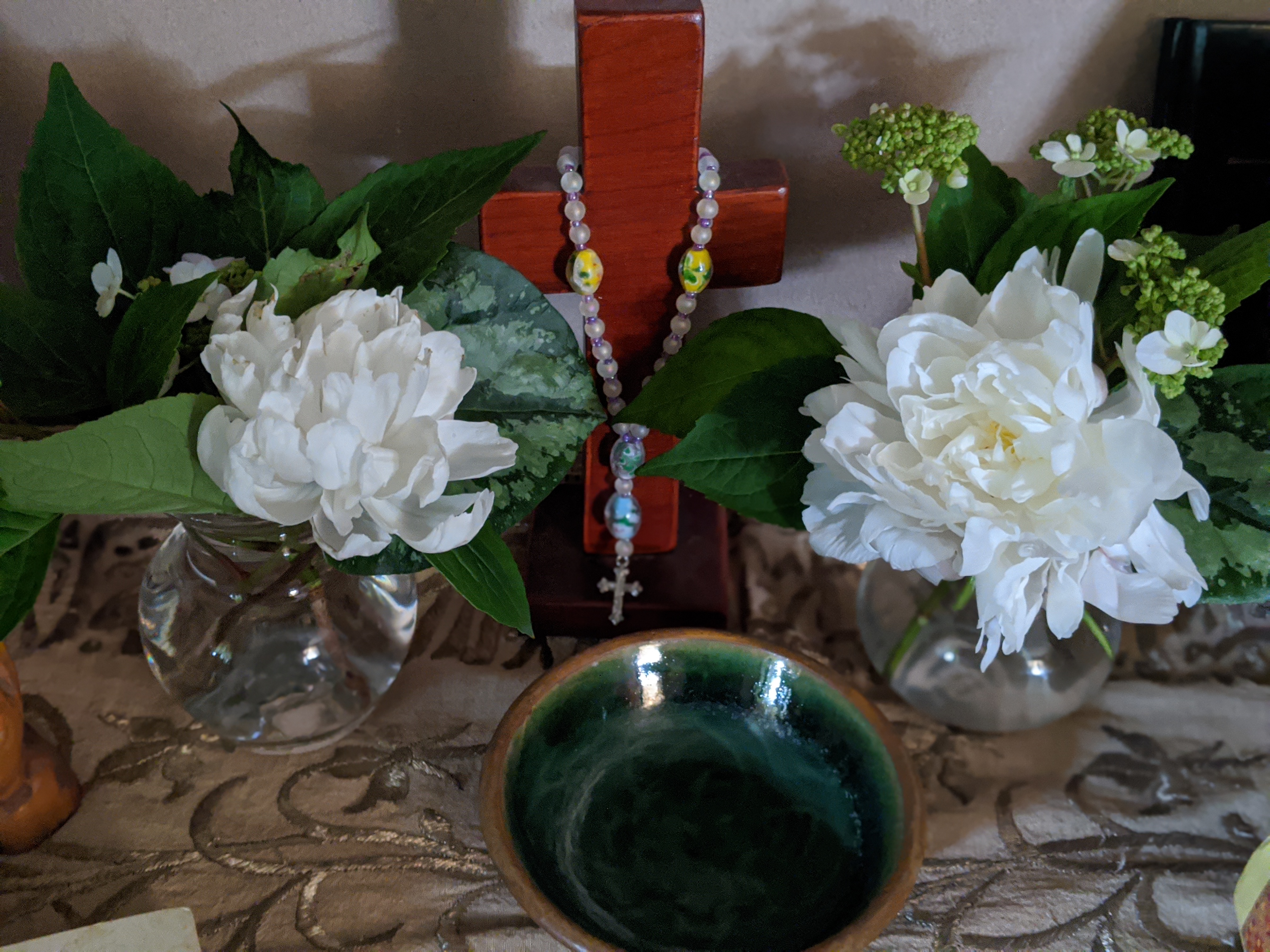
It was only after I woke up that I became aware that the images in my mind were just as much memory as dream.  Gathering flowers from my yard was my Sunday morning routine during the weeks after Easter 2020, when we were all worshiping at home.  Our buildings had been closed during COVID; we still thought the time of the pandemic shut-down would be measured in weeks.  Each week I would fill two small glass vases  from whatever cuttings my garden had to offer up.  Granted, my dreamscape garden was a lot better maintained than my overgrown yard. But there was always something to be found to fill the two small glass vases that would rest on makeshift home altar set up on the cedar chest in my guest room, a calming and fragrant background while I would “Zoom” our Sunday worship and Thursday Compline.  

I never realized there were so many things growing in my yard, to be honest.  I remember being stunned and a little embarrassed that I had not been paying attention to all that was right around me: the beauty of spiderwort, the variegated leaves of ginger or the way a few big magnolia blossoms brought inside in a bowl could open fully and scent the whole house.

I celebrated the first anniversary of my ordination to the priesthood during those late Eastertide days of 2020.  I wrote a blog entry during that time called, “Priesting in Pandemic” which I looked up and read again this week, after I had that dream.  In it, I talked about the joys that I was discovering not only in my yard, but in our virtual worship.  I reflected on the way that online teaching and learning in my secular life had prepared me for something I didn’t realize that I would be doing in my church life.  In that blog post, I said, “Priesting in pandemic reminds me that relationships…with each other, and with God…are what everything else is about.  That’s not new information, but it’s uncluttered for me now.”

I know with my logical brain that during that time of isolation there was also so much anxiety: the unknown risks of health impacts, personal, family and global…the uncertainty of work…challenges of education…mental health impacts we’re still not talking about seriously as we should.  I only half-jokingly talk about those many months for me as my “workdemic” where my commute was between the laptops for three different positions all of which demanded the “pandemic pivot” from in person teaching, worship and formation into completely virtual spaces.  That time of pandemic shut-down sometimes feels like a dream now, but all of that was very real.  

Another very real thing for many of us here during the shut down was a life of prayer and care, both in virtual community and privately.  I read the verse we hear in today’s Epistle over and over again, “cast all your anxiety upon God who cares for you.”  There was, for good reason, a lot of anxiety. And in it, we prayed for and with each other.  I still have cards, notes and check-in emails.  We prayed for and took care of each other, even when we couldn’t see one other.  While weeks stretched on before vaccines and dropping transmission rates, there was nothing to have but faith in the midst of fear.  

Every Sunday morning as I refreshed my flowers, I would remember that even if my world was as small as my yard for now, it was virtually expansive.  Relationships still mattered.  We had to believe in what we could not see, touch or experience with our senses in the way we’d grown used to doing.  And somehow, that weekly ritual of flower picking gave me the touch-point that I needed to tangibly remind me of God’s presence and care in all of this.  Even when I thought I wouldn’t find anything, those vases would come inside to my home altar filled with once-hidden beauty.

In today’s Gospel lesson we find ourselves standing with the disciples towards the end of John’s Gospel’s account of the “farewell discourse” of Jesus, where he had been preparing his followers for his betrayal, crucifixion, death, resurrection and as we celebrate today, his ascension.  I know we are only reading a portion of the Gospel in today’s lectionary but let me give you this spoiler alert: the disciples were not immediately calm in the face of this news they were receiving.  They were, in fact, quite anxious about what Jesus was saying.  They were trying to wrap their minds around it, to figure out the timeline, to get some concrete and tactile reassurance.  It’s easy to stand in solidarity with them.  We’re very familiar with the grief, pain,  injustice, confusion and anxiety of the world in which we live.  With good reason, we often pray during our intercessions for ourselves and others to escape from it.

But Jesus’ intercession, in unity with the Father, gives us more than escape from the changes and chances of this world.  Jesus prays: “Holy Father, protect them in your name that you have given me, so that they may be one, as we are one.”

Jesus’ prayer for us was and is that through the love of God in Jesus Christ, we will be protected by being one with each other.

The prayer Jesus offers for his followers…then and now… isn’t our escape or removal from this world, nor is it our “rising above” or outshining one another.  It isn’t about special privileges or even earning our way to advantage.  Jesus’ prayer for us is that we may be one, even as Jesus and the Father are one.

Experiencing the at-one-ness of being the Body of Christ means that we share one another’s joys as well as grief; that when one of us is hurt we all wrap around them with healing, and when one is healed, we all experience joy and give thanks.  This prayer Jesus offers is the exact opposite of opportunistic consumerism and rugged individualism that demands we pull ourselves up by our own bootstraps and ignore the needs of our neighbors.  It reminds us of the words that reformers like Fannie Lou Hamer, Martin Luther King, Jr.,  and Emma Lazarus have repeated: none of us are free until all of us are free.  In Jesus’ prayer for us, we get a glimpse of God’s vision for us. And what we see is that the presence of God is made known to us through one another.

Through that dream, my mind became uncluttered again.  I was taken back to a singular moment: those walks in my yard, collecting the hidden gifts of creation from a loving Creator who formed the world and called it “good.”  In those uncluttered moments, it was clear to me that I wasn’t in isolation all by myself; I was a part of a larger community who worshiped together, prayed together, and took care of each other.  And as we lived faithfully into being one, we felt protected through Christ who made us one.  I still feel it, and I hope that you do as well.  It is the gift of Christ’s Ascension, the gift of Jesus’ prayer for all of his followers of that generation and all the generations to come.  Sometimes, we get too caught up in doing all the things to stop and feel the presence of that gift.  But like the blooms and leaves that would appear week after week when I stopped to notice, slowing down to welcome God’s presence reveals the gifts that are already present with us in the faces of our friends, neighbors and even holy strangers.  

Jesus’ invitation to us remains: be present.  So, as we come to this table where we are made one body and one holy people we remember not only Christ’s death and resurrection, but also Christ’s Ascension, the prayer of at-one-ness with each other and the reminder that Jesus Christ is always being revealed in more ways than we can see when we’re moving quickly through our lives.  So, in this time where we remember Christ’s Ascension I invite you to pause and pray and allow your eyes to be opened to the wonders revealed in each other, in this community, and in the hidden gifts which continue to be revealed as we walk, and pray and love one another.

Risen and ascended Christ, you surround us with witnesses and send us your Holy Spirit who opens our minds to understand your teaching. Bless us with such grace that our lives may become a blessing for the world now, and in the age to come. Amen.

Vases with home altar flowers, May 2020

Posted in sermons | Tagged , , , , , , , | Leave a comment

Salt and Light

Homily for the Fifth Sunday after the Epiphany, Year A

St. Mary’s Episcopal Church, Colonial Beach Virginia

Lectionary Texts:

You are the salt of the earth.

I was raised in a rural area of upstate New York. Growing up, I regularly heard my parents and other adults referring to dependable, hard-working friends and neighbors as “salt of the earth” people.  I really had no idea what that meant but it sounded boring. Salt was something I kind of took for granted.  It poured out of a big, blue paper covered canister that never seemed to get empty to matter how much we used it.  We’d bring it out for baking, and I’d pull out the little spout and fill a quarter, half or even whole teaspoon.  Then, it would return to its cupboard perch.  We used the most salt in the summer, when we were canning vegetables from the garden.  The crystals changed the water and allowed higher heat to be used without getting the vegetables soggy. The jars of green beans, beets and tomatoes preserved a taste of summer into the cold days of winter.  When I had a sore throat, inevitably that paper salt cylinder would come down from the cupboard and my Mom would mix up some briney solution that I needed to gargle with. I was not a fan, but often, it worked some wonder that seemed like magic.  That’s a lot of uses for some tiny little crystals: flavoring, strengthening, preserving, healing.

You are the salt of the earth

Over the years, I’ve learned to deeply appreciate the salt of the earth people who cared for me: spicing up my blandness; preserving and strengthening qualities in me that could make a contribution; adding to my wholeness and healing. My salt appreciation has expanded, too. My cupboard now has some flaky, Japanese sea salt; some smoked salt crystals, and herby Virginia blend called, ‘Peg Salt” that I got a taste of once at a farmer’s market have continued to order and use ever since in a wide variety of dishes.  I love to cook and, for those of you who do as well, I recommend Samin Nosrat’s “Salt, Fat, Acid, Heat” which has both a cookbook and a Netflix series. I watched the “Salt” episode again this week…we’ll call the “exegesis”…and I was fascinated to learn that in Japan alone there are over 4,000 varieties of salt available for consumption. I was also reminded that all salt ultimately comes from water, whether hard pressed under the earth from ancient seabeds, or extracted from seaweed drying in the sun until crystals emerge. Salt brings flavor; salt preserves; salt makes us yearn for more water and in doing so, helps keep our bodies in metabolic balance.

So, I take back my childish presumptions: being the “salt of the earth” is anything but boring!

In today’s Gospel lesson, Jesus is talking to some salt-of-the-earth folks who are gathered around him.  These are people who are doing all the right things: the actions of piety, of kindness, of prayer and fasting.  They are good, solid salt-of-the-earth people.  Kind of like those canisters up on a cupboard.  But salt on its own is just…salt.  

Jesus reminds the salt of the earth followers about why their saltiness matters: its action is to bring out the essence of whatever it touches; to preserve vitality; to stimulate others in their thirst for righteousness. These salt of the earth people, when aware of their essence, are also the lights of the world. Illuminated with a source that is beyond themselves, their light magnifies the Light of Christ when raised up and shared, rather than hidden beneath a bushel where light is self-serving and easily extinguished.  

We often hear these messages applied to our individual lives, and that’s true and important. But, to stop there would be like staring at each individual salt crystal.  It’s really about how the nature and essence of salt works collectively. These messages of salt and light are also church messages, Body of Christ messages, which apply to all of us.  To the people of St. Mary’s that connect with the Diocese and the Diocesan staff that visit in your midst; to the Deacons who translate the needs of the world to the people of the church; to the Diocese of Virginia that connects to The Episcopal Church, to The Episcopal Church that is part of the global Anglican communion and joins with other expressions of Christian worship across denominations and ecumenical ministries: all of us are working together to be the salt of the earth, to boldly illuminate  the Light of Christ that dwells in us to a world that so desperately needs it.  We, the Church…the Body of Christ…are to be salt and light, people called to live with their full essence into righteousness, 

Just like we shouldn’t reduce salt to an individual crystal or cover the light of the world with a bushel basket, we are reminded not to reduce our righteousness to piety. Jesus reminds us that exceeding the righteousness of the law means going beyond merely following the rules and rubrics and invites us to be transformed, participating in God’s vision for the world through actions of justice and mercy which deepen our understanding of all of God’s creation, and our relationship with God.

God’s covenant with God’s people has always been a covenant of love. Like salt losing its saltiness, if we lose sight of the divine mercy, justice and love that are the core of our righteousness, we miss the point entirely.  In our reading from Isaiah, the prophet speaks to this, calling out those whose actions of fasting come from practice alone, and not from relational love God lavishes on God’s people: particularly those in need.

The righteousness to which we are called as followers of Christ, as bearers of the Light of Christ into the world is to make Christ’s light and love known through tangible actions that emanate from the core of who we are, and further magnify the light of Christ which burns in us.

We are salt and light when we gather here, at this table.  We join together, nourish our essence and recharge our Christ-light at this Holy Eucharist which we make together.  We share with each other in the holy communion among God’s people, and we are then sent out renewed, to do the work we are called to do.  That’s why the Deacon, the bearer of the light of Christ and proclaimer of the Good News sends us forth each week, fed and renewed, nurtured through relationship with God into righteousness, to be salt and light for the world.  May others see the Light of Christ in us, and may our saltiness make them yearn for the Living Water.

St. Augustine is said to have offered the gifts of the Holy Eucharist to the people with the words, “Behold what you are, become what you receive.” Our Eastern Orthodox siblings sometimes present the gifts to the people with a similar phrase, one I’ve incorporated into use as well: “Holy things for holy people” to remind us not only of the act of receiving, but the source of transformation of all of us as the elements of God’s work in the world. It’s important for us to not only be nourished as individuals and remember the salt and light that we are, but to be nourished and strengthened as community, to do the work together that we are called to do in this world.

I am grateful to be with you today to share this Holy Eucharist, to be fed together with you, to be sent out with you, to go forth into our lives remembering who we are, and reflecting the light of Christ, whose we are.  We all get to be stronger now, because we are strengthened by this connection we’ve made with each other.

Be salty salt; be radiant light.  And may the righteousness of Jesus Christ who makes us one nourish, sustain and transform you this day and all the days to come.

Posted in sermons | Tagged , , , , , , | Leave a comment

Heaven must be a fabulous place

A homily in memoriam of David Patrick Lenz

Gospel Lesson: John 14:106

Heaven must be a fabulous place.

Seriously.  It must be.  I haven’t actually been there, but all the evidence that I have tells me with absolutely certainty that when my day arrives and my friend David greets me…along with so many other of my beloveds…it is going to be an absolutely fabulous, beyond the pale celebration of the power of love and the divine spark of the radiant Holy Spirit. This, I believe, with all of my heart and soul.

Maybe you’re a little skeptical of that statement, and maybe it seems like, if I’m standing up beneath the preacher-crusher wearing this stole and collar, it means I’m supposed to tell you that.  I’m not just saying that because I’m all fancied up in what some of my friends have been known to call “priest drag” although I did choose this particular stole for David, I admit.  I’m not trying to convince you because I’ve been to seminary or because I’ve been a Hospice chaplain or because the ordination conferred upon me has given me some secret knowledge of the specific nature of the afterlife that others don’t have.  None of those are the reasons why I’m here, in this place, preaching this particular aspect of the Good News today. 

I’m just here to offer you some words from my heart.

Heaven must be a fabulous place. I wouldn’t say that unless I believed it was true, from the depths of my heart and my soul.  So let me share, just for a few minutes, what evidence I have of the veracity of that statement:

Here we are, gathered at the most challenging of times in life, and the music my friends has been divine.  This is just the opening act.

Here we are, and we don’t even all know each other, and yet I feel a kinship that transcends our earthly connections.  We are family, children of the same loving parent.

Here we are…beautiful and handsome as we all are…but there is a light that burns in our souls that makes all of that outward glamor pale in comparison.  And if you don’t believe me, close your eyes and picture the sparkle in David’s eyes that was there every single time I spoke with him, no matter how much bodily pain or illness he was going through.  Fabulous, to the core.

Here we are, each one of us holding in our hearts today this companion on life’s journey that we love so much…and I know we are carrying others, too.  Fabulous, amazing people whose lives intersected with our own for a time, beloved lights of this world who gave us the gift of seeing ourselves and each other as brighter and more promising than we ever could see ourselves.  All of those people we love and remember, and David among them, live on in our hearts and our minds and they, too, are a part of the world we cannot yet see and yet we know is alive in us.  Take a minute right now: remember…see them all…the incredible people who walk on the other side of the veil. Picture who you’d most want David to meet.  There you go…I see you smiling! 

Heaven, my friends, must be a fabulous place.  Even more fabulous now, with David in the midst.

This is the same message Jesus was telling his disciples in the Gospel passage that we read. Jesus was speaking from his heart, too, from all the evidence that he had about the place where he was going, and where he would be preparing the greatest, most fabulous welcome imaginable for the friends whom he loved.  This passage from the Gospel offers words of comfort from Jesus to his friends, as Jesus was preparing for his own death and the end of his human life.  What he chooses to tell his friends to prepare them is this, “Don’t let your hearts be troubled…where I’m going there’s plenty of room for y’all…I wouldn’t tell you this if it weren’t really true…I’ll get things ready and then come and invite you when it’s time, so that where I am you can be, too.  And you already know the way!” 

His friend, Thomas, was a bit of a skeptic, too.  And he didn’t know the way, and he didn’t want to get lost. He wanted to know he would see his friend. So he asked Jesus, “how can we know the way?”  And Jesus looked at his friend Thomas and said to him, “I am the way, and the truth and the life.  All anyone needs to do is know me, and in that knowledge they will find the way.”

I know that last part sounds different than it did when you heard it earlier. People in their fear have corrupted the beauty of Jesus’ words of reassurance to his friends.  I spent half my life being force-fed the “no one comes except” part by hurt people, who get caught in a spiral of hurting other people.  Maybe some of you have been caught in that web, too. But that “no one comes except” translation isn’t the emphasis in the original Greek, and I don’t believe that is the meaning and the good news of this passage.  When you study the sources, and pull back the layers, what you hear is Jesus saying, in complete reassurance and loving response to his friend’s worried question, “don’t worry: it’s through me that everyone comes…no one is lost.”

No one is lost. Everyone is welcome.

My faith, and all the evidence of my heart tell me, David is now part of the preparations crew and the willing chair of the hospitality committee for all the rest of us.  Welcome.  There’s a place for you, and you, and you and you and all y’all.  And that is all the evidence I need to be completely convinced that heaven is going to be a fabulous place.

Don’t let your hearts be troubled, friends.  And don’t think it’s crazy to believe the longing in your heart that wants to believe.  That spark is put there for a reason, as a reminder, as an ember of yearning that reminds us of our belovedness by God, that helps us to feel our connection as family, that fuels our remembrance and celebration of the bright lights of this world who live on in our souls as beacons to show the way to where we, too, are  invited and welcomed in love..

There is one more thing I know for certain: this belovedness of God is something David also knew, treasured in his heart, and celebrated every single time he engaged with this community whether in person or via Zoom.  And he will always be a part of this place.  A part of us.

So, sing when you remember David singing.  Love when you remember David’s love.  Pray when you are grateful for his presence in your life and this community.  And know that all of these things are drawing us towards each other, and helping us see and know God more fully. Jesus is the way of love, the truth of our belovedness, and the life everlasting.

And get ready to laugh and sing, friends.  Because heaven is going to be a fabulous place.

Posted in sermons | Leave a comment

Darkness AND Light

Homily for the Third Sunday after the Epiphany, Year A

St. Mark’s Episcopal Church, Richmond VA

Lectionary Texts:

“The people who have walked in the darkness have seen a great light.”

A few years ago, I was given a copy of Barbara Brown Taylor’s book Learning to Walk in the Dark. I wasn’t too far into the text when her descriptive metaphors of light and dark playing out in our spiritual lives stirred up a vivid childhood memory for me. I was probably 7 or 8 and staying the night with my Gramma and Aunt at the family farm.  It was a moonlit night, and my Aunt invited me to follow her outside; we walked down the steps and across the front lawn, crossed the dirt and gravel driveway, and headed through the shadows into the larger side yard where she had a flower garden.  She motioned for me to come around the back corner of the garden, by the barn which looked rather spooky at night.  I was a little bit scared but as I walked, my eyes adjusted and the scene began to be familiar.  Then, much to my surprise, I saw a bush that had been a green, leafy vine all day suddenly filled with beautiful, round white flowers that had unfurled in the night.  That first encounter with moonflowers made me a lifelong fan. I even snuck out to try to find them on my own several times after that.

I’ve come to learn that there are many things that emerge during the darkness, once we learn to see them. The stars come into view in what at first seems like a dark sky, sometimes layers upon layers of them; as my vision acclimates, I might notice the rabbit family by the back fence, or the squirrels nesting in a tree; I can infer the position of the moon in the sky by what is illuminated and what is in shadow.  Walking in the darkness begins to feel quiet and peaceful, even when at first, we’re afraid.

In Barbara Brown Taylor’s book, we’re invited to confront some of the fears and social value judgements we’ve been taught about the dark, breaking down the “dark is bad/light is good” dichotomy and all of the layers of complexity and unconscious bias that can accompany that polarization. She invites us to sit in the darkness, to let our fears and misconceptions come into full view and then invites us to move more deeply into the spaces of darkness that are holy and essential for our growth.  Seeds germinate in the dark.  The cycles of darkness and light mark the days, and the seasons.  The earth rotates with regularity so that the sun’s light is not perpetually on one side or the other, but balanced in the rotation of day and night that provides time to work and time to rest. The dark is essential to our growth. The deliberateness with which we learn to walk in the dark is essential to our own journey of learning to trust not only what seems obvious to us in the light, but also what we can only sense and observe when we have walked in the dark.

I also want to acknowledge that many of us may feel like we’re walking in the dark today. We’re grieving some beloved members of this community. We woke to news of another senseless mass shooting. The darkness we may be experiencing is a real part of life, not just a metaphor. I see you, and invite you to come into this exploration of darkness and light just as you are.

In today’s Gospel passage, the darkness in which Jesus has been walking is hinted at in the first verse of the portion we read.  If we would have started reading at the beginning of Chapter 4 instead of verse 12, we would have heard the story-between-the-stories from Matthew’s Gospel: Jesus is Baptized by John; Jesus is immediately led by the Spirit into the wilderness where he is tempted by Satan for 40 days…and waited on by angels; Jesus returns from this wilderness vision quest to learn that John has been imprisoned, which we know under Roman occupation was at great risk and in response to John’s public proclamation of the coming of the Messiah. I imagine that Jesus immediately saw and heard the fear in those around him.

In response, Jesus withdraws to Galilee. As he had learned to trust during his time in the wilderness, he now walked in trust into his ministry, one step in the dark at a time.  We’re told that he follows the course which has been laid out for him through the great prophet, Isaiah, and makes his home in Capernaum by the Sea.  From that time, Jesus took up the ministry of John, following the same words, “Repent, for the kingdom of heaven has come near.”

The Jewish readers of Matthew’s Gospel would have recognized the words of the prophet Isaiah. And those who had followed John in the wilderness would have known John’s wilderness cry.  John had been exiled to prison; Jesus had been tempted in the desert; the marginalized Jewish people of Roman-occupied Galilee were not able to see what was next.  But Jesus reminded them, the people who sat in darkness began to see a great light.

I admit, I went on a bit of an exegetical tangent this week, spending time with the Hebrew and the Greek in an effort to understand why the Gospel text we have says, “sit” while the passage from Isaiah said, “walk.” I won’t take us too far down that road, but what my conclusion was is that there is an action orientation implied that this use of “sit” is a precursor to “walk.” Sitting in the darkness holds the potential to walk, and to follow.

I invite you to consider today’s passages about light and darkness not like a sudden blaze of glory, or as one canceling out the other but as the both/and of divine presence.  The radiant Light of Christ which the people saw in Jesus was sourced from God who was and is also present in darkness, not in spite of it. We aren’t abandoned by God when we are walking through the dark places of our lives or of this world. Like the moonflowers of my childhood, the wonder of God’s presence is often the most noticeable from the dark places of our lives, as our eyes open to see the wonder of God around us.

The Gospel lessons in the Sundays after the Epiphany help us see the Light of Christ which Jesus has been emboldened to carry into his ministry. We see it in his Baptism; through navigating the wilderness of temptation to collude with structures of power; through returning home to visible oppression and jarring grief knowing one’s companion in ministry has been imprisoned for merely being who they were. This Light of Christ was an illuminating beacon, one that perhaps had been charged and intensified in the wilderness.  The Light offered direction, and revealed a depth and dimension of this world that those sitting and walking in the darkness began to see as their eyes attuned to it. The divine, radiant Light now dwelling with them helped open their eyes to behold the wonder that was opening all around them.

I think this Light of Christ is what caught the attention of Simon Peter and Andrew, casting nets on shore and James and John, mending their nets on a fishing boat. We get caught up imagining the immediacy of their leaving and following so surprisingly and unconditionally. This story and all its images of light AND darkness makes me wonder whether the soon-to-be-disciples had already been attuning to the light of God’s presence in their lives, seeing more clearly with the eyes of their hearts, walking their faith step by step as they went about the tasks of their lives. As people who fished for a living, they also had become adept at responding when the time was right.  Body, mind and spirit aligned on the shores of Galilee; the radiant Light of Christ was revealed in the ordinary activities of their lives and filled them with new possibility; and like the glory that shone in the star of Bethlehem and at the Baptism of Jesus, they saw the wonder with their own eyes and were compelled to follow.

Of course, we can’t know exactly what was happening in the inner lives of the disciples leading up to that call. We can catch glimpses, though, and these glimpses of the divine help paint a story not only of the disciples who followed Jesus, but of the ways in which Jesus himself carried the Light of Christ as his own light, having been named and claimed as God’s own in Baptism and following the leading of the Holy Spirit. Jesus’ ministry emerged from that holy naming and claiming of his heavenly identity AND the call upon his human life.

In this narrative of Jesus’ first immersion into a life of ministry, even if much cannot be seen, we can be assured that God was and is present in the person and ministry of Jesus…through every bright and shining moment, and through the wilderness and the darkness, too. In our lives of faith, we are assured that the Light of Christ and the Love of God and the power of the Holy Spirit are present for us, too.  That’s true in the darkness, and true in the light.

When we are grieving for the people we love, God is present with us.  When we are frustrated by the systems of power and oppression that leave groups of people marginalized, God is present at those very margins illuminating the spark of the divine that rests in each and every person, regardless.  When we walk the shores of our lives alone, God is present showing us those who are also on the journey whose gifts and strengths can be for us exactly what we need.  When we face the realities of our lives and labors which are daunting and in need of repair, God is present and showing us the net-menders who can help us heal. Throughout our lives, the Light of Christ shines and gives us deeper, clearer vision for ministry. We need to take time: to remember who we are, and whose we are.  And in that remembering, the clarity of what we know in our lives of faith and the Good News of Jesus Christ illumines our path and helps us see what once was hidden. The Light of Christ dwells with us and in us, and in all those whom we encounter.

As Barbara Brown Taylor offers up in her book, “remembering takes time, like straightening a bent leg and waiting for the feeling to return.  This cannot be rushed, no matter how badly you want to get where you are going.  Step 1 of learning to walk in the dark is to give up running the show.  Next you sign the waiver that allows you to bump into some things that may frighten you at first. Finally, you ask darkness to teach you what you need to know.” (p. 15).

I’ve never heard a more truthful depiction of ministry into the corners of the world (and of ourselves) most in need of the Light of Christ.  As we continue our biblical foray into the lives of Simon Peter, Andrew, James, John and the other disciples throughout the liturgical year, we hear the desire to rush, to try to control things, the many times of bumping into themselves or others and being frightened of what they see or might encounter in the days to come.  And we continue to hear Jesus, the Light of Christ, reminding them that everywhere they turn there are lessons and things to see right where they are: at tables others don’t want to eat at, in people deemed unclean, by crossing into places other people have rejected as less worthy, by taking on roles of servant and learning that the poor will see God and the meek will inherit the earth.  It wasn’t what they had seen before; like us, they were still learning to walk in trust. And yet, in the Light of Christ people are healed; systems are broken down and remade; the Good News is shared, and love prevails. Love that is stronger, even than death. Those lessons cannot be rushed: they come through trust, through our step by step walk through life; through learning to see with new eyes as the Light of Christ illuminates it for us. 

Jesus, our Light:  Give us grace to see the wonder of your presence as we step faithfully to do the work that you have called us to do.


Posted in sermons | Tagged , , , , , , , , | Leave a comment