Lessons We Keep Learning

Homily for Proper 7, Year A

Grace and Holy Trinity Episcopal Church

Lectionary Texts:

Jeremiah 20:7-13

Psalm 69: 8-11, (12-17), 18-20

Romans 6:1b-11

Matthew 10:24-39

[Contextual Note: Grace and Holy Trinity was the parish that I served in seminary; they are part of my own formation. Many people hearing this know that I was a practicing social worker for many years, who became a Professor of Social Work and during that time, I was called to the priesthood and went to seminary as part of my own vocational formation for ministry. Four years later, I now serve as the Vocations Minister for the Episcopal Diocese of Virginia.]

When I was in social work graduate school, every social worker in training had to take two classes in our first semester.  The first one was a course on Family Systems Theory, where we delved into an understanding of the ways that not only individuals but also families tend to relate to each other: the way we form relationships, deal with conflict, and create functional…and sometimes dysfunctional…ways of coping with the challenges of life.  At the same time, we had to take a course called the “Therapist’s Own Family” (you’ll note, it’s abbreviation TOF is best pronounced, “TOUGH”) in which all those erudite things we learned in the theory course got applied to our own family systems.  Yikes.  The word around campus when I started the program was that one had to do a tremendous amount of studying to get an “A” in the theory course, and one had to break down sobbing to get an A in the other.  I can verify both of those things were true!

I learned a few really important things from that experience, though.  First, it made me realize that learning about something is not the same as applying those lessons to oneself.  It’s very easy to keep knowledge at a head level: intellectualizing the challenges of family life, in this case.  It’s another thing to apply that knowledge at a heart level.  I had to go to class every week and speak out loud about things that I didn’t want to speak about.  And at the same time, I learned to listen with empathy and compassion to my class colleagues doing exactly the same thing. Through that process, I learned that I was not better or worse than anyone else.  We were different: each of our families had challenges, and each of our families had resilience.  We all learned that there were secrets that our families wanted to keep hidden: that the family system protects itself by not letting anyone else see or know the challenges, especially where there is stigma or shame around particular experiences.  My mind wrapped around the why and how in theory class.  But in TOF class, the lessons became real: it was like shining a light into all the shadowy places of my own heart.  In doing so, I learned compassion for myself and for others which gave me the tools I needed to do the work of social work I’d been called to do.

Our Gospel lesson today drops us into the middle of Jesus’ mentoring of his disciples to do the work he had called them to do: not just theoretically but with real implications.  Keep in mind that the word “disciple” means “learner” and some lessons are tough.  Jesus was preparing his disciples as learners sent to do God’s work in the world and to see people as God sees them: “nothing is covered up that will not be uncovered, and nothing secret that will not become known.”  He keeps right on going with this tough-teaching to his disciples: “don’t be afraid” he tells them, even when their own safety and well-being seem to be on the line: the ultimate value is one’s soul to God, not playing it safe in this life.  

The disciples were not being called to easy work.  No.  They were being called to get their hands dirty, to get their hearts involved, and to see themselves as no greater than or lesser than anyone else.  Jesus was giving them some lessons in tough love.  

This Gospel is giving us some tough love, too, especially in this final portion.  When our lessons are challenging, we need to sit with them.  So, this week, I’ve been sitting with these jarring words and I’d like to offer up a few lessons that have emerged for me.  

First: peace isn’t always what we think it is.  It’s easy for us to confuse the comfort of the familiar with the true peace that emanates from God. Like the disciples, we can let the familiar become an escape from our fears.  We keep secrets; we don’t rock the boat; we keep everything calm and under control even when we see the world hurting and broken. We can be tempted to smooth things over so things look smooth and perfect.  But we aren’t asked to attain perfection before we follow Christ. We aren’t better than or worse than anyone else.  We are ourselves. We are asked to bring our strengths and our challenges; our shame and our resilience. And in this journey of discipleship, we too will be broken open.

I go back to the lesson of my first semester of social work graduate school: you can’t learn to do the healing work, without first recognizing your own need for healing. Or, to put it into theological language: in order to do the kingdom work of helping to heal the brokenness we see in this world, we need to make room for the healing Grace of God in our own lives.

These words of Jesus, “I have come not to bring peace, but a sword” are jarring.  And maybe that’s the point.  Maybe the jarring nature of Jesus’ love and grace are what shakes us out of our perfection paralysis and shame-induced status quo, and reveals wounds in need of healing.  Maybe the superficial peace of the ways things always have been gets in the way of the healing work that still needs to happen.  That’s true beyond our own selves and families, too. Our silence in the face of the injustice and hurt we see inflicted on others in this world keeps us from acting in the very ways that discipleship demands of us.  It reminds me of a famous quote from Bishop Desmond Tutu:

“If you are neutral in situations of injustice, you have chosen the side of the oppressor.”  -Desmond Tutu

This opens us up to the next lesson: the hard work of discipleship always starts with our own hearts first. Are there areas of discipleship that we’ve closed ourselves off to?  What are the fears that keep us paralyzed from standing up for the kind of justice, compassion and mercy that Jesus demonstrates in his miracles of healing and his profound compassion for those at the social margins of this world?  What makes it so hard for us to speak up about the good news? 

The Good News, friends, is that these questions we struggle with today are the same lessons that Jesus is holding out to his disciples for their learning.  They are lessons for the church, which is why we worship, we confess, we pray and we support and encourage each other to do the work that we are called to do, even when it is hard.

A third lesson: we are all disciples; that means that we are all learners.  My learning as a social worker never stopped after those classes. And my learning as a priest didn’t stop with seminary: it continues, too. Our Epistle lesson caught my attention this week, speaking of being united with Christ in Baptism, in death and in resurrection. It took me to one of the prayers in our prayer book that has most impacted me: the Prayer of Commendation prayed when ministering to someone at the time of death, or as part of the funeral liturgy: Acknowledge, we humbly beseech you, a sheep of your own fold, a lamb of your own flock, a sinner of your own redeeming.  

The first time I offered that prayer, I was sitting with my Dad during his final hours.  I was and I still am profoundly aware that the prayer applies not only to the person with whom I am pastoring; it also applies to me.  It applies to each and every one of you, too. The power of that prayer isn’t just for the benefit of the dying and bereaved: that prayer breaks us open and links us to our Baptism.  It serves to remind us at all times that even at our most vulnerable state we are loved, we are known, we are welcomed by our Good Shepherd, and we are…all of us…redeemed and transformed by that love.  

That brings me to the final lesson I’d like to share with you today: praying…truly and honestly praying…is not a passive act.  It is an act of vulnerability and an act of healing. That’s because prayer isn’t only for the recipients…prayer changes us. Through that Prayer of Commendation I am reminded…not just in my mind but in my heart…that all the beloved sheep of God’s fold are held in that same transforming and redemptive love.  Yes, those who are beloved to us.  But also, the people we don’t like very much, that we don’t agree with, that have harmed us, that we ourselves have harmed through our action, or our inaction.  It applies inwardly, too…God sees even the most hidden places of our lives where we’d rather not have a light shine, thank you very much. And God loves us.  We are the sheep of God’s fold, lambs of the flock of the Good Shepherd, sinners who have been redeemed by grace.

Prayer pierces our hearts with vulnerability. Through prayer, we come to know that we are loved, broken open, transformed a little more every time we pray so that we can truly live into the vision of discipleship that Jesus holds out not just to the named apostles in today’s lesson, but also to all of us.  Discipleship is our lesson to be learned.  Relationship is God’s desire for us.  The Sword of the Spirit which is the Word of God cuts through the complacency so that we, and the world around us, can be transformed and made new.  And our prayers open a space for God to speak, and move and transform us. We aren’t meant to stay the same.  We are meant to change, to learn, to heal…and in doing so, to heal others and this world in which we live.

Posted in sermons | Tagged , , , , , , | Leave a comment

Laughing in Solidarity

Homily for Proper 6, Year A

St. John’s Episcopal Church, Richmond VA

Lectionary Texts:

Genesis 18:1-15, (21:1-7)
Psalm 116:1, 10-17
Romans 5:1-8
Matthew 9:35-10:8(9-23)

I come from a family of people who laugh.  I wasn’t necessarily raised to have a stiff upper lip, nor was I encouraged to let my feelings spill out freely for all to see.  But I was taught in word and example that there was nothing that could happen in this lifetime that could separate us from the love of God, and there was nothing that couldn’t be made more bearable through laughter.

We are that family who tells jokes at funerals. Tears of sorrow often mingle with tears of laughter. I have a bittersweet but beautiful memory of my Dad finding enough strength during his final hours of life to whisper a joke, a rhyming “punny” Dad joke at that.  These times of laughter aren’t ways to escape the hard realities of life.  From these moments, I’ve learned that laughter can be a doorway that helps us welcome unexpected joy in the midst of encountering the sobering realities of life. 

So, as you can imagine, the story of Sarah, Abraham and three messengers of God resonates with me in ways both human and holy.  My parents chose my namesake well. I can actually imagine myself in solidarity with Sarah listening in to this conversation, hearing repeated a prophecy which my heart still wants to believe while my mind and body wrestle with the unshakable realities of aging.  Sarah could have been angry, bitter, hopeless or despondent.  Instead, she hears spoken once again the promise God has made: not only to Abraham, but to HER.  I can imagine that she rolled those words over and over in her mind hundreds of times over the years.  Even when she lost confidence in herself and made short-sighted choices to control the situation.  God didn’t abandon her.  But standing there in her tent, listening in to this conversation she heard that prophecy again and, our story tells us, she laughed at the core of herself.

I’ve been imagining this story and thinking about Sarah’s laughter all week.  It feels like grief marinated in hope, the kind of hope that cannot be spoken out loud for fear of ridicule.  It feels like the kind of dream that we only dare to dream of in solitude, when no one will accuse us of being too naïve, too out-of-touch, too self-centered. I think it is revealing that the words we are told that she said as she laughed to herself were, “After I have grown old, and my husband is old, shall I have pleasure?” and to know that Hebrew word for “pleasure” implies a luxury and a delight.  Sarah wrestled with her worthiness  and capacity to bear God’s promise.  And yet, there was a space of hope in Sarah’s soul that never dissipated.  And I imagine that her laughter was as much filled with the possibility of delight as it was with doubt.  If God saw Abraham’s seed of faith and reckoned it to him as righteousness, God heard Sarah’s laughter and honored it as an ember of hope that would soon ignite into holy delight.

This story of God’s steadfast providence through the harsh realities of our lives repeats over and over again through our Holy Scriptures.  We humans don’t always get it right.  We try to figure out how to manipulate the situations of our lives to get to that thing that we believe God wants for us, rather than opening ourselves vulnerably to the unfolding of our journey with God wherever it may lead.  We become disappointed and disillusioned, and we can begin to doubt whether God is present with us on the journey at all.  And out of nowhere, God shows up for us in the faces of strangers and we find ourselves entertaining messengers of God’s redemptive love even when we least expect it.  It might make us laugh, like Sarah.  It might give us hope even in the midst of our sufferings as we hear in today’s lesson from the Epistle to the Romans, “knowing that suffering produces endurance, and endurance produces character, and character produces hope, and hope does not disappoint us, because God’s love has been poured into our hearts through the Holy Spirit that has been given to us.”

At all times and in all places, God is showing up to us in ways that are bewildering, ridiculous and unexpected.  And sometimes we ourselves are the agents of God’s gifts and messengers of unexpected delight.

Let me repeat that so we can open our hearts to really hear it:

Sometimes we ourselves are the agents of God’s gifts and messengers of unexpected delight. 

Maybe that statement makes you laugh, like Sarah.  It often feels like we are burdened by the needs of the world; we have enormous amounts of work to do and the needs and concerns of the world in which we live overwhelm us.  And that may be true.  But what if God is asking us to show up and be present to the lives that we lead and the people that we encounter exactly as we are? What if God is working through not only our gifts, but also our struggles and confusions to be present to others in this world, through our own willingness to be agents of God’s mercy, love and grace in a hurting world. 

The disciples in today’s Gospel lesson didn’t accomplish the miracles of curing the sick, raising the dead, cleansing the lepers, and casting out demons on their own merits, strengths or authority.  They went out to the people of God to whom they were sent and were charged with sharing the Good News with them: “the kingdom of heaven has come near.”  The disciples offered faithfully the message and reminder of God’s steadfast promise. All that healing flowed from God’s redemptive and transforming love, not their personal merits.  And I am positive that in the alleviation of pain, suffering and death there was also laughter and a great giving of thanks and returning to hope.

Sarah’s laughter was a human response to the surprising and overwhelming nature of God’s steadfast love, even when it seemed all hope was gone.  This is holy laughter, not bitterness.  She is invited by the messengers to own her laughter, but she once again becomes afraid.  She tries to deny it; but they note to her that she did indeed laugh. 

God sees us. 

God notices us. 

God loves us.

Exactly as we are.

I’ve read a few commentaries suggesting that Sarah was being chastised for her laughter.  But I think that interpretation emphasizes our fears, not God’s abundant love.  What this lesson goes on to tell us is, “The Lord dealt with Sarah as he had said, and the Lord did for Sarah as he had promised” and we know the rest of that story: Isaac is born to Sarah and Abraham, and the lineage of the chosen and beloved people of God continued.  And Sarah responded with her faith renewed and her delight evident, “God has brought laughter for me; everyone who hears will laugh with me.”

This week, I have held this image of Sarah’s laughter and pondered the ways in which it demonstrates a sort of holy defiance to the limitations placed on us in this world, whether by age or gender or any other defining characteristic of our humanness.  As I affirm my solidarity with my sisters who are ordained in the Baptist tradition who are standing in the strength of their call against the voices that seek to diminish their worth or question the veracity of their ministry; as we celebrate Juneteenth with joy and choose to be in community and elevate the liberation of formerly enslaved African Americans over the tyranny of the institution of slavery and oppression; as we celebrate pride and joyfully embrace the knowledge that all people are beloved and wonderfully made exactly as we are: we live in the hopefulness of Sarah’s laughter.  We choose to embrace the divine providence of love even while we recognize the pain and grief inflicted by social injustice in this world.  We laugh in defiance of the limitations of the world as we recognize that all things are possible with God.

So, I want to issue us all the challenge of welcoming Sarah’s laughter.  Whether it is the delight of encountering God’s presence in the midst of a hurting world; whether it is the joy of liberation as we join together across parishes in solidarity on Juneteenth; whether it is our willingness to be present as the face of God to a hurting world: we have cause to laugh rather than to despair.  We have reason to hold hope in our hearts: for justice, for healing, for reconciliation of a broken world filled with broken hearts.  God is bigger, stronger, greater and yes even more surprising than we could ever ask or imagine.  So, I invite you to hope boldly, to laugh proudly, and to open yourselves to being the vessels of the good news, sharing the message of God’s liberating, life-giving love for the world with every one we encounter.

Posted in sermons | Tagged , , , , , , , , , , | Leave a comment

Hidden Gifts

Homily for the Seventh Sunday in Easter, Year A 

St. Mark’s Episcopal Church, Richmond VA

Lectionary Texts:

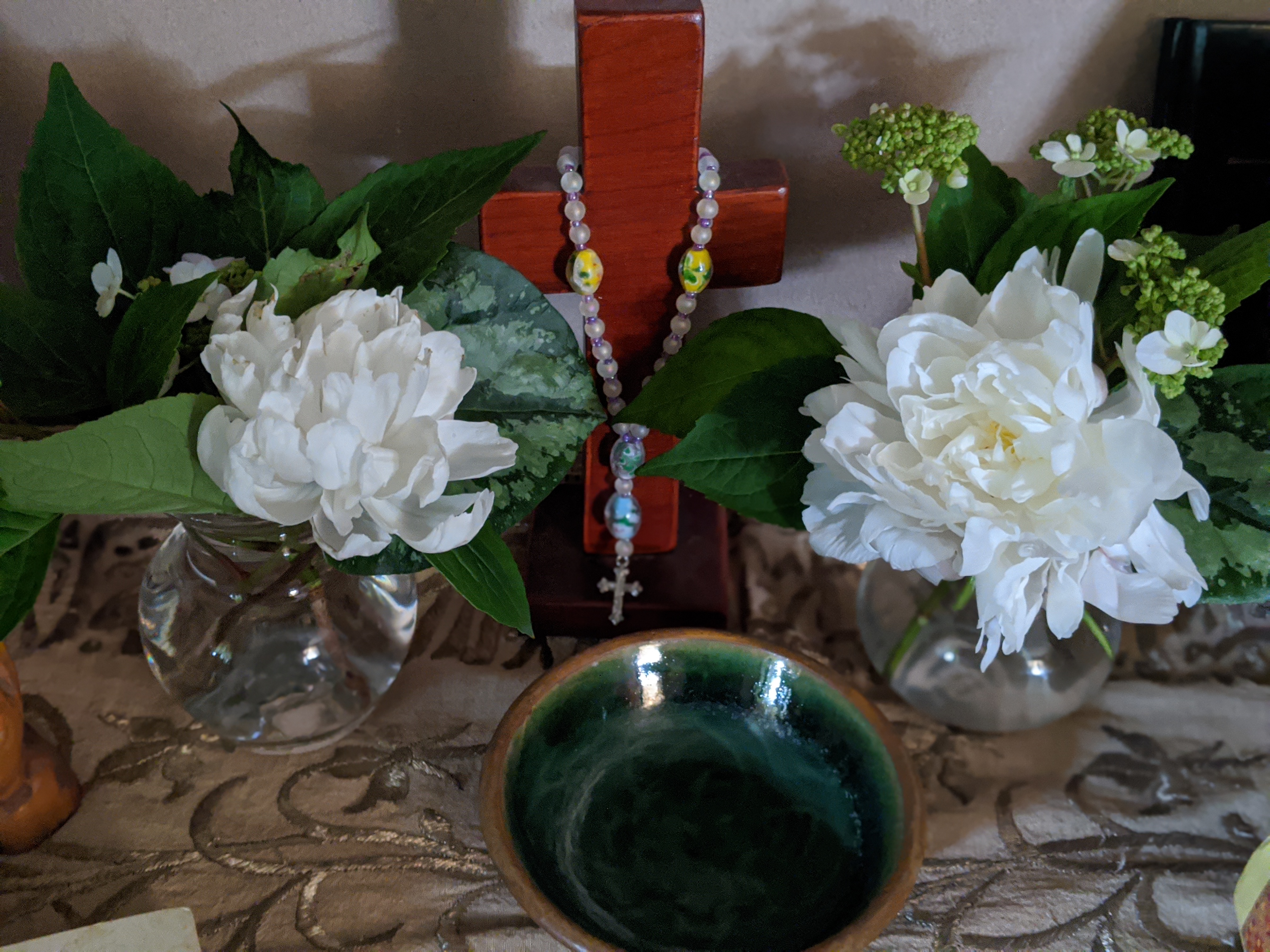
I woke up the other morning from a pretty vivid dream, the kind that lingers for a while. I was walking through a garden wearing a black clergy dress, and picking the flowers that were blooming there.  It was this time of year in my dream…there were peonies, hydrangea, white blossoms from shrubs as filler between the bigger flowers.  I was filling two vases full of the fragrant blooms from this dream garden. 

It was only after I woke up that I became aware that the images in my mind were just as much memory as dream.  Gathering flowers from my yard was my Sunday morning routine during the weeks after Easter 2020, when we were all worshiping at home.  Our buildings had been closed during COVID; we still thought the time of the pandemic shut-down would be measured in weeks.  Each week I would fill two small glass vases  from whatever cuttings my garden had to offer up.  Granted, my dreamscape garden was a lot better maintained than my overgrown yard. But there was always something to be found to fill the two small glass vases that would rest on makeshift home altar set up on the cedar chest in my guest room, a calming and fragrant background while I would “Zoom” our Sunday worship and Thursday Compline.  

I never realized there were so many things growing in my yard, to be honest.  I remember being stunned and a little embarrassed that I had not been paying attention to all that was right around me: the beauty of spiderwort, the variegated leaves of ginger or the way a few big magnolia blossoms brought inside in a bowl could open fully and scent the whole house.

I celebrated the first anniversary of my ordination to the priesthood during those late Eastertide days of 2020.  I wrote a blog entry during that time called, “Priesting in Pandemic” which I looked up and read again this week, after I had that dream.  In it, I talked about the joys that I was discovering not only in my yard, but in our virtual worship.  I reflected on the way that online teaching and learning in my secular life had prepared me for something I didn’t realize that I would be doing in my church life.  In that blog post, I said, “Priesting in pandemic reminds me that relationships…with each other, and with God…are what everything else is about.  That’s not new information, but it’s uncluttered for me now.”

I know with my logical brain that during that time of isolation there was also so much anxiety: the unknown risks of health impacts, personal, family and global…the uncertainty of work…challenges of education…mental health impacts we’re still not talking about seriously as we should.  I only half-jokingly talk about those many months for me as my “workdemic” where my commute was between the laptops for three different positions all of which demanded the “pandemic pivot” from in person teaching, worship and formation into completely virtual spaces.  That time of pandemic shut-down sometimes feels like a dream now, but all of that was very real.  

Another very real thing for many of us here during the shut down was a life of prayer and care, both in virtual community and privately.  I read the verse we hear in today’s Epistle over and over again, “cast all your anxiety upon God who cares for you.”  There was, for good reason, a lot of anxiety. And in it, we prayed for and with each other.  I still have cards, notes and check-in emails.  We prayed for and took care of each other, even when we couldn’t see one other.  While weeks stretched on before vaccines and dropping transmission rates, there was nothing to have but faith in the midst of fear.  

Every Sunday morning as I refreshed my flowers, I would remember that even if my world was as small as my yard for now, it was virtually expansive.  Relationships still mattered.  We had to believe in what we could not see, touch or experience with our senses in the way we’d grown used to doing.  And somehow, that weekly ritual of flower picking gave me the touch-point that I needed to tangibly remind me of God’s presence and care in all of this.  Even when I thought I wouldn’t find anything, those vases would come inside to my home altar filled with once-hidden beauty.

In today’s Gospel lesson we find ourselves standing with the disciples towards the end of John’s Gospel’s account of the “farewell discourse” of Jesus, where he had been preparing his followers for his betrayal, crucifixion, death, resurrection and as we celebrate today, his ascension.  I know we are only reading a portion of the Gospel in today’s lectionary but let me give you this spoiler alert: the disciples were not immediately calm in the face of this news they were receiving.  They were, in fact, quite anxious about what Jesus was saying.  They were trying to wrap their minds around it, to figure out the timeline, to get some concrete and tactile reassurance.  It’s easy to stand in solidarity with them.  We’re very familiar with the grief, pain,  injustice, confusion and anxiety of the world in which we live.  With good reason, we often pray during our intercessions for ourselves and others to escape from it.

But Jesus’ intercession, in unity with the Father, gives us more than escape from the changes and chances of this world.  Jesus prays: “Holy Father, protect them in your name that you have given me, so that they may be one, as we are one.”

Jesus’ prayer for us was and is that through the love of God in Jesus Christ, we will be protected by being one with each other.

The prayer Jesus offers for his followers…then and now… isn’t our escape or removal from this world, nor is it our “rising above” or outshining one another.  It isn’t about special privileges or even earning our way to advantage.  Jesus’ prayer for us is that we may be one, even as Jesus and the Father are one.

Experiencing the at-one-ness of being the Body of Christ means that we share one another’s joys as well as grief; that when one of us is hurt we all wrap around them with healing, and when one is healed, we all experience joy and give thanks.  This prayer Jesus offers is the exact opposite of opportunistic consumerism and rugged individualism that demands we pull ourselves up by our own bootstraps and ignore the needs of our neighbors.  It reminds us of the words that reformers like Fannie Lou Hamer, Martin Luther King, Jr.,  and Emma Lazarus have repeated: none of us are free until all of us are free.  In Jesus’ prayer for us, we get a glimpse of God’s vision for us. And what we see is that the presence of God is made known to us through one another.

Through that dream, my mind became uncluttered again.  I was taken back to a singular moment: those walks in my yard, collecting the hidden gifts of creation from a loving Creator who formed the world and called it “good.”  In those uncluttered moments, it was clear to me that I wasn’t in isolation all by myself; I was a part of a larger community who worshiped together, prayed together, and took care of each other.  And as we lived faithfully into being one, we felt protected through Christ who made us one.  I still feel it, and I hope that you do as well.  It is the gift of Christ’s Ascension, the gift of Jesus’ prayer for all of his followers of that generation and all the generations to come.  Sometimes, we get too caught up in doing all the things to stop and feel the presence of that gift.  But like the blooms and leaves that would appear week after week when I stopped to notice, slowing down to welcome God’s presence reveals the gifts that are already present with us in the faces of our friends, neighbors and even holy strangers.  

Jesus’ invitation to us remains: be present.  So, as we come to this table where we are made one body and one holy people we remember not only Christ’s death and resurrection, but also Christ’s Ascension, the prayer of at-one-ness with each other and the reminder that Jesus Christ is always being revealed in more ways than we can see when we’re moving quickly through our lives.  So, in this time where we remember Christ’s Ascension I invite you to pause and pray and allow your eyes to be opened to the wonders revealed in each other, in this community, and in the hidden gifts which continue to be revealed as we walk, and pray and love one another.

Risen and ascended Christ, you surround us with witnesses and send us your Holy Spirit who opens our minds to understand your teaching. Bless us with such grace that our lives may become a blessing for the world now, and in the age to come. Amen.

Vases with home altar flowers, May 2020

Posted in sermons | Tagged , , , , , , , | Leave a comment

Salt and Light

Homily for the Fifth Sunday after the Epiphany, Year A

St. Mary’s Episcopal Church, Colonial Beach Virginia

Lectionary Texts:

You are the salt of the earth.

I was raised in a rural area of upstate New York. Growing up, I regularly heard my parents and other adults referring to dependable, hard-working friends and neighbors as “salt of the earth” people.  I really had no idea what that meant but it sounded boring. Salt was something I kind of took for granted.  It poured out of a big, blue paper covered canister that never seemed to get empty to matter how much we used it.  We’d bring it out for baking, and I’d pull out the little spout and fill a quarter, half or even whole teaspoon.  Then, it would return to its cupboard perch.  We used the most salt in the summer, when we were canning vegetables from the garden.  The crystals changed the water and allowed higher heat to be used without getting the vegetables soggy. The jars of green beans, beets and tomatoes preserved a taste of summer into the cold days of winter.  When I had a sore throat, inevitably that paper salt cylinder would come down from the cupboard and my Mom would mix up some briney solution that I needed to gargle with. I was not a fan, but often, it worked some wonder that seemed like magic.  That’s a lot of uses for some tiny little crystals: flavoring, strengthening, preserving, healing.

You are the salt of the earth

Over the years, I’ve learned to deeply appreciate the salt of the earth people who cared for me: spicing up my blandness; preserving and strengthening qualities in me that could make a contribution; adding to my wholeness and healing. My salt appreciation has expanded, too. My cupboard now has some flaky, Japanese sea salt; some smoked salt crystals, and herby Virginia blend called, ‘Peg Salt” that I got a taste of once at a farmer’s market have continued to order and use ever since in a wide variety of dishes.  I love to cook and, for those of you who do as well, I recommend Samin Nosrat’s “Salt, Fat, Acid, Heat” which has both a cookbook and a Netflix series. I watched the “Salt” episode again this week…we’ll call the “exegesis”…and I was fascinated to learn that in Japan alone there are over 4,000 varieties of salt available for consumption. I was also reminded that all salt ultimately comes from water, whether hard pressed under the earth from ancient seabeds, or extracted from seaweed drying in the sun until crystals emerge. Salt brings flavor; salt preserves; salt makes us yearn for more water and in doing so, helps keep our bodies in metabolic balance.

So, I take back my childish presumptions: being the “salt of the earth” is anything but boring!

In today’s Gospel lesson, Jesus is talking to some salt-of-the-earth folks who are gathered around him.  These are people who are doing all the right things: the actions of piety, of kindness, of prayer and fasting.  They are good, solid salt-of-the-earth people.  Kind of like those canisters up on a cupboard.  But salt on its own is just…salt.  

Jesus reminds the salt of the earth followers about why their saltiness matters: its action is to bring out the essence of whatever it touches; to preserve vitality; to stimulate others in their thirst for righteousness. These salt of the earth people, when aware of their essence, are also the lights of the world. Illuminated with a source that is beyond themselves, their light magnifies the Light of Christ when raised up and shared, rather than hidden beneath a bushel where light is self-serving and easily extinguished.  

We often hear these messages applied to our individual lives, and that’s true and important. But, to stop there would be like staring at each individual salt crystal.  It’s really about how the nature and essence of salt works collectively. These messages of salt and light are also church messages, Body of Christ messages, which apply to all of us.  To the people of St. Mary’s that connect with the Diocese and the Diocesan staff that visit in your midst; to the Deacons who translate the needs of the world to the people of the church; to the Diocese of Virginia that connects to The Episcopal Church, to The Episcopal Church that is part of the global Anglican communion and joins with other expressions of Christian worship across denominations and ecumenical ministries: all of us are working together to be the salt of the earth, to boldly illuminate  the Light of Christ that dwells in us to a world that so desperately needs it.  We, the Church…the Body of Christ…are to be salt and light, people called to live with their full essence into righteousness, 

Just like we shouldn’t reduce salt to an individual crystal or cover the light of the world with a bushel basket, we are reminded not to reduce our righteousness to piety. Jesus reminds us that exceeding the righteousness of the law means going beyond merely following the rules and rubrics and invites us to be transformed, participating in God’s vision for the world through actions of justice and mercy which deepen our understanding of all of God’s creation, and our relationship with God.

God’s covenant with God’s people has always been a covenant of love. Like salt losing its saltiness, if we lose sight of the divine mercy, justice and love that are the core of our righteousness, we miss the point entirely.  In our reading from Isaiah, the prophet speaks to this, calling out those whose actions of fasting come from practice alone, and not from relational love God lavishes on God’s people: particularly those in need.

The righteousness to which we are called as followers of Christ, as bearers of the Light of Christ into the world is to make Christ’s light and love known through tangible actions that emanate from the core of who we are, and further magnify the light of Christ which burns in us.

We are salt and light when we gather here, at this table.  We join together, nourish our essence and recharge our Christ-light at this Holy Eucharist which we make together.  We share with each other in the holy communion among God’s people, and we are then sent out renewed, to do the work we are called to do.  That’s why the Deacon, the bearer of the light of Christ and proclaimer of the Good News sends us forth each week, fed and renewed, nurtured through relationship with God into righteousness, to be salt and light for the world.  May others see the Light of Christ in us, and may our saltiness make them yearn for the Living Water.

St. Augustine is said to have offered the gifts of the Holy Eucharist to the people with the words, “Behold what you are, become what you receive.” Our Eastern Orthodox siblings sometimes present the gifts to the people with a similar phrase, one I’ve incorporated into use as well: “Holy things for holy people” to remind us not only of the act of receiving, but the source of transformation of all of us as the elements of God’s work in the world. It’s important for us to not only be nourished as individuals and remember the salt and light that we are, but to be nourished and strengthened as community, to do the work together that we are called to do in this world.

I am grateful to be with you today to share this Holy Eucharist, to be fed together with you, to be sent out with you, to go forth into our lives remembering who we are, and reflecting the light of Christ, whose we are.  We all get to be stronger now, because we are strengthened by this connection we’ve made with each other.

Be salty salt; be radiant light.  And may the righteousness of Jesus Christ who makes us one nourish, sustain and transform you this day and all the days to come.

Posted in sermons | Tagged , , , , , , | Leave a comment

Heaven must be a fabulous place

A homily in memoriam of David Patrick Lenz

Gospel Lesson: John 14:106

Heaven must be a fabulous place.

Seriously.  It must be.  I haven’t actually been there, but all the evidence that I have tells me with absolutely certainty that when my day arrives and my friend David greets me…along with so many other of my beloveds…it is going to be an absolutely fabulous, beyond the pale celebration of the power of love and the divine spark of the radiant Holy Spirit. This, I believe, with all of my heart and soul.

Maybe you’re a little skeptical of that statement, and maybe it seems like, if I’m standing up beneath the preacher-crusher wearing this stole and collar, it means I’m supposed to tell you that.  I’m not just saying that because I’m all fancied up in what some of my friends have been known to call “priest drag” although I did choose this particular stole for David, I admit.  I’m not trying to convince you because I’ve been to seminary or because I’ve been a Hospice chaplain or because the ordination conferred upon me has given me some secret knowledge of the specific nature of the afterlife that others don’t have.  None of those are the reasons why I’m here, in this place, preaching this particular aspect of the Good News today. 

I’m just here to offer you some words from my heart.

Heaven must be a fabulous place. I wouldn’t say that unless I believed it was true, from the depths of my heart and my soul.  So let me share, just for a few minutes, what evidence I have of the veracity of that statement:

Here we are, gathered at the most challenging of times in life, and the music my friends has been divine.  This is just the opening act.

Here we are, and we don’t even all know each other, and yet I feel a kinship that transcends our earthly connections.  We are family, children of the same loving parent.

Here we are…beautiful and handsome as we all are…but there is a light that burns in our souls that makes all of that outward glamor pale in comparison.  And if you don’t believe me, close your eyes and picture the sparkle in David’s eyes that was there every single time I spoke with him, no matter how much bodily pain or illness he was going through.  Fabulous, to the core.

Here we are, each one of us holding in our hearts today this companion on life’s journey that we love so much…and I know we are carrying others, too.  Fabulous, amazing people whose lives intersected with our own for a time, beloved lights of this world who gave us the gift of seeing ourselves and each other as brighter and more promising than we ever could see ourselves.  All of those people we love and remember, and David among them, live on in our hearts and our minds and they, too, are a part of the world we cannot yet see and yet we know is alive in us.  Take a minute right now: remember…see them all…the incredible people who walk on the other side of the veil. Picture who you’d most want David to meet.  There you go…I see you smiling! 

Heaven, my friends, must be a fabulous place.  Even more fabulous now, with David in the midst.

This is the same message Jesus was telling his disciples in the Gospel passage that we read. Jesus was speaking from his heart, too, from all the evidence that he had about the place where he was going, and where he would be preparing the greatest, most fabulous welcome imaginable for the friends whom he loved.  This passage from the Gospel offers words of comfort from Jesus to his friends, as Jesus was preparing for his own death and the end of his human life.  What he chooses to tell his friends to prepare them is this, “Don’t let your hearts be troubled…where I’m going there’s plenty of room for y’all…I wouldn’t tell you this if it weren’t really true…I’ll get things ready and then come and invite you when it’s time, so that where I am you can be, too.  And you already know the way!” 

His friend, Thomas, was a bit of a skeptic, too.  And he didn’t know the way, and he didn’t want to get lost. He wanted to know he would see his friend. So he asked Jesus, “how can we know the way?”  And Jesus looked at his friend Thomas and said to him, “I am the way, and the truth and the life.  All anyone needs to do is know me, and in that knowledge they will find the way.”

I know that last part sounds different than it did when you heard it earlier. People in their fear have corrupted the beauty of Jesus’ words of reassurance to his friends.  I spent half my life being force-fed the “no one comes except” part by hurt people, who get caught in a spiral of hurting other people.  Maybe some of you have been caught in that web, too. But that “no one comes except” translation isn’t the emphasis in the original Greek, and I don’t believe that is the meaning and the good news of this passage.  When you study the sources, and pull back the layers, what you hear is Jesus saying, in complete reassurance and loving response to his friend’s worried question, “don’t worry: it’s through me that everyone comes…no one is lost.”

No one is lost. Everyone is welcome.

My faith, and all the evidence of my heart tell me, David is now part of the preparations crew and the willing chair of the hospitality committee for all the rest of us.  Welcome.  There’s a place for you, and you, and you and you and all y’all.  And that is all the evidence I need to be completely convinced that heaven is going to be a fabulous place.

Don’t let your hearts be troubled, friends.  And don’t think it’s crazy to believe the longing in your heart that wants to believe.  That spark is put there for a reason, as a reminder, as an ember of yearning that reminds us of our belovedness by God, that helps us to feel our connection as family, that fuels our remembrance and celebration of the bright lights of this world who live on in our souls as beacons to show the way to where we, too, are  invited and welcomed in love..

There is one more thing I know for certain: this belovedness of God is something David also knew, treasured in his heart, and celebrated every single time he engaged with this community whether in person or via Zoom.  And he will always be a part of this place.  A part of us.

So, sing when you remember David singing.  Love when you remember David’s love.  Pray when you are grateful for his presence in your life and this community.  And know that all of these things are drawing us towards each other, and helping us see and know God more fully. Jesus is the way of love, the truth of our belovedness, and the life everlasting.

And get ready to laugh and sing, friends.  Because heaven is going to be a fabulous place.

Posted in sermons | Leave a comment

Darkness AND Light

Homily for the Third Sunday after the Epiphany, Year A

St. Mark’s Episcopal Church, Richmond VA

Lectionary Texts:

“The people who have walked in the darkness have seen a great light.”

A few years ago, I was given a copy of Barbara Brown Taylor’s book Learning to Walk in the Dark. I wasn’t too far into the text when her descriptive metaphors of light and dark playing out in our spiritual lives stirred up a vivid childhood memory for me. I was probably 7 or 8 and staying the night with my Gramma and Aunt at the family farm.  It was a moonlit night, and my Aunt invited me to follow her outside; we walked down the steps and across the front lawn, crossed the dirt and gravel driveway, and headed through the shadows into the larger side yard where she had a flower garden.  She motioned for me to come around the back corner of the garden, by the barn which looked rather spooky at night.  I was a little bit scared but as I walked, my eyes adjusted and the scene began to be familiar.  Then, much to my surprise, I saw a bush that had been a green, leafy vine all day suddenly filled with beautiful, round white flowers that had unfurled in the night.  That first encounter with moonflowers made me a lifelong fan. I even snuck out to try to find them on my own several times after that.

I’ve come to learn that there are many things that emerge during the darkness, once we learn to see them. The stars come into view in what at first seems like a dark sky, sometimes layers upon layers of them; as my vision acclimates, I might notice the rabbit family by the back fence, or the squirrels nesting in a tree; I can infer the position of the moon in the sky by what is illuminated and what is in shadow.  Walking in the darkness begins to feel quiet and peaceful, even when at first, we’re afraid.

In Barbara Brown Taylor’s book, we’re invited to confront some of the fears and social value judgements we’ve been taught about the dark, breaking down the “dark is bad/light is good” dichotomy and all of the layers of complexity and unconscious bias that can accompany that polarization. She invites us to sit in the darkness, to let our fears and misconceptions come into full view and then invites us to move more deeply into the spaces of darkness that are holy and essential for our growth.  Seeds germinate in the dark.  The cycles of darkness and light mark the days, and the seasons.  The earth rotates with regularity so that the sun’s light is not perpetually on one side or the other, but balanced in the rotation of day and night that provides time to work and time to rest. The dark is essential to our growth. The deliberateness with which we learn to walk in the dark is essential to our own journey of learning to trust not only what seems obvious to us in the light, but also what we can only sense and observe when we have walked in the dark.

I also want to acknowledge that many of us may feel like we’re walking in the dark today. We’re grieving some beloved members of this community. We woke to news of another senseless mass shooting. The darkness we may be experiencing is a real part of life, not just a metaphor. I see you, and invite you to come into this exploration of darkness and light just as you are.

In today’s Gospel passage, the darkness in which Jesus has been walking is hinted at in the first verse of the portion we read.  If we would have started reading at the beginning of Chapter 4 instead of verse 12, we would have heard the story-between-the-stories from Matthew’s Gospel: Jesus is Baptized by John; Jesus is immediately led by the Spirit into the wilderness where he is tempted by Satan for 40 days…and waited on by angels; Jesus returns from this wilderness vision quest to learn that John has been imprisoned, which we know under Roman occupation was at great risk and in response to John’s public proclamation of the coming of the Messiah. I imagine that Jesus immediately saw and heard the fear in those around him.

In response, Jesus withdraws to Galilee. As he had learned to trust during his time in the wilderness, he now walked in trust into his ministry, one step in the dark at a time.  We’re told that he follows the course which has been laid out for him through the great prophet, Isaiah, and makes his home in Capernaum by the Sea.  From that time, Jesus took up the ministry of John, following the same words, “Repent, for the kingdom of heaven has come near.”

The Jewish readers of Matthew’s Gospel would have recognized the words of the prophet Isaiah. And those who had followed John in the wilderness would have known John’s wilderness cry.  John had been exiled to prison; Jesus had been tempted in the desert; the marginalized Jewish people of Roman-occupied Galilee were not able to see what was next.  But Jesus reminded them, the people who sat in darkness began to see a great light.

I admit, I went on a bit of an exegetical tangent this week, spending time with the Hebrew and the Greek in an effort to understand why the Gospel text we have says, “sit” while the passage from Isaiah said, “walk.” I won’t take us too far down that road, but what my conclusion was is that there is an action orientation implied that this use of “sit” is a precursor to “walk.” Sitting in the darkness holds the potential to walk, and to follow.

I invite you to consider today’s passages about light and darkness not like a sudden blaze of glory, or as one canceling out the other but as the both/and of divine presence.  The radiant Light of Christ which the people saw in Jesus was sourced from God who was and is also present in darkness, not in spite of it. We aren’t abandoned by God when we are walking through the dark places of our lives or of this world. Like the moonflowers of my childhood, the wonder of God’s presence is often the most noticeable from the dark places of our lives, as our eyes open to see the wonder of God around us.

The Gospel lessons in the Sundays after the Epiphany help us see the Light of Christ which Jesus has been emboldened to carry into his ministry. We see it in his Baptism; through navigating the wilderness of temptation to collude with structures of power; through returning home to visible oppression and jarring grief knowing one’s companion in ministry has been imprisoned for merely being who they were. This Light of Christ was an illuminating beacon, one that perhaps had been charged and intensified in the wilderness.  The Light offered direction, and revealed a depth and dimension of this world that those sitting and walking in the darkness began to see as their eyes attuned to it. The divine, radiant Light now dwelling with them helped open their eyes to behold the wonder that was opening all around them.

I think this Light of Christ is what caught the attention of Simon Peter and Andrew, casting nets on shore and James and John, mending their nets on a fishing boat. We get caught up imagining the immediacy of their leaving and following so surprisingly and unconditionally. This story and all its images of light AND darkness makes me wonder whether the soon-to-be-disciples had already been attuning to the light of God’s presence in their lives, seeing more clearly with the eyes of their hearts, walking their faith step by step as they went about the tasks of their lives. As people who fished for a living, they also had become adept at responding when the time was right.  Body, mind and spirit aligned on the shores of Galilee; the radiant Light of Christ was revealed in the ordinary activities of their lives and filled them with new possibility; and like the glory that shone in the star of Bethlehem and at the Baptism of Jesus, they saw the wonder with their own eyes and were compelled to follow.

Of course, we can’t know exactly what was happening in the inner lives of the disciples leading up to that call. We can catch glimpses, though, and these glimpses of the divine help paint a story not only of the disciples who followed Jesus, but of the ways in which Jesus himself carried the Light of Christ as his own light, having been named and claimed as God’s own in Baptism and following the leading of the Holy Spirit. Jesus’ ministry emerged from that holy naming and claiming of his heavenly identity AND the call upon his human life.

In this narrative of Jesus’ first immersion into a life of ministry, even if much cannot be seen, we can be assured that God was and is present in the person and ministry of Jesus…through every bright and shining moment, and through the wilderness and the darkness, too. In our lives of faith, we are assured that the Light of Christ and the Love of God and the power of the Holy Spirit are present for us, too.  That’s true in the darkness, and true in the light.

When we are grieving for the people we love, God is present with us.  When we are frustrated by the systems of power and oppression that leave groups of people marginalized, God is present at those very margins illuminating the spark of the divine that rests in each and every person, regardless.  When we walk the shores of our lives alone, God is present showing us those who are also on the journey whose gifts and strengths can be for us exactly what we need.  When we face the realities of our lives and labors which are daunting and in need of repair, God is present and showing us the net-menders who can help us heal. Throughout our lives, the Light of Christ shines and gives us deeper, clearer vision for ministry. We need to take time: to remember who we are, and whose we are.  And in that remembering, the clarity of what we know in our lives of faith and the Good News of Jesus Christ illumines our path and helps us see what once was hidden. The Light of Christ dwells with us and in us, and in all those whom we encounter.

As Barbara Brown Taylor offers up in her book, “remembering takes time, like straightening a bent leg and waiting for the feeling to return.  This cannot be rushed, no matter how badly you want to get where you are going.  Step 1 of learning to walk in the dark is to give up running the show.  Next you sign the waiver that allows you to bump into some things that may frighten you at first. Finally, you ask darkness to teach you what you need to know.” (p. 15).

I’ve never heard a more truthful depiction of ministry into the corners of the world (and of ourselves) most in need of the Light of Christ.  As we continue our biblical foray into the lives of Simon Peter, Andrew, James, John and the other disciples throughout the liturgical year, we hear the desire to rush, to try to control things, the many times of bumping into themselves or others and being frightened of what they see or might encounter in the days to come.  And we continue to hear Jesus, the Light of Christ, reminding them that everywhere they turn there are lessons and things to see right where they are: at tables others don’t want to eat at, in people deemed unclean, by crossing into places other people have rejected as less worthy, by taking on roles of servant and learning that the poor will see God and the meek will inherit the earth.  It wasn’t what they had seen before; like us, they were still learning to walk in trust. And yet, in the Light of Christ people are healed; systems are broken down and remade; the Good News is shared, and love prevails. Love that is stronger, even than death. Those lessons cannot be rushed: they come through trust, through our step by step walk through life; through learning to see with new eyes as the Light of Christ illuminates it for us. 

Jesus, our Light:  Give us grace to see the wonder of your presence as we step faithfully to do the work that you have called us to do.


Posted in sermons | Tagged , , , , , , , , | Leave a comment

Holy Names

Homily for the Feast of the Holy Name
January 1, 2023 (Year A)
St. Peter’s Episcopal Church

Readings:

Happy New Year, Merry Christmas and Blessed Feast of the Holy Name! All of those greetings apply today, this particularly special day where the calendar of our culture intersects with the calendar of the church. Every year on January 1, the liturgical calendar that we follow in The Episcopal Church recognizes the Feast of Holy Name. It doesn’t always fall on a Sunday, though, so that means we often miss the opportunity during our worship together to recognize this particular celebration and its importance in the unfolding of the Christmas story. I want to start with a little bit of learning about this feast, because God’s word is always unfolding for us as our knowledge increases. Then, I want us to think about the meaning and value of names, and especially the name of Jesus, in our lives.

In Luke’s Gospel, we pick up where the Christmas story usually closes. The angels have returned to heaven; the Shepherds have shared the story of their encounter with the heavenly messengers, and Mary and Joseph following the custom of their Jewish heritage go to the Temple on the appointed day (the eighth day after birth) where the ceremonies marking entry into this child’s Jewish faith are affixed: the baby boy is circumcised in a Jewish ritual (brit milah or “bris”) marking his welcome into Jewishness with this sign of the covenant that has been set between God and God’s chosen people. As a part of that ceremony, a name is also affixed to the baby. The name given to this child has been in existence since the Angel Gabriel’s first annunciation: the name we in English say as “Jesus” which is the Hebrew Yeshua or Joshua, which we know both from our biblical stories and linguistically means “to rescue” or “to deliver.” This isn’t an unusual name for a Jewish boy, but it isn’t a family name, either. The Gospel is clear to point out that this name is the one that has come before the physical existence of the child; it is from God, as delivered through the message of the angels.

What I love about this short passage of Luke’s Gospel is that the nativity scene image isn’t frozen in time. All those who were a part of the story are continuing to live into the depths of what it has meant to experience the holy moment of that Silent Night: the Shepherds are praising and glorifying God; Joseph is caring for this child who will be brought to the Temple and welcomed into faith, family and tradition. And Mary is pondering the meaning of all of these things and holding them in her heart. Today, a name is placed on this child, not just any name but a name given from heaven. Here, heaven meets human in all of these things, all of them. The Word becomes Flesh, and even in the rending of human flesh, a heavenly covenant is made known.

We don’t always focus on the human nature of Jesus, but these weeks just post Christmas are filled with them: a baby born in a stable, without home and in the poverty of human existence; the baby’s very human flesh being marked in the ritual of circumcision and then given a human name. Jesus was, after all, a human baby who did all of the growing and crying and developing that human infants do. It isn’t all pretty. At times, as the new parents in this room can attest, it is all pretty messy and smelly and relentless. Aspects of this fleshy humanness in the story make us cringe. In our Christianity, we have too often sanitized the Christmas story and the fleshy, humanness of Jesus’ whole existence on this earth. But this life was the real life that happened in the days, weeks, months and early years of Jesus’ life. It was full of beautiful, messy human, family life with a newborn baby.

It might go without saying, but I’m going to say it anyhow: these attributes of being fully human are not in opposition to God. Fully integrating Jesus’ humanness into the narrative of our salvation doesn’t make Jesus less pure or less holy or any less fully God. These brief glimpses we have in our Holy Scriptures of Jesus’ infancy and childhood remind us of the ordinary, human miracle of the ways our bodies, minds, and souls develop beautifully, evolving in ways that are magnificent with the support and loving care from those who care for us. We are beautifully and wonderfully made, created and loved by God. And so, too, Jesus the newly named baby was beautifully and wonderfully made, raised and cared for in body, taught how to be a human being with an inquiring and discerning mind, and shaped in the faith of his ancestors in Jewish faith, tradition and spiritual practice. Next week, we will celebrate Epiphany on January 6 and the Baptism of Jesus on the First Sunday after the Epiphany, which are also beautifully human and fully divine reminders of Jesus’ early life and ministry. But it all began with the faithful walk of faithful people, his human parents Mary and Joseph, who offered thanks to God for the gift that was and is from God and gave him the holy name of Jesus.

So, what is in that holy name for us?

I want you to take a moment, right now. Take a deep breath and think about a time that you reached out in prayer in the name of Jesus. Maybe something was happening in your life that was overwhelming. Maybe you were scared, or a family member was sick or suffering. Imagine that time, when you called out for Jesus.

Maybe even take a moment now, and as you feel led, speak that Holy Name with the same deep longing that you spoke it then.

[silence]

This is a place filled with the presence of Jesus. So, I want you to do one more thing. I want you to take a moment and think about your own name. Whatever it is for you: the name you were given at birth, the name you’ve claimed for yourself, the name with which you identity.

I know, for each one of you, there is someone who speaks that name in a way that hits your heart in just the right way. Maybe it was your mother, your father, your grand-mother or grand-father. Or a child, a friend, a spouse, a lover: someone who really knows you and when they speak your name, you feel it.

I want you to hear that name. Listen to what it sounds like. Savor it.

[silence]

That holy name you hear is the name that Jesus calls you, just as you call out the Holy Name of Jesus. You, each one of you, are known of God, and beloved by God. You are known by name, and you are loved by name.

The Holy Name of Jesus matters when we speak it with love, when we utter it with recognition of the presence of Jesus in our lives, when we recognize the holy name that also marks us as beloved children of God, followers of Jesus Christ.

So, on this feast of the Holy Name on this Sunday after Christmas at the start of this New Year 2023, I urge you to carry the Holy Name with you not only through the rest of this season, but in all the days beyond. The work of Christmas doesn’t end. I’m going to close with a poem by Howard Thurman that might be familiar to you, reminding us that through all our days, it is the Holy Name of Jesus who speaks our name, inviting us to the work that we need to do, in Jesus’ name, throughout this world in which we live:

The Work of Christmas

When the song of the angels is stilled,
When the star in the sky is gone,
When the kings and princes are home,
When the shepherds are back with their flock,
The work of Christmas begins:
To find the lost,
To heal the broken,
To feed the hungry,
To release the prisoner,
To rebuild the nations,
To bring peace among others,
To make music in the heart.

–Howard Thurman

Posted in sermons | Tagged , , , , , | Leave a comment

Full of Grace and Truth

Homily for Christmas Day, Year A
St. Mark’s Episcopal Church

Merry Christmas!

You all know me: I’m an academic, a social worker, a writer, a musician, a priest and a preacher. So, there is nothing about me that doesn’t love words. My Dad was fond of telling a story about me as a preschooler and destined-to-be-social-worker: one day, my parents had stealthily gotten me into the car for a ride not knowing we were going…only for me to find out that it was to the doctor’s for some required immunizations. When we pulled up in front of the office and I was supposed to get out of the car, I barricaded myself inside and through my tears of fear cried out, “Can’t we just talk about this???!!” Sarah, in all of her vocational paths, has never been accused of not use her words. Too many words, possibly. But words hold meaning for me.

When we reach this lesson from Gospel according to John, usually on this Christmas Day, I get excited. I recognize that not everyone has the same love of the fourth Gospel or finds these words as exciting as the angelic choirs of the heavenly host, or shepherds watching their flocks by night. And I’ll admit, a Christmas Pageant based on the text from John wouldn’t be quite so adorable. So, I’m going to read the words of my favorite verse of this Christmas Gospel again in a few different ways, so you can hear a translation that resonates with you. Here it is first from our Lectionary, using the NRSV:

And the Word became flesh and lived among us, and we have seen his glory, the glory as of a father’s only son, full of grace and truth. (John 1:14, NRSV)

Or, perhaps you like sound of the King James Version:

And the Word was made flesh, and dwelt among us, (and we beheld his glory, the glory as of the only begotten of the Father,) full of grace and truth. (John 1:14, KJV)

Or perhaps what resonates more is the paraphrase by Eugene Peterson in The Message:

The Word became flesh and blood,
and moved into the neighborhood.
We saw the glory with our own eyes,
the one-of-a-kind glory,
like Father, like Son,
Generous inside and out,
true from start to finish. (John 1:14, The Message)

The words of Christmas declaring that Jesus Christ is born are holy words, and the Incarnate Word coming to dwell with us in this world is a holy and awe-inspiring gift. It’s the Gift behind all of our gift-giving; the Joy inspiring all of our festivities; the Love that is the foundation for our love of one another. The Word is living among us, dwelling with us, and yes…has moved into the neighborhood! Riding the Pulse, walking down Arthur Ashe Boulevard, browsing through the VMFA, sheltering under the I-95 overpass. All of those places. The Word has moved in with us, through the ins and out of our days, and that is true whether we are home owners, renters, couch-surfers or living in a tent. The Word, beloved as an only child, has come to be with us. And we get to experience the Word that is God, filled with grace and truth.

It’s those two words that are standing out for me this year: Grace and Truth.

I’ve already confessed to being a word nerd, so no surprise that I needed to read those words not only in three translations, but also in context of their original language, which was Greek. Grace, “χάρις” a quality of generosity and loving-kindness, extending favor beyond that which is expected or deserved. It tips in favor of the recipient, and is freely extended without expectation or coercion. And Truth, “ἀλήθεια” which speaks to truth not merely as the presence of fact (or the absence of lies), but as holding a quality of essential, non-evasive reality being handed down existentially and therefore, knowable humanly. In ancient Greece, this was the “truth” to which Homer aspired and of which Plato spoke of as the essential meaning of all philosophy.

Let me connect those two words with another important word: AND

The writer of the fourth Gospel that we call John, and the followers of the Johanine community, had experienced this Grace, and had come to know this Truth. This opening narrative is a creation narrative, one of a new creation ushered in through the incarnation of Jesus Christ. It tells the Christmas story as one of truth and grace:

Jesus, whose birth ushers in a new divine reality, is present with us in a way which lavishes undeserved loving kindness AND does so unambiguously and with certainty.

The words of this Gospel text may be poetic, but they are not intended as metaphor or illusion. They were written to convey a gift of truth that had become known to those living them out in the experience of community. The gifts of Grace and Truth born of God are the realities of our lives as followers of Jesus Christ.

My hope and prayer is that you will leave this place today with these gifts being as real for you as the packages under your tree or in your stocking. My hope and prayer is that in these days where disinformation, half-truths, ideological panderings, and “spin” fill us with confusion and division, that you will receive the fullness of the essential truth of God’s profound Love made human in the person of Jesus Christ. My hope and prayer for you is that you don’t spend your days worried about your worthiness, or your nights anxious about what is to come and instead, receive the Grace upon Grace, lavished upon you with loving-kindness which is real, and present, and a gift none of us could ever deserve. And yet, it is given from the heart of God to all of us. And my hope and prayer for us throughout this Christmas season is that we come to understand this Love as the source of the good news of salvation which has come for all people and continues to be made known to us, and in us, and through us for all the world to see.

Joy to the World and Go Tell in on the Mountain friends: The Word dwells with us and Jesus Christ is born!

God, through your infinite Love the Word became flesh, breathing a new song of joy and praise into the world. Grant that we may speak the good news of your salvation filled with grace and truth, proclaiming your promise of peace to the ends of the earth. Amen.


Posted in sermons | Tagged , , , , | Leave a comment

What Mary knows

Homily for Advent 3

St. Peter’s Episcopal Church, Richmond VA

December 11, 2022


Friends at St. Peter’s, it is always a joy to worship with you. I have the daunting task of preaching the Sunday after you all were inspired by what I know was a good word from Presiding Bishop Michael Curry. If you came here expecting him, I know I’m going to disappoint.  But I have good news: even though Bishop Curry might not be there, the Good News is here, and the transforming power of Love is here. And all we have to do is bring ourselves with open hearts, and the God who is Love will meet us here.  So, we have all that we need to be present together and see how the Holy Spirit is moving in our midst.

As the Collect of the day says: Stir up your power, O Lord, and with great might come among us.

These days of Advent are moving on quickly, and today we light a rose-colored candle and embrace a moment to “Rejoice” which is what the traditional name for this day means: Gaudete, the Third Sunday in Advent.  On this day, we are given the gift of reading together Mary’s rejoicing in the song of praise that we call the Magnificat: My soul proclaims the greatness of the Lord, and my spirit rejoices in God my Savior.  

I cannot be Bishop Curry.  But I am a woman who has held expectation in my heart and in my body even when uncertainty was all around me.  I’m guessing some of you have, too. If you are also someone who has caught a glimpse of that, this Sunday is especially for you.  I’m going to ask all of us to step vicariously into Mary’s rejoicing today, because I believe it holds a special and beautiful resonance for how it is that our spirits rejoice, in spite of all evidence to the contrary in the world around us..

What do we know about Mary, this woman who raises her voice to God in praise so moving that the words have carried across generations?  We know a few things about her person: she is young; she is set to be married to Joseph (sneak preview: next week’s Gospel lesson features his story!), she traces her ancestry in the long line of the house of David and the relational covenant between God and Israel.  And, she is presently in precarious circumstances.  She has been promised in marriage, and she is in a society where her freedom and livelihood are tied to family, not to person.  She is moving from the care of her household of origin, to the care of the household of Joseph.  And, she now has the blessing and overwhelming challenge of learning that she’s going to give birth to a child when all human reality points to that being impossible or under circumstances that would be immoral.  She is at the mercy of the family of her betrothed.  She could find herself house-less, spouse-less, and cast out from society in the same breath with which she is singing her praises to God.  

But Mary is a woman of God, who sources her strength in the faith of her tradition.  She has willingly opened herself to God, and her participation in something greater than she is, and her spirit rejoices.  What pours forth from her is not just a song of praise, it is a song of liberation.  Mary’s Magnificat is her awareness not of her own strength or of the world’s limitations, but of God’s ability to work in and through her to achieve more than she ever could on her own.  

In the Magnificat, Mary makes her proclamation in full awareness that she is an agent of and participant in God’s plan of salvation, and simultaneously she herself is not responsible for bringing about God’’s plan.  What is asked of Mary is what is asked of us: our active and willing participation in God’s plan, which is always bigger, better and greater than any plan we ourselves could put into place.

I want to invite you to walk with me into Mary’s earnest and brave proclamation of rejoicing.  

God has mercy on those who fear him in every generation.

God has shown the strength of his arm, he has scattered the proud in their conceit.

Mary knows that she is not alone in God’s favor; she stands in a long line of women and men who have heard the voice of God and followed it, not out of blind obedience but out of deep and abiding love.  The stories of her people are filled with the reminders of God’s presence, and the ways in which those who are lowly are lifted up and those who prevail do so from a strength and power that belongs to God.  Mary speaks this with knowledge of God’s steadfast love and the belief that God’s mercy will prevail because her life and that of her people are living proof of God’s mercy and strength.  

God has cast down the mighty from their thrones, and has lifted up the lowly.

God has filled the hungry with good things, and the rich he has sent away empty.

Mary can see, know, believe and live with fullness of her own life and her willing commitment that she has been invited to be a part of God’s plan of salvation for all people. Mary lives not in her lowliness, but in the ways that she is lifted up in God’s strength into the recognition that this “Upside Down Kingdom” has been, is currently, and will continue to come to pass.  God has, though all creation, found ways to lift and center the voices of the lowly.  God has, throughout the history of covenant and relationship, found ways to provide the food and nourishment and daily bread for all of God’s people, and to send away those who reap their rewards on earth while ignoring their fellow human beings. God sides with the poor and the oppressed; it is evident in her life and we know that it will also be evident even in the birth of Jesus in the midst of cows, donkeys and all the worldly stench of farm life which was transformed into a place of heavenly grace.  I believe Mary held all of these things and treasured them in her heart, too.

God has come to the help of his servant Israel, for he has remembered his promise of mercy,

The promise he made to our fathers, to Abraham and his children for ever.

Mary knows, in her body and mind and spirit, that God has been persistent in a covenant of love and mercy with Israel.  That promise that has been made is both beyond her, and also intimately, about her.  She is a child of Abraham. She knows this truth generationally, and carries it in her lineage, literally written on her heart, perhaps as we can even say today in the genetic code of her lineage as well as in the teaching of her culture. Historian and womanist theologian Wil Gafney, in her translation of this portion of the Magnificat from Luke’s Gospel, offers up this paraphrase of Mary’s praise: “God has helped God’s servant, in our faithfulness and in our faithlessness. God has been faithful. In our history, in our memories, in our scriptures, God has been faithful and it is enough.”

It is enough.  

I mean, that’s really it, isn’t it?  What Mary brings is her self, her consent and full participation in this plan, her groundedness in history and tradition that gave her the confidence to say YES with rejoicing.  What she brings is enough.  Who she is is enough.  

Who we are is enough, too, when we open our hearts and participate fully in the plan of salvation that God continues to unfold for this whole, entire, crazy, beautiful world.  God doesn’t ask us to be perfect, or even extra-special, or to hold an elevated place in society or any recognition, really, on the world’s terms.  God asks us to bring ourselves: body, mind and spirit into full participation in a world as God has envisioned it and where our life is also written into the loving plan of salvation God has for all of God’s people.  

It is enough.

This, my friends is Good News indeed.  We are the ones that our God has invited to participate as well in this inbreaking of incarnate Love that has come for all the world.  And we are enough, God working through us.  We are enough.

Rejoice, Rejoice.  “My soul proclaims the greatness of the Lord, and my spirit rejoices in God my savior

We are enough.  And God is indeed with us and in us today.

Posted in sermons | Tagged , , , , , , , | Leave a comment

Prophets

Homily for the Second Sunday in Advent
Grace and Holy Trinity Episcopal Church
December 4, 2022

It’s good to be back in the space with all of you; I can’t help reflecting on the time that I spent here first as seminarian and then when I was serving as a deacon. You all then launched me as a priest, and now I’m working with the Episcopal Diocese of Virginia, supporting all of those who are preparing for Holy Orders in my role as the Vocational Development Minister. I find myself saying something to those who are preparing for ordained ministry that I often felt while I was discerning and forming in this call: that season of preparation can feel like a very long Advent. That isn’t a bad thing! It attests to the way in which we are emptied, exposed to new ideas, formed and reformed, awaiting something new. As we prepare for the season of the incarnation in the Church, we’re doing the same thing: the vast transcendence of God becomes immanent, real, tangible for us in human form. The words of the prophets speak of this great mystery and divine intervention, the magnitude of which humanity has been longing for. Prophets like Isaiah give us visions of a world in which we hope to live but that is yet to come. Advent immerses us into the prophets who reveal the past, present and future of God’s vision for God’s people.

Prophets reveal what we need to hear, not just what we want to hear. Prophets rise up when difficult truths need to be spoken; prophets speak those truths to those who need to be shaken out of complacency; prophets offer us an opportunity to crack open the status quo and move into alignment with a new way of being. This realignment is all about relationship: the desire God has to be in relationship with God’s people, and the desire we have to realign ourselves with God’s vision for us. We need the prophets: today, not just in history. There are areas of our lives and in this world that need the light to shine into the darkness so that the darkness does not overcome.

In our Gospel lesson today, John the Baptist is speaking with those gathered to be baptized with water for repentance. John was preaching the Good News of the coming of Jesus, “who will baptize you with the Holy Spirit and fire.” John was a prophet in the long lineage of prophets in the Hebrew tradition; like the prophet Isaiah, he stood in the precarity of preaching hope and repentance to a yearning people. John’s voice called out not only in the wilderness of Judea, but in the wilderness of people’s lives: exhaustion, occupation, political and cultural marginalization of the people of the temple living under the reign of the roman empire.

The Holy Spirit in Judaic tradition is the source of Divine Wisdom and Prophecy, present across time with God, moving across the waters of creation. John speaks of Jesus as the one who comes after, who will baptize with the Holy Spirit and with fire. Think of that combination: the holy fire that purges away the impurities, the holy spirit who creates and renews. We think of John as a lone wolf of sorts, out there like a wild man in the wilderness. But, John stands in the lineage of the prophetic tradition of the Hebrew people, inviting them to readiness for the one who is to come on whom the Holy Spirit will rest. He does this as a prophet, not as a poet. John is helping those who have gathered for a baptism of repentance prepare their hearts instead of building up expectations in their minds. John, like Isaiah, has a divine and necessary message to deliver which requires open hearts to receive.

Isaiah began this foretelling, and today our first lesson invites us into that space through images that seem contradictory: wolves and lambs living together; calves and lions grazing together. I’m taken in by these words of Isaiah, because while the images are beautiful, they run so counter to the ways in which we logically operate. Why not just keep the wolves and the lambs in their respective places and keep the kids playing on the playground instead of over snake holes? Our logical brains tell us that this doesn’t make sense. It isn’t what our eyes see, or our ears hear. It’s just not how we do things.

Our prophets speak across time: God who is Wisdom says, there is another vision of creation.

When our Advent season comes around each year, we find ourselves faced with a choice: do we move through this season in business as usual mode, assured that we know the story and are ready to celebrate the magic of Christmas? Or, do we open our hearts to the prophets who tell us that maybe we don’t know everything that we think we do about what it means for God’s love to so profoundly infuse this world that God’s own self, in the Person of Jesus, would come to join with us as one of us, to show us a glimpse of the world that could be?

As I’ve been preparing this homily and our adult forum today, I’ve been thinking about the Advent moments that I’ve had in this space. There were ones that you might expect, of beautiful music and the delight and wonder of our children. There were also Advent moments that caught me completely off guard. It turns out that I wrote about one of them in an Ember Day letter, the quarterly journal of our formation that those who are preparing for ordination write to their Bishop. I’m going to read you a piece of my Advent Ember letter, from December 2016, while I was serving as a seminarian here. I was aware that I was learning, but it is only in retrospect that I can see a glimpse of the incredible transformation that was taking place;

Context: I had a cold, and was very worried that my lack of voice was going to keep me from being able to cantor the Magnificat on Sunday.

When I sat down to Morning Prayer today and we began to pray the Magnificat, I had an image of Kate come to my mind. Kate is a Red Door regular who has been homeless for several months; she also has a cold, perhaps even the source of my own. She greeted me with a big hug on Friday all the while coughing and sneezing, but telling me about how she was finally starting to feel better after several days of having to sleep outside in the rain when her tent was leaking until she could access some safety pins and duct tape to fix it, and then telling me how grateful she was for the extra-warm sleeping bag she had been given here and other warm items helping her through this unsheltered time in her life. We sat, and talked, and prayed as we do most weeks; her story is complex and filled with personal disappointments and system failures. She listens intently at every Friday noon-day service and her voice always comes through in the litany of prayers; I can watch her face as the Gospel breaks open when I am preaching and it changes both of us. She told me today that to her I was pastor first and social worker as an afterthought…it made me realize that it is all blending together for me, as happens more and more. I’m grateful to her for telling me that. Her gratitude for what she has seems disproportionate for how little she has, at least on the world’s terms. Her weekly faithfulness challenges me to move beyond simply trying to fix or fulfill basic needs, and instead to be present, patient and persistent in prayers, support, and the love of Christ. I know she prays for me, just as I pray for her. It is Kate’s face that I saw today as the words of Mary’s song echoed in my ears: “My soul proclaims the greatness of the Lord, my spirit rejoices in you, O God my Savior, for you have looked with favor on your lowly servant.”

Just like Kate’s depth of gratitude in a living situation that seems unfathomable to many of us, Jesus’ life and teaching often don’t make sense to us in rational terms: the last will be first; the meek will inherit the earth; those who lose their lives will find them; those we think we are serving reveal to us the face of Christ. It’s humbling and vulnerable to open ourselves to a world turned upside down where God is revealed so profoundly apart from the structures of power, wealth and opportunity that we have come to believe are the signs of God’s favor because we live in a society that values those creature comforts. Advent reminds us that our vision is more limited than God’s vision: God’s favor rests with all of us, word made flesh in the person of Jesus Christ.

Isaiah the prophet speaks of the fullness of this divine vision he has seen revealed in the celestial temple; John the prophet tells the people to prepare for the one who is to come; the Epistle to the Romans speaks to the new hope in Christ that unites us and brings us to live in harmony with one another so that with one voice we may glorify God. Truly living out this Advent hope in all of its revelations means that we begin to see a world that makes no logical sense but is filled with heavenly grace. It means that we delight when the lion and lamb are living in a peaceable kingdom, and when those who we would least expect to show up as Christ in our lives suddenly appear, melting our preconceived notions about where we find Jesus in today’s world. These unpredictable moments, these inbreakings of divine paradox renew our understanding and wisdom to glimpse the world and each other as God sees us.

So, while I’m here with you today in this holy space and community that has shaped and formed me, I wish each of you Advent moments that surprise and delight you. I challenge you to open your hearts to the ways in which God is being revealed to you in the unlikely people and places that you encounter. And, I pray for you and for all us to be the conduits of divine love and grace that speak with Advent hope through all the corners of this world.

All-powerful God, increase our strength of will for doing good that Christ may find an eager welcome at his coming and call us to his side in the kingdom of heaven, where he lives and reigns with you and the Holy Spirit one God, forever and ever. Amen.

Posted in sermons | Tagged , , , , | Leave a comment