The Fox, The Hen and the Kingdom of God

A Sermon for the 2nd Sunday in Lent, Year C 

Gospel Lesson: Luke 13:31-35

 At that very hour some Pharisees came and said to him, ‘Get away from here, for Herod wants to kill you.’ He said to them, ‘Go and tell that fox for me, “Listen, I am casting out demons and performing cures today and tomorrow, and on the third day I finish my work. Yet today, tomorrow, and the next day I must be on my way, because it is impossible for a prophet to be killed away from Jerusalem.” Jerusalem, Jerusalem, the city that kills the prophets and stones those who are sent to it! How often have I desired to gather your children together as a hen gathers her brood under her wings, and you were not willing! See, your house is left to you. And I tell you, you will not see me until the time comes when you say, “Blessed is the one who comes in the name of the Lord.”


“The Fox, The Hen and the Kingdom of God”

The way Luke tells it, it seems that Jesus was having a very productive day in his ministry. Before we even get to the passage of today’s reading, this 13th chapter of Luke’s Gospel begins with Jesus offering up to the crowd the example of a fig tree that had only so long to be productive, or it would be cut down. Then, Jesus heals a woman who has been suffering for many years and subsequently, he is publically castigated by the religious authorities for his audacity in healing on the Sabbath. His response to the hypocrites who criticize him begins to garner praise from the crowds, but stirs up anger among the church leaders. Jesus doesn’t stop there. He compares the Kingdom of God to a mustard seed so small but which still grew into a tall tree in which birds nested in the branches; he then compares it again to grains of yeast that, added to flour, triple the dough in size. Then, he speaks of a very narrow door through which only a few will be able to pass into this expansive Kingdom of God of which he has been speaking. We enter today’s Gospel lesson right after Jesus’ pronouncement that “…some are last who will be first, and some are first who will be last.”

And so it is that in the midst of this particular moment of pastoral and prophetic ministry that the Pharisees come to Jesus and let him know that Herod wants him killed. As shocking as a death threat may seem on the surface, I doubt that it is news to Jesus that the magistrate of the land…the temporal authority that he has been repeatedly challenging since his very birth…might be very ready to see his ministry in Jerusalem come to an end.

What it is important to consider about the particular place where this Gospel passage begins is that Jesus had not come to Jerusalem to confront King Herod. Instead, Jesus came to do exactly what we’re hearing him do: he has been delivering a message to his own people; he has been speaking with and healing among and prophesying to the people of faith who were gathered around him, challenging them to consider their relationships with each other and to begin to see their role in bringing the Kingdom of God into its full potential. Jesus hasn’t come to town to challenge the temporal authority of Herod. Jesus has come to town to help his followers see that they, too, are essential to carrying out the will of God in their world. He was revealing a message for them about healing, community, and faith-driven action that could change the world as they knew it. This, he fully understood, was his calling and his ministry. So, what Jesus points out to the Pharisees, who try to distract him by planting fears about Herod, is that his ministry right there, right then to that congregation gathered in Jerusalem, isn’t finished yet.

In his words of response to the Pharisees, Jesus uses another allegory…this one, with images of a fox and a hen. In fact, when I first read today’s Gospel, I found myself calling to mind a little childhood rhyme my Grandmother used to recite whenever she saw me lurking a little too close to trouble:

The Hen roosted high on her perch;
Hungry Fox down below, on the search,
Coaxed her hard to descend
She replied, “Most dear friend!
I feel more secure on my perch.”

It’s interesting to me that Jesus refers to Herod as a fox. Foxes are smart and cunning, and often symbolize the deceptive nature of luring in unsuspecting prey.  When we point out someone being “smart like a fox” we imply that they have motives beyond the surface which they are using to get exactly what they want. Jesus seems to be letting the Pharisees know that he is able to see beyond Herod’s threats, and likely able to see beyond their own use of those threats to have him head out of town before he threatens the status quo even more. It’s dangerous ministry for Jesus, especially in the home crowd.

It’s even more interesting to me that this passage goes on to reveal the very longing of Jesus’ own heart: “How often have I desired to gather your children together as a hen gathers her brood under her wings.” The imagery Jesus uses of a nurturing mother bird gathering those she protects beneath the shelter of her wing really sticks with me and tells me something about the nature of divine love. It’s that same kind of love I was experiencing when my Gramma would loving hold out her wing to keep me from the temptations of trouble brewing. It is a love that protects, not attacks. After all, it’s not as if an army of chickens is going to wage war and out-power a fox. But it is true that when we are gathered together, the likelihood of susceptibility to sneak attack is minimized. It foils the fox to see the hens gathering together…it’s harder to isolate and cunningly lure one unsuspecting creature away from under the arms of its parent, gathered with its loving community. It strikes me that Jesus knows this, too, which is why this same Beloved Community is what he longs to create throughout his ministry.

But Jesus points out that as much as he longs for this beloved community, the people are not willing to receive it, preferring (it would seem) to keep drawing attention to the fox lurking at the proverbial hen house door.

So why is it so hard for the people of Jerusalem…and for us…to be willing to gather under the wings of a sustaining and nurturing God? Maybe it’s hard to believe that we’re truly loved enough to be enfolded with care. Maybe it’s that the thought of facing the fox scares us so much that we run away to a place we think is safe because the fox can’t be seen. Maybe it’s because we feel it’s our personal obligation to out-wit and out-smart the fox, and our ego convinces us that the protection of community will somehow make us seem weaker. Maybe we think we’re somehow better, smarter, holier or stronger than the community we see already gathering beneath the wing. The self gets in the way of the whole, every single time.

And so it is that Jesus sees us as we are, because we are deeply known and just as deeply loved. We enter this story through the eyes of a people who feel incapable of producing growth, who are in need of healing, who struggle with fledgling faith just like a mustard seed or a grain of yeast. Jesus is not only ministering to them…he is ministering to us, and with us, and he isn’t finished yet. Even when reminded that the fox is near, Jesus doesn’t scatter or flee. He remains, offering outstretched arms in which we can choose to take refuge. We aren’t forced there. We might not feel worthy to gather together with others. We might even reject that same outstretched gift of unconditional love offered freely to us. But Jesus doesn’t leave. Jesus speaks of, and lives into the prophesies about his ministry: in today’s Gospel we hear his prophetic voice reaching out to us before his triumphal entry on Palm Sunday, before his betrayal, before that rooster crows three times reminding us all that the wings that want to enfold us are the same ones that we struggle so hard to avoid.

We hear this same echo in the Epistle reading, with Paul exhorting the church in Philippi to remember that “…our citizenship is in heaven, and it is from there that we are expecting a Savior, the Lord Jesus Christ who will transform the body of our humiliation that it may be conformed to the body of his glory by the power that also enables him to make all things subject to himself.” You see, it isn’t just our individual lives that are protected when we are willing to move toward that space of longing and nurturing of which Jesus speaks. There is something greater than our own self in our divine togetherness that gives us communal strength to divert the sly fox; this togetherness offered through the outstretched arms of love creates a Body…the Body of Christ into which we are drawn, and where are all made more, together.  This journey that we are traveling…the journey through Lent, and the journey through our lives…offers us the opportunity to see what stands between our selves, and the loving arms that want to enfold us and nurture us…all of us…into becoming this beloved community, the Church, the transformed Body of Christ.

 

Posted in Uncategorized | Leave a comment

Lent 2016: I will give up…

It was three years ago when I started blogging on Ash Wednesday.  As I’ve learned, no matter how much of a “planner” I am, my discipline for the Lenten season does not really emerge until I stand in that space where I drop my ego, open my heart and I remember that I am dust, and to dust I shall return.  I usually have some sense of an intention welling up in my soul: for balance, for prayer, for stillness, for discernment.  The details of my Lenten journey seem to await my yearly cracking open, the Lenten sledgehammer of powdery dust breaking through the comfortable routines of ordinary days and ordinary time.

This particular lent offers me a bridge.  When the next 40 days comes to a close, I will have wrapped up the transformative but intense chaplaincy internship which has offered so much growth, but has come at the cost of already precious time.  I feel the toll on my family, my work, my sleep and my self-care.  My path this Lent asks me to feel both the cost and the gain as parallel processes on my journey of formation.  This particular Lent is also a wilderness.  On Sunday, I lovingly set forth from my safe and welcoming community of faith to open my eyes to where I am being called for the next steps in my formation.  I go in love, and with love, and in search of love.  But it is still a wilderness.

My intention today was to discern and pray, and I found myself at Richmond Hill, my favorite space to do those things.  My eyes began to well up as we prayed for the brokenness of our city’s heritage, the legacy of oppression and the slave trade still rippling into our relationships, politics, and everyday life.  It was the strong hands of an African-American clergy leader that pressed the cross to my forehead and reminded me of the dust of our common humanity.  I need that touch…her touch, God’s touch, the touch of the cross against my skin to land me squarely into the Holy.  This space and intentionality of prayer is what I knew I would be taking on during the season.

But what would I give up?

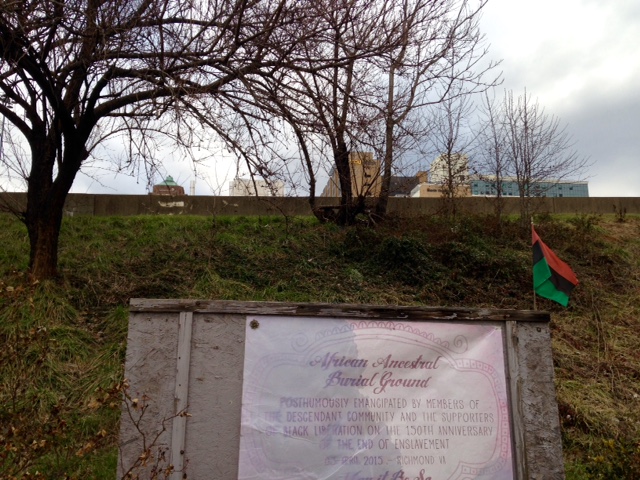
That answer came later in my day, after multiple conversations and side glances at the ashen cross marking my face.  It came in the midst of unintentional pilgrimage, a trip with my students to the empty former parking lot where we have come to know that unmarked graves of African slaves lie beneath.  Last spring, a community group successfully petitioned for its recognition as a holy park, and a deserving sacred space.  The plan had vision, but not a good flow of funding.  So, it is still a vacant field, except for the love shown by community members doing what they could with the resources available.  A laminated sign describing the efforts to remember and reconcile hung limply off a mark-shift plywood.  The space…practically unfindable if one is not looking..was palpable with pain, sadness, and anger.

I walked to the sign where one of my students was attempting to hang it back up.  She couldn’t find the tacks that once held it to the board.  As suddenly as I walked to assist, I found myself removing a vintage broach from my coat.  I stabbed the sharp stick from the pin-back into the press-board.  And I heard the words, “Give it up…”

And so it is that I came to realize this will be 40 days in the wilderness of prayer and devotion, being led daily to what I will give up.  I will say Yes if it’s a vintage pin, or a donation, and I will say Yes even if it hurts, even if it burns me with my own need for control or desire for safety.  I lack the time to write daily, although words may come from time to time.  But, there will be a place and time to experience the small points of light that emerge when giving it up in gratitude and love, and experiencing the small but significant sacraments of the daily ordinary that await.  Each day I will ask, “What can I give up?”  And, rest assured, I know the rest will follow.

For today, the broach on my jacket was given up and went on to a new life so others could see and read a message of hope, remembrance and reconciliation.

FullSizeRender

More reflections to come as these 40 days unfold, as I lean into what I am asked to give up and see with new eyes what new life emerges.


Posted in Lent 2016, Uncategorized | Tagged , , , , , , , , , , | Leave a comment

Madonna

Madonna at the Food Pantry
Christmas Eve, 2015

She caught me unaware when she turned around,
Saw my face and exclaimed, “I know you!”
She was indeed familiar, whether in body or spirit.
Coffee in one hand, wrapping her sweater with the other
to cover the growing mid-section of her body.
She was also great with child.

“Mary” she spoke when I asked her name,
as if I needed to have asked at all.

Her eyes were melancholy and her voice hushed
as she told me of her losses and her loves.
And this love that she mothered, although unsure
of how to offer care or where to lay her head.
She cooed at another baby held in its own mothers arms.
Brightening, she began to realize who she was
and what she needed to do.

Today was her day, her annunciation.

It can be tempting to think that it was so long ago
that God moved, incarnate, into this world.
But the Divine is in motion here and now,
Real between us, as if I was her Elizabeth.
Emmanuel, God with us.

Always present, the Word made flesh,
Reminding us that we are never alone.


FullSizeRender (36)


Posted in Poetry and verse | Tagged , , , , , , , , , , , | Leave a comment

Sanctus

I have a few vivid memories of the sixth grade, most of which are unbidden and unwanted glimpses of pre-adolescence rocking the world as I knew it.  One unquestionable high point was the honor of being selected for All County Chorus.  I have always loved to sing; the joy of being wrapped on all sides with song while singing in a large choir was something I had never experienced as a small town girl, leading a small town life.  We rehearsed on Saturdays at one of the big high schools closer to the city than was our rural home town.  I, notorious now for my lack of height, was assigned music folder #1 as the tallest girl in the chorus at that time.  Five foot two is tall for the sixth grade.  Unfortunately for me, I had stopped growing by the time everyone else was just getting started.

In elementary All-County chorus we sang several songs which I vaguely remember…some medley of Hungarian folk songs, a version of the Tree Song (“I saw a tree by the riverside, one day as a I walked along…”) and a few other things that I might remember if I heard them.  But, unquestionably and without doubt, the most memorable to me was a song I called, “Sanctus, Sanctus” for which I needed to learn to correctly pronounce the words in Latin.  It felt so powerful, so strong, and so palpably important.  I didn’t really know why I loved it so much.  I was raised deeply religious, but in the pentecostal tradition, so the words of the Latin Mass meant little, if anything, to me at that time.  But, whenever I rehearsed that song it was stuck in my mind for hours on hours.  I could close my eyes and hear it, as if conducted by the wind whispering around me.

The afternoon of our big All County concert finally came.  I put on my required white shirt and blue skirt and my parents and I drove to the city, to Kleinhan’s Music Hall in downtown Buffalo.  My stomach churned with nerves as I lined up to sing these songs I had been learning with students from all around the county.  My folder #1 meant that I also was the line leader, and I marched in, climbed up and walked toward the end of the top row of risers.  I was still terrified that I might fall off.  But, somehow, I made it to the top riser and turned around.  I was awestruck by the lights that blinded me to see anything other than the arms of our conductor.

The opening strain of our performance gripped me, and soon I was thinking of nothing but the sounds of my voice blending with others around me, echoing each other in the alternating stanzas of the Sanctus that I now know as part of Gabriel Fauré’s Requiem:

Sanctus, Sanctus, Sanctus Dominus Deus Sabaoth. Pleni sunt coeli et terra gloria tua. Hosanna in excelsis.

Holy, holy, holy, Lord God of Sabaoth.  Heaven and earth are full of Thy glory. Hosanna in the highest.

In that moment, I felt that I was being carried to some otherworldly place and time.  The song had no context for me, no connection to my own religious upbringing.  I didn’t even know the translation of the Latin, the pronounciation of which had been drilled into me from weeks of rehearsing.  I simply knew that it spoke to me, remained with me, and took residence in a place in my mind and spirit where it made its home.

I revisited that time and place tonight.

Tonight, I stood beside the altar, assisting at the Solemn Eucharist of All Souls.  This is one of my favorite services of the year, and every year until this one I have practiced and rehearsed with my choir several selections from the Requiem Mass of Faure, Brahams, and/or Rutter.  My life has shifted now; my love for singing and for my choir remains.  But, my soul is following its calling and, like the wafting of incense, it has carried me to new places.  I find such deep beauty in the holiness of liturgy, and awe in service to the ministry to which I’ve been called.  Liturgy seems to course through my veins now, and The Episcopal Church is the place I call home.  I am honored to serve in that space and over time, that space has filled me in a way that pulls me outside of my familiar roles and into new ones.  I stood tonight, in the awe of Presence, and I heard my choir friends begin to sing a familiar refrain as we reached the Sanctus of the Eucharistic Prayer:

Sanctus, Sanctus, Sanctus Dominus Deus Sabaoth. Pleni sunt coeli et terra gloria tua. Hosanna in excelsis.

In this moment, time and space seemed to fold.  I was standing with music surrounding me, beneath bright lights, standing at an edge.  This time, it was not the uneasy ledge of music hall risers.  It was the edge of eternal presence, the place where time and space are so thin that they are crossed in sacramental mystery.  It was as if those sacred words were given as a gift, long before my soul could truly hear them.  They were around me, and in me, and moving through me.  And not just me, of course.  In the wholeness of all who gathered, seen and unseen.  The communion of saints, the remembrance of the faithful departed, the shells of our former selves and the depths of our potential.  All gathered, all welcome, all united in the eternal and holy presence of that space and time.

Sanctus.

Posted in Spiritual journey, work and life | Tagged , , , , , , , , , , , , , , | Leave a comment

Impermanence

During the years of my life where I set myself adrift from organized religion, I began to enjoy reading the sacred stories of many different faith traditions.  Being pretty high on the introvert scale, I’ve always been drawn to contemplative practices and Buddhist thought. I can empty my mind and open my heart with great delight.  But, I always tripped up on the notion of “impermanence.”  It was more than my very educated, socialized, Western mind could take: the idea that I would voluntarily wish to let go of the very nature of what was so important to me, right down to my identity.

On any given day, I have so many reasons and ways to cling to everything: people citing my work, reading my blog, listening to my lectures, archiving my emails.  Not only am I socialized into the notion that my thoughts and ideas must be pertpetuated, but my workplace rewards me for it.  More publications, citations, professional notoriety.  I’m not suggesting there is something inherently wrong with any of that.  I’m just acknowledging that the idea of impermanence is both foreign…and perhaps terrifying…to someone very steeped in the Western academic tradition.

So, I find it more than a bit ironic that now that Fall is upon us and I’m steeped both in my academic work and in seminary, I’m thinking about impermanence again.

About a year ago now, I had a very vivid dream.  In the dream, I had just arrived in an airport with plenty of time to catch my flight.  In fact, I had so much time that I stopped to browse in a bookstore.  I set down the bag I was carrying so that I could read.  All of a sudden, I glanced at my watch and realized my flight was about to take off.  I ran out of the store and to the gate, just as the door was about to close.  The flight attendant held out her hand to take my ticket, and it was at that moment that I realized that I had left my bags, my ticket, and my identification in the store.  She nodded at me knowingly and waved me through, but I panicked and told her that I had to go back for my identification.  In the dream, a thousand things were swirling in my mind:  if I got on the plane and needed to disembark, no one would know who I was; if I left to claim my identification, I might miss my plane altogether; if I could just get to my identification I could just abandon the bags and all the replaceable “stuff.”  So, I told her I was just going to get my identification and forget the bags, just hold my seat for two minutes.  I took off running, found the store and snatched my wallet and ID, abondoning my bags.  I rushed back through the airport to the gate, breathlessly holding out my identification as proof of who I was.  The flight attendant was still there, patiently waiting.  I showed it to her and she shrugged and said, “I told you I knew who you were.”  I was both baffled and amazed, “The plane is still here!” I exclaimed.  She looked at me with both kindness and the patience one shows to a naive child.  “Of course it is,” she said, “it’s your plane.”

That dream has been a powerful metaphor for me ever since.  It’s helped me as I explored the timing of pursuing a new vocation, and of my fears of everything falling apart if I didn’t do absolutely. everything. right. now.   Many days, the mantra of “it’s your plane…” has been enough to ground me and realign myself with the journey.  I’ve considered that dream a gift to my calmness and sanity.

I was thinking about that dream again today.  I wondered for the first time what would have happened if I had forgone the jog back to find my identification and instead, just stepped aboard.  I couldn’t even wrap my head around the absence of that proof of identity before.  Now, I wondered, would it really have made any difference to anyone except me?  Perhaps I was the one who needed proof of who I was.  To the flight attendant, the plane and I were all one.  My identity was both inseparable, and impermanent.

There is something profound in realizing you are known so well that you and your life are indistinguishable from each other.  When I am moving through my life with deepest authenticity, I have no need of explaining who I am or what my intentions are.  My acts of living speak more loudly than words, or a name.  I have come to realize that the less I cling to the need to prove or explain, the more deeply and authentically I can live.

Maybe this explains why my blogs are less frequent than they once were.  I still love to write and curate things on the web.  And when inspired, I do both.  Lately, I find myself engaging in the very impermanent activity of curating a virtual daily office with my seminary cohort which I complete…and then subsequently erase and replace…every day.  Some days, it’s like a stick figure drawing of the basic rubrics of common prayer in the Anglican tradition.  Other days, it’s more akin to a full blown mandala with pictures and music and perfectly selected prayers.  And every day, no matter what, the slate is wiped clean as our prayers are released.  I have come to realize that there is something about this process that is feeding me far more than an archive.  I have also realized that ours prayers source themselves in Divine Presence, and return to that source.  No archive needed.  In the impermanence of prayer there is the deepest of peace.

In that spirit, it’s time to send out these thoughts to whomever and wherever they may go.

Enjoy the ride.  It’s your plane….

mandala

Posted in work and life | Tagged , , , , , , , , , , , , , , | 2 Comments

Magnificat

August 15:  Feast of St. Mary

My soul proclaims the greatness of the Lord, my spirit rejoices in you, O God my Savior, for you have looked with favor on your lowly servant.  From this day all generations will call me blessed: you, the Almighty, have done great things for me, and holy is your name. 

I saw you there, sitting across from me.  We were both mothering our newborns in the great glass fishbowl of the NICU.  The swaddled eight pound bundle of red-faced crying baby that I carried looked suddenly so big next to others so small.  You sat outside the plexiglass womb, the tiniest of babes being nurtured into life by something more complex than either of us could understand.  I resented being there, feeling more hostage than home.  I rocked my daughter and thought, “let us out!  we are fine!” and I argued with the nurses who wanted to tell me how to do what my body, mind, and soul were trying to piece together organically.  I wanted to be anywhere else; wished that they had never noticed my daughter’s imperfections; wished that my body harbored no bacteria that I could have accidentally passed to her.  But, all the wishing in the world didn’t change that we were here, and not at home.  A tiny IV in her tiny foot, antibiotic that would be deadly to me dripping into her for healing.  I was paralyzed with fear.  Then, I saw you.  Across from me, but in a whole different world.  You were no where else but in this moment.  Your gaze was fixed on that child, your world forming around all the potential of those tiny lungs to breathe, to cry, to claim his space in the world.  Your face was calm, your smile was gentle.  I felt my heart shift when you looked at me. Madonna in the NICU, you gaze at your child and we can all see the face of heaven.

You have mercy on those who fear you from generation to generation.

I think of the scene often:  a small apartment, an empty place at the table, other children running and playing and laughing and crying, parents stunned from the sudden cruelty of death too early in life.  Your eyes held back tears as you scooped up a surviving sister and held her close, telling her it would be OK.  You were reminding yourself, too.  Death can be devastating and senseless.  Injustice can be palpable.  You wondered out loud if there was a reason, but you knew there was not.  You wondered out loud if you could survive this, but you knew that somehow you would.  Nothing prepared you to say good-bye to a child.  Nothing prepared you to keep loving those who remain, while feeling the deep stabbing pain of the one who is gone.  But, you tell me, you pray.  You have his clothes and his pictures and the indelible memories that cannot be erased.  You pray to be reunited; you pray for his comfort; you pray for peace; you pray for mercy.  I cannot fix your pain.  I can simply sit with you and pray with you.  Madonna of those who mourn, in your mercy you comfort those of all generations whose prayers reach heavenward.

You have shown strength with your arm and scattered the proud in their conceit, casting down the mighty from their thrones and lifting up the lowly. You have filled the hungry with good things and sent the rich away empty.

You were standing outside in the cold, waiting for the pantry doors to open.  I opened the doors as soon as I came in, letting everyone inside for warmth.  When I said good-morning, you looked me right in the eye and said, “Praise God, yes it is, I am blessed!!” and before you could even sit down, you added, “how can I help?”  I was the first one there that day, and I knew we were short-handed.  The shelves and canned goods needed to be stocked; bags needed to be set up; all the donated bread needed to be sorted, sliced, and bagged.  I knew I was supposed to do that before opening the doors to let people in, but it was too cold to follow that rule with all of you outside waiting.  The rules also say that you can’t pick up food and volunteer on the same day.  But, those rules do not recognize that we are one community, each one giving and receiving.  But you…you realize that, and that makes you strong, stronger even than the ones who make the rules.  I stepped out of your way, and you stepped in with the knowledge of she-who-has-seen-and-done-it-all-before.  While I was still getting everyone in the door, you had assembled your crew, who were gloved and ready to be put to work.  We laughed together when we both said at the same time, “…many hands make light work.”  We all looked to you as you effortlessly led with love and grace. You laughed and smiled, and warmth filled the room.  When we were ready to begin serving, you asked if you could say a prayer to welcome everyone to our pantry, this place where miracles happen every week.  You stood before us and proclaimed how God has done great and marvellous things for us all.  The Holy One was indeed in our midst.  You were blessed, and you blessed me.  I took in the meaning of “ministry with” a little deeper that day.  Madonna in the food pantry, you have blessed us with abundance.

You have come to the help of your servant Israel, for you have remembered your promise of mercy, the promise made to our forebears, to Abraham and his children for ever.

I have thought many thoughts, and prayed many prayers sitting in the quiet awe of your presence.  I have wandered in the wilderness, and laughed liked my ancestral namesake.  I have scoffed, and protested, and tried to flee, but I have never been alone.  God’s mercy endures in ways too marvellous for words, in moments of the daily serendipity that baptize the ordinary with greatness.  I sit, humbled, imagining the glimpse you may have seen in the God-child that you nurtured.  I imagine there were times you second-guessed your own recollection of events, and then were stirred to faith by a glimpse of divine purpose which likely came for you as they do for me, at the moments least expected and most needed.  I imagine the power of your own yes-saying, taking on the divine role of emptying oneself to the fullness of possibility.  I imagine your strength of purpose, the inner conveyance of call that would be with you from giving birth, to witnessing death, to experiencing the power of resurrection.  Mothering is filled with acts of mercy.  I have seen them, and in those moments have glimpsed your enduring and merciful presence.

IMG_0736

Posted in quotations and reflections | Tagged , , , , , , , , , , , , , | 1 Comment

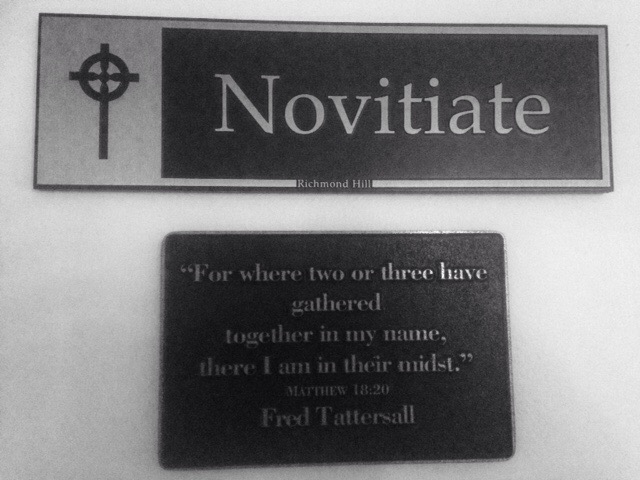
Novitiate

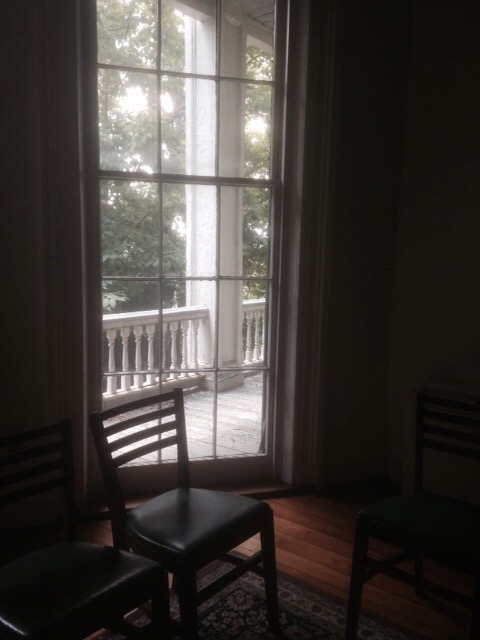
In the hazy stillness of afternoon sunlight, I cannot even observe what year it is. I have walked through double doors, cloistering myself away from the pace of life, the attachment of family, the security of that which I have come to know as home. For a span of time, all I know of home is here. There is newness: the grace of beginnings, the hope of kindled awareness. There is something in my soul where yearning once was, but I haven’t yet learned to speak its name.

I leave my shoes and kneel in the center of the room, perhaps invited but more honestly, compelled.

My book opens, and I hear these words, spoken to me:

I am, you anxious one.

Don’t you sense me, ready to break into being at your touch?

My murmurings surround you like shadowy wings.

Can’t you see me standing before you cloaked in stillness?

Hasn’t my longing ripened in you from the beginning as fruit ripens on a branch?

I am the dream you are dreaming.

When you want to awaken, I am that wanting.

I grow strong in the beauty you behold.

And with the silence of stars I enfold your cities made by time.

–Rainer Maria Rilke, Love Poems to God

I cannot rise.

In my mind, I see myself among the anxious ones who have sat in this circle.  Being taught is one thing: history, catechism, liturgy, scripture, prayers.  Learning is another thing altogether: listening, quieting, trusting, opening.  Those soul lessons have filled this space for longer than I have been breathing, or thinking.  Generations of the newly obedient to their inner call.  Some fighting it, some relieved, some fearful, some content.  All some of all of that, at least some of the time.

Perhaps the young novices of another age wouldn’t have even imagined this middle-aged woman, postulant to the priesthood, kneeling here in the Awe of Presence.  How we live out our vocation is a matter of context, history, and social sanction.  The mind tells us of limits, and walls, and rules, and order.  The world in which we live educates us in that which is allowed, permitted, tolerated.  The soul knows nothing of these limits.

I find tears filling my eyes, weeping with gratitude that I am in this context at this time.  But, I am them and they are me.  We are more alike than different, this communion of the ordinary saints of the sacramental present.  We are not in this space from our own merit, nor perhaps even fully by our own choice.  We are learning to follow the nameless yearning that resides within and beyond.  We are praying, moving, making room for the incarnate to become present in ways that are yet to be known and experienced.

We are not different.

I quiet to stillness.

I welcome the new, like a loving stranger becoming a soul friend.

And I know, kneeling here in my silence just as they knew in theirs:

All will be well.

Posted in Poetry and verse, quotations and reflections, Spiritual journey | Tagged , , , , , , , , , | 2 Comments

Sundays

My daughter asked at dinner last night, “Does the week start on Sunday, or Monday?”  It was a loaded question, the way that questions from adolescents generally are.  She had her opinion and she wanted to float it to her parental units so she could either dispute or trump our responses with her own.  My husband went pragmatic, “Sunday.  That’s how people decided to lay out the calendar.”  I decided to walk down her enigmatic path, “My work week starts on Monday so I’ve always thought of that as the start of the week and Sundays as the weekend” I said.  “But, I have to admit, I’m already shifting to Sundays.”

She gave me the half eye-roll, half-respect look that she does these days as she added, “I knew you were going to say that…”  It’s not easy for me to explain how changes in my own sense of self and vocation lead to all these pragmatic shifts, even in my calendar settings.  It’s even harder, I suspect, when you’re twelve and watching from the sidelines.

I have been thinking about Sundays this morning, sitting in my back room with the doors open with my coffee and my computer.  The sounds of crickets and cicadas and songbirds make me feel connected to summer Sundays across the geographic and temporal chapters of my life.  Just this space fills me with a deep, inner calm.  Today, I savored unrushed morning prayer; I’m catching up on my weekly Fresh Air episodes, listening to On Being and perhaps a TED talk or two.  In summer, my church’s services are scheduled later than usual so even with choir practice, I have an extra carved out bit of freedom to breathe in the calmness of a sacred, summer day that way I had honored it for years, whether or not “church” was a fixture in my routine.  On Sundays, my work gets set aside and it’s quite easy for me to say, “tomorrow is another day….”   I love this cadence of Sunday as it falls in my life right now.  I probably love it even more these days because I know this experience of Sunday is unquestionably, as my Buddhist friends remind me, impermanent.  My clergy colleagues point that out, repeatedly.  But, there is a soulfullness to Sundays that seems to remain at the core.

What do I make of the fact that I’m taking on a vocation that centers around Sundays?  How do I reconcile my soul’s need for rest with its calling to minister?  This presents a bit of a challenging conundrum for me which means it’s something I like to think about.

This morning, I am remembering back to a little tension that I observed in my youth.  I have come to realize that I have had the “both/and’ spirit of Anglicanism in my nature for far longer than it was in my repetoire of ecclesiology.  The fundmentalism of the churches my family attended in my youth meant that there were some voiced frustrations when our pastor literally interpreted, “Remember the sabbath day to keep it holy…” to mean, “Don’t work on Sundays, or I’ll call you out from the pulpit.”  I remember that happening once to my Dad, who retorted back with, “Well, YOU work on Sundays, don’t you?”   Touche.  Score one for Dad.  In a literally translated world, even my blogging or a pastor’s preaching is work.  Even though I gave up that world of literal, fundamentalism years and years ago there has always been something about Sundays that craves to be different.

I might argue that this need is cultural and spiritual, not just religious.  I think the craving for Sunday is true in the secular world, too.   We need a sabbath, a day in which we hold as sacred those things which are holy and life-affirming to us: family, friends, the nurturing of our minds and bodies and spirits.  We need and crave a day to remind us of our wholeness and not just the slices of our working, visible selves that we show to the world and to which others assign our social identity.  We need to be shaped, encouraged, and guided into respect for stillness and a slower pace amid our hectic routines.  Sundays hold us accountable for our full humanity.  The literal day of the week isn’t the issue; the issue is our need for sacred wholeness in a society where we are constantly pushed and reminded that we can never be good enough, smart enough, or rich enough.  We crave a safe space where we can simply BE.

I think about this a lot, particularly as I consider that we have sometimes replaced religiousity with spirituality in our Western expressions of faith.  The two have to work hand-in-hand.  There is true joy in a Sunday where we can create the forms and expression of worship where we can simply BE…be present, be loved, be whole, be in community, be in communion with the Divine.  Where I watch people fall away…where I myself have abandoned ship in my religious past…is when those experiences mirror our working selves:  we aren’t good enough, or smart enough, or rich enough to truly belong.  People leave churches all the time for those reasons:  they feel judged; they don’t understand what is happening in the worship service; they don’t meet the social standard of the community in dress or in lifestyle or in social expectations beyond the hour of structured meeting time.  What has become of us if we remove the sacred wholeness from the very day on which it should be celebrated and appreciated?

For me, I will always have Sundays.  The cadence and responsibilities may change across my lifetime, and that has and will find new expressions.  But, this is a day of sacred wholeness that has transcended whether or not my body could find a worship space that fit it during any one specific point of my journey.  Sacred wholeness is my goal: whether I am the liturgical leader, the Vestry person on duty, the choir member, the Mom, the quiet listener to sounds of nature, the one taking in ideas and concepts larger than my current understanding so that I can be transformed and renewed.  Although many have said that one doesn’t need to be in a church to find this (and conceptually I agree), I can attest to the fact that this can be found in abundance in many formal spaces of worship, both liturgical and free form.  It is a beautiful, holy space where our yearning meets the abundance of divine love and grace.  Sacred wholeness is something that we can embrace with intention, from the small points of light in the ordinary extraordinary of our days to that which is created when our intentions reach beyond ourselves in sacred ritual, song, and worship.

Yes, that is the Sunday that I crave, that I seek and graciously find, that I will strive to be a conduit to offer in my own ministry.  On this Sunday, I delight in divine wholeness in all its forms and expressions.  My soul is fed with abundance.

Grace, peace, and sacred wholeness to you this Sunday…

15710911180_2b2ec344f9_z

Posted in work and life | Tagged , , , , , , , , , , , , , , , , | Leave a comment

Restorative Justice

A few weeks ago, one of my BSW students sent me an email.  She was doing a summer internship with the First Lady’s office and on the side, doing some volunteer work with the office for restorative justice.  Virginia has recently taken some steps forward in granting civil rights back to ex-felons (voting, holding public office and seeking public employment) and she had 1,000 envelopes to stuff for those who had petitioned for their rights to be reinstated.  She was seeing if some of us would gather with her in the library to help stuff envelopes.  I had a flash idea that I ran past her: I thought about taking these to our food pantry where clients are craving service and advocacy opportunities.

So, last night I met her in the parking lot of a campus restaurant and filled my trunk with papers, envelopes, and voting registration forms.  I brought them to pantry this morning…along with my daughter who was willing to help out on a summer vacation day…and we set up shop on a table.  As people gathered in anticipation of pantry opening, I stood up and explained the project and asked if anyone was willing to help assemble envelopes and packets.  What happened during the following hours, I did not anticipate.

Today, I have heard the tearful, hearfelt felony conviction stories of my friends and neighbors.  I have heard about the wrongs committed, and the aftermath of devastation created in their lives.  I have heard stories of repentence, and felt the awe of the possibility of having some manner of dignity and civil rights restored.  I have felt the hope, and the pain.  I listened to every story.  I gave hugs.  I offered prayer.  I completed forms for restoration of rights with people whose eyes welled up with tears.  I realized that this envelope-stuffing wasn’t just an act of advocacy.  This was reconciliation.  This was a moment of self-forgiveness.

The stories that I heard today I hold with deep confidence.  There is one, though, that sits with me so strongly that I need to write it, wrestle with it, and learn from it.  I will change enough details to protect the person, but keep to the core of the situation.

It was five minutes before the pantry closes, and we had already served everyone who had been waiting.  Volunteers were cleaning up, and I sat down at one of the intake tables to clean off the tablet screens and organize the piles of papers left from the day.  The volunteer at the door handing out numbers pointed someone my way.  As he approached the desk, he said, “…are you Ms. Sarah?” and I said…without thinking about context…”guilty as charged!”

He did a little 180 and then his eyes lit up.  “Well, you and me both!” he said, and then corrected himself by leaning in a little closer, “Actually I’m not guilty as charged, but it just took them seven years to figure that out.”

It turns out that Mr. Jones had run into a friend on the street, who told him that a lady down at the church food pantry was helping people get their rights back.  He was supposed to go there, and ask for Ms. Sarah.

I didn’t actually realize until that moment that I was doing anything other than helping out my student with her summer service project.  But, I should know better.  What I do whenever I enter the pantry is take a step into whatever ministry God thinks I should be doing.  And today, that ministry was restorative justice and reconciliation.

I listened to Mr. Jones’ story.  I heard about his arrest, about the two names that he had been given in 1942 by his mama.  She gave him her name…which wasn’t legal…because his legal name was of his father, the man that had beat her and left her.  I heard about how he used that name…his mama’s name…now as his only name.  I heard about how the other name (which was practically as common as “Mr. Jones”) was identified by someone as the perpetrator of the crime.  I heard how he was arrested, a man of color, accused by one person of privilege solely on the basis of his name.  I heard how he was asked to sign at his arrest and how…because he knew better than to use a non-legal name on an arrest warrant…he signed with his legal name.  I heard about his conviction, and the seven years that he remained in the county jail while people fought over whether it was really him or someone else.  But he had no family, and no friends to help him make bail.  So, he stayed in jail for seven years.

Mr. Jones pulled out his identification and his statement from the governor about his release for wrongful conviction.  He was living in temporary, congregate housing while he applied for benefits and social security, since he had passed into retirement age while incarcerated.  He asked me, “do you know how I feel today?”

I admitted that I could not possibly know how he felt.

He said, “I feel free.”

I sat there with him in that moment.  I was feeling so many things: Anger at the system, anger at racism, anger at injustice and oppression; Joy for his release, for wrongs reversed even if after so long, for the fact the this man came into this space; Gratitude for his presence in this space, for the humble honor of hearing his story, for the spirit of God’s Divine Presence filling that space.

Mr. Jones and I did a few practical things.  We filled out his restoration of rights paperwork, we entered him into the food pantry system so he could regularly be supported with some nutritious food and meals, we discussed social programs he was eligible for and where and how to access them, and we sorted through his papers and talked about what needed to be kept in safe places at all times.  I made him some photocopies of things he should have several copies of in his possession.

Then, we prayed.  Silently.  Together, we prayed.

When Mr. Jones left with his food, he said:  “I will be praying for you, Ms. Sarah” and I said, “I am praying for you even now, Mr. Jones.”

Restorative justice crosses boundaries of age, race, class, need, worthiness, unworthiness.  We are all impacted by the injustices of this world; each and every one of us carries with us things for which we are convicted justly, and things for which we may be unjustly convicted.

In ordinary moments…the small points of light…we come to know that we are one community: united, restored, redeemed.

link818_5

Posted in work and life | Tagged , , , , , , , , , , , , , , , | 2 Comments

Freedom Accolades

It’s an overcast southern afternoon on this Independence Day holiday and I am feeling the deep freedom of an unstructured day.  Often, we are a family of nomadic wanderers on July 4th, packing up the car for a trip to visit either the family in St. Louis or in upstate New York.  While it’s always fun to travel, I’m grateful that this year, we are at home and relaxing.

Relaxation can be one of those charged words.  I’m not one who can sit poolside staring at my toes (not that there is anything wrong with that, friends….it’s just not in my genetic or personality profiles).  What I mean by that word is that I am embracing the freedom to do the small things that give me pleasure.  I’m working in my garden and picking big bouquets of coneflowers and brown-eyed susans to bring into my house.  I’m getting started on the assignments I brought back with me from my seminary classes in an unrushed and thoughtful way, since I have a long-weekend away from my workplace.  I’m catching up on media stories and videos that I’ve bookmarked for later.  I’m connecting with friends nearby and far away, and cooking unhurried dinners for my family with fresh ingredients from the farmer’s market.  This is the good stuff of my middle-class American life.  These are the ways I live into the life, liberty and pursuit of happiness afforded to me by my privilege to be a citizen of the United States.  I am grateful, I am humbled, and I am reflective.

I have been thinking and reflecting a lot about freedom.  Earlier this morning, I read the text of the Declaration of Independence from beginning to end.  As I read, I wondered how I would have encountered and interpreted it at the time.  Of course, I immediately realized how false this whole notion was, because I would not have encountered it at all.  I am a woman.  I may possibly have been given some rudimentary lessons in writing if I were of the correct social class.  But, I would not have been the correct social class.  My people were peasant, farm people in the countries from which they originated and my people were and are mostly country, farm people here in the United States, too.  Being hard workers grounded to the earth is an amazing attribute, and my family of origin is beloved to me for their personalities and their values.  But, it’s unmistakable reality in our history that workers have been separated from intelletuals for centuries.  In some ways, we still perpetuate that dichotomy.

Today, I am grateful and humbled and reflective of my freedom to be both grounded in the world of the working, and educated in the thoughtful and critical hallways of academia.  My blood still pumps in the circular rhythms of the seasons and craves the daily pattern of sunup to sundown work.  That was modeled for me in my rural farming family of origin, and I honor and respect that heritage even today.  It brings me to farmer’s markets instead of grocery stores and makes me very leery of buying anything prepared in a package.  It’s also why I am productive…not because I am particularly fast, but I do have a hefty tolerance for working long hours.  When people encounter me in some of the very formal and structured institutions of which I am a part, they sometimes remark, “you’re a breath of fresh air.”  I take that as a compliment to my heritage, not my person.  Being grounded to the earth and partnered with the people is something I cherish.

I realize that it seems counter-intuitive to images of July 4th poolside, hot-dogs and beer, fireworks and festivities: but one of the things I am most thankful for this Independence Day is the freedom to engage in meaningful work.  For me, meaningful work involves a combination of intellectual discourse, social advocacy, community engagement, and soulful service.  So, on this Independence Day I am going to give out a few freedom accolates to women who perhaps haven’t had as much coverage in history as they should have, but without whom I would not be following the journey I am today.  I thank them today for ways in which I express my freedom of meaningful work.

As a woman, I am grateful to my sisters of suffrage for beginning to shape an understanding of women’s work in non-domestic settings.  My first freedom accolate on this Independence Day goes to Abigail Adams.  While it would be generations after her death that meaningful work, property rights, and political influence would be granted to women, she was unafraid to use her domestic sphere to influence her husband, “If particular care and attention is not paid to the ladies, we are determined to foment a rebellion, and will not hold ourselves bound by any laws in which we have no voice, or representation.”  And so it has been.  Accolade to you for your foresight, Abigail…

a_adams

As an advocate for civil and human rights, my next freedom accolade goes to one of the first female graduates from a co-educational American University (Oberlin), Lucy Stone.  I give this accolade in honor of the fact that her first actions were not to revel in her own accomplishments, but to advocate for the rights of another oppressed group as a lecturer for the Anti-Slave Society; she consistently linked the struggle for freedom with one group with the struggles for freedom with others. For freedom to be a vocal advocate whether I not I feel I “belong” in the academy, I honor Lucy with a freedom accolade.

Lucy_Stone

My next freedom accolade goes to Phillis Wheatley, an enslaved African woman who was taken from her home in what is now Senegal and was kept in servitude in the household of John Wheatley.  Her poetry inspired abolitionists in both the United States and in Europe.  I cannot envision her life as an enslaved artist; but in her words freedom finds voice irrespective of her station.  She has several more famous poems, but as someone who has counselled so many grieving parents, this elegy written to parents who are grieving the death of their infant is soulful, theological and comforting:

To shining guards consign thine infant care
To waft triumphant through the seas of air:
Her soul enlarg’d to heav’nly pleasure springs,
She feeds on truth and uncreated things.
Methinks I hear her in the realms above,
And leaning forward with a filial love,
Invite you there to share immortal bliss
Unknown, untasted in a state like this.
With tow’ring hopes, and growing grace arise,
And seek beatitude beyond the skies.

Phillis, to you I extend a freedom accolade for your willingness to express your soul even when it was in captivity.

pe0015-08

Finally, on this independence day, I extend a freedom accolade to Mary Kenney O’Sullivan.  While she is the most contemporary of my accolades bestowed today, I celebrate with her my working class heritage, my embrace into social reform, and my commitment to community partnership and organization.  Mary Kenney was one of the few working class women to become leaders with Jane Addams at Hull house.  She lived and learned from life and used her knowledge, skills, and vision to blaze a trail for others.  Before and after her time at Hull House, she worked as a labor organizer striving to secure safe and equitable employment for women which included securing the right to vote, hold political office, and be in paid positions of leadership.  I extend to Mary a freedom accolade for establishing the value of professional work in women’s lives and committing your passion to securing a freedom that I celebrate, even on my “off” days….

o'sullivan2

There are so many other women and men that I could recognize.  I hate to stop, but other meaningful work is calling me.  But, as we celebrate independence on this July 4th holiday, I’m pleased to have been able to give a few of my heros some additional accolades.

Happy Independence Day….

Posted in quotations and reflections, work and life | Tagged , , , , , , , , , , , | Leave a comment