Thoughts on Bridges

Today has been an exercise in bridging the gap and feeling the strain.  Sometimes in this public writing forum, I can’t authentically convey the stories of what comes my way while living into my Lenten intention  of proximity without oversharing around issues impacting others.  So, instead, I want to reflect for a few minutes on this idea of bridging the gap in a very real and vulnerable way…the lesson is here, not the stories.

I sometimes think that the role of the bridge builder is diminished by being socially elevated as a never-ending supply of giving, as though those of us who span the distance between people have the capacity to stretch without breaking.  It isn’t true.  We actually sometimes snap and give way.  We realize that in our attempts to build proximity, we are not fortified enough, or the distance is too great.  The realization comes that even if a bridge is needed and desired, we can’t actually keep being the bridge without the right kind of supports: internal, external, existential.

I find myself having burned some bridges today, and built others.  I also find myself reflecting tonight that both are necessary parts of the same whole.  Some bridges are well intended, but not structurally sound; they need to come down before someone gets hurt.  Some bridges will be stronger for what I can offer of myself in extending from one side to the other with the support and suspension from above and below.  In my attempts at bridging, I have been prayerful.  In these attempts, I have gained wholeness and awareness of both limits and capacity.

I found this poem speaking loudly and clearly to me tonight.  Kate Rushin, poet and black feminist comes through for me on this day.  So, I share her poem, with gratitude for her vulnerable authenticity and spoken truth on which I continue to reflect:

The Bridge Poem

I’ve had enough
I’m sick of seeing and touching
Both sides of things
Sick of being the damn bridge for everybody

Nobody
Can talk to anybody
Without me Right?

I explain my mother to my father my father to my little sister
My little sister to my brother my brother to the white feminists
The white feminists to the Black church folks the Black church folks
To the Ex-hippies the ex-hippies to the Black separatists the
Black separatists to the artists the artists to my friends’ parents…

Then
I’ve got the explain myself
To everybody

I do more translating
Than the Gawdamn U.N.

Forget it
I’m sick of it

I’m sick of filling in your gaps

Sick of being your insurance against
The isolation of your self-imposed limitations
Sick of being the crazy at your holiday dinners
Sick of being the odd one at your Sunday Brunches
Sick of being the sole Black friend to 34 individual white people

Find another connection to the rest of the world
Find something else to make you legitimate
Find some other way to be political and hip

I will not be the bridge to your womanhood
Your manhood
Your human-ness

I’m sick of reminding you not to
Close off too tight for too long

I’m sick of mediating with your worst self
On behalf you your better selves

I am sick
Of having to remind you
To breathe
Before you suffocate
Your own fool self

Forget it
Stretch or drown
Evolve or die

The bridge I must be
Is the bridge to my own power
I must translate
My own fears
Mediate
My own weaknesses

I must be the bridge to nowhere
But my true self
And then
I will be useful

-Kate Rushin from This Bridge Called My Back (1981)
edited by: Cherrie Moraga and Gloria Anzaldua

Or listen, read by the author, here: Kate Rushin reads The Bridge Poem

bridge night

Posted in Lent 2017 | Tagged , , , , , , , , , , , , , | Leave a comment

Tasting Proximity

I just came back from grocery shopping, my usual Saturday morning routine.  This was my first shopping expedition during Lent, and I note that having an intention of “proximity” combined with some Orthodox vegetarian eating habits is proving a bit of a challenge in East Coast early March.  My intention did make me pause and think, though, about what I usually just grab and buy without much thought as to where, when, why, and how it was grown.  As I always learn: that is really the point of Lent.  It isn’t really about what we give up or take on, but the intention that it creates in us.

Suffice it to say, it was a much longer trip than usual.  I’m also really happy with the interesting and creative combinations that I’m planning to prepare this week.  Whether my family is or not remains to be seen.  But, I digress.

I have to admit one big, huge, realization that occurred to me while shopping, though: proximity isn’t just where your body finds itself.  Proximity is a state of presence.

In a very real way, what I wanted to eat for breakfast all week was avocado toast.  That is definitely not local to Virginia.  But, I paused to think about it deeply instead of superficially.  Avocado toast is basically what I eat every morning that I’m in California for my seminary intensives, possibly with some berries and yogurt to alternate. I’ve never lived on the West Coast until these multi-week intensives, so I am part amazed tourist and part local partaker when it comes to what is grown locally in that shorter…but very real…bicoastal part of my life right now.  Local avocados (and Meyer lemons, when I’m there in winter) are like a culinary communion to this part of the country in which I am learning and forming for ministry.  While shopping today on the East Coast, I came across some lovely avocados from my West Coast second-home and it was practically a sacramental experience.  So, I bought two (at about four times the price I will pay for one in June), and some local-to-me sprouts, whole grain bread and an (admittedly, local hot-house grown) hydroponic tomato.

So, I am writing and eating my lenten brunch…and feeling richly connected, proximally, thinking about my friends who are living on the West Coast right now and those who, like me, live all around the country and will gather together a few months from now for our intensive studies together.  Eventually, our twice yearly mutual communion in chapel worship, during classes, and over shared meals…featuring local lemons and avocado and loquats and more…will live out its days.  It is a season, and a beautiful one that I cherish and celebrate.  Our proximity to each other after that season will need to be either carefully constructed or virtually supported, but it will still be there if we are intentional about creating and maintaining it.  But it will require that intention, just as our lives of faith are intentionally nurtured as well.

Proximity isn’t accidental.  It requires effort  and intention.  It is an act lived into through heart and soul, not only body.

Today, I taste proximity.  And it is a good, and holy thing.

Holy One, draw us close in thought, in heart, and in spirit to each other, and to you.

For further reflection: Psalm 34: 1-10

Psalm 34

I will bless the Lord at all times;
his praise shall continually be in my mouth.

My soul makes its boast in the Lord;
let the humble hear and be glad.

O magnify the Lord with me,
and let us exalt his name together.

I sought the Lord, and he answered me,
and delivered me from all my fears.

Look to him, and be radiant;
so your[a] faces shall never be ashamed.

This poor soul cried, and was heard by the Lord,
and was saved from every trouble.

The angel of the Lord encamps
around those who fear him, and delivers them.

O taste and see that the Lord is good;
happy are those who take refuge in him.

O fear the Lord, you his holy ones,
for those who fear him have no want.

The young lions suffer want and hunger,
but those who seek the Lord lack no good thing.

img_3888


Posted in Lent 2017, Uncategorized | Tagged , , , , , , , , , , , | Leave a comment

Proximity: Interfaith Intention

A visitor to today’s Red Door lunch ministry pulled me aside and related to me an incident that happened a few moments earlier.  Rather than concern, he was relating to me with wonder and appreciation how the situation he observed quickly resolved.  One of the student volunteers had been assigned to the table to hand out fruit: oranges, apples, bananas.  As he handed someone an orange, the meal guest threw it back at him.  The student just smiled and said, “would you rather have an apple?” and when the person walked back angrily, he just shrugged it off and helped the next person.  When the visitor said to him, “Why didn’t you react?” the student volunteer said, “I know he probably didn’t want to take it from me, because I’m Muslim.  He had said that before.  But, I’m used to it.”

I sighed.  This was very distressing for me to hear.  I value the fact that this faith-based food ministry in the parish hall of an Episcopal Church attracts student and community volunteers from all walks of life, all faith backgrounds, and we serve and work together in deep peace.  In fact, it gives me hope for the future to have such a beautiful, caring spirit breathing life to us all in the midst of diversity.

The students behind the table seemed fine.  I was tempted to brush it off.  But, proximity is my intention this Lenten season, so I drew near.  I asked the students at the fruit table how things were going, making small talk.  The incident didn’t come up.  So, I said: “One of the visitors suggested that you might have had been on the receiving end of an orange in flight?” The student volunteer, a young and gregarious student, just laughed and said, “yeah, I can duck quick…no harm done.”  I said, “well, it hurt me to hear that you may have been targeted by anyone.  We love that you are here and I apologize if you felt anything differently.”  The young student and his friend smiled.  “Like I said, I am used to it.  People aren’t always kind.  But I know that it is people’s fear that usually is in the way of kindness.  And this man, he is confused and I can see that, so there was no harm.  Everyone has been grateful and we are grateful to be here; we each have our own path and we are walking it.”

I smiled and grabbed an apple, offering the students one, too.  I noted that there wasn’t a lot else we were serving I could eat that day.  The other student at the table said, “are you fasting?  It is Christian fasting season, Lent, right?”

“Yes, actually it is, and I am,” I said, “I’m still getting used to this one.  I’m keeping a Lenten fast from the Orthodox tradition this year, so there is a lot that I usually eat that I’m not eating right now.  It’s fine, though…I’m learning a lot about that branch of our Christian tradition and praying a lot, and thinking of one of my friends who is keeping the same fast, too.” The two students and I began a conversation about fasting: the Ramadan fast, the Lenten fast, the various histories and contemporary versions of how and why we fast.  I shared my own challenge, how I had kept a fast in solidarity for one day last Ramadan when I had been invited to Iftar and how much after that I realized I appreciated water, more than anything.  I listened to the stories of their family traditions, their prayer traditions, and they asked me about customs of Lent they had heard about and how it all fit together in my own life.  We all learned things about what we assumed, what we experienced, and what was important to us.  After a few minutes of this engaged dialogue, the student said, “You know, it really is all about intention, isn’t it?  Prayer and intention.”

Yes, it is.  I stopped at that moment and said a silent prayer of gratitude.

We are more alike than different, people of faith who live prayerfully into a life in awareness of others.  Intentional living, choosing, relating, forgiving, seeking out where the threads of our live intersect.  We grow closer because of our diversity, our deep listening, and our prayerful intentions.

My prayer for us all is that we live into an intention of reaching across boundaries, loving and listening to our neighbors.  Drawing near reveals not only more about our neighbors, but about ourselves.

Holy One, your intention for us all is mercy, love, and grace.  Help us to see you in all who we encounter.

heart-art

Photo: https://www.flickr.com/photos/qthomasbower/3470650293

Posted in Lent 2017 | Tagged , , , , , , , | Leave a comment

Proximity of Place

I’ve come to realize that some places are deeply imprinted on my soul.  Like a bird drawn to patterns of seasonal migration, there is a sort of homing beacon that prompts me to go, just go to particular places at particular times.  At another point in my life…and I admit that at times, even now…I wonder if there is something great and mighty destined to happen when I arrive, as if that inner beckoning foretells a moment where all I am capable of being will be actualized by some major event.  I don’t actually believe it works that way, but the temptation exists get pulled into that fantastical movie script.  The reality is, when I listen and I am present to draw near to those proximal places that call me, something is always there to greet me.  But, usually, it is not at all what I am expecting.

Yesterday, the pull in my soul was put myself in proximity with one of my favorite local places, Richmond Hill.  This former convent, now ecumenical retreat center sits on a hill, at the very top point of the City of Richmond.  It is the place of my discernment, the space where I am met exactly as I am and aligned with where I am meant to be.  I had no logical reason to be there yesterday…I was unable to make the times of scheduled morning, noon or evening prayer as I sometimes do.  I didn’t have an appointment to meet with someone, and there were no special events scheduled.  I was almost deterred from going when there was a posted thunderstorm warning (the kind that comes to my email inbox with red exclamation points) that didn’t bode well for the afternoon.  But, the homing beacon was activated, and so I went.

The wind was already gusting when I arrived.  After being buzzed in, I asked if I could walk the labyrinth and was met with a loving, “of course, just don’t get blown away!”  I laughed a little, although realizing that it was probably part of the reason to be in that particular space, on this particular day.  There is something powerfully redemptive about being wind blown. I made my way to the labyrinth, stepping through the garden paths amid the just-post-winter, not-yet-fully-spring piles of brown leaves and made my way down stone stairs.  No one was there that day, and the sense of solitude was palpable.  The wind was blowing wildly at this point, and I was caught up in the imagery and experience of the Winds of Spirit as I walked each step in prayer.  Whether my imagination or the timing of serendipity, I felt as if the strength of the wind in the center of that labyrinth walk might actually carry me off this earth.

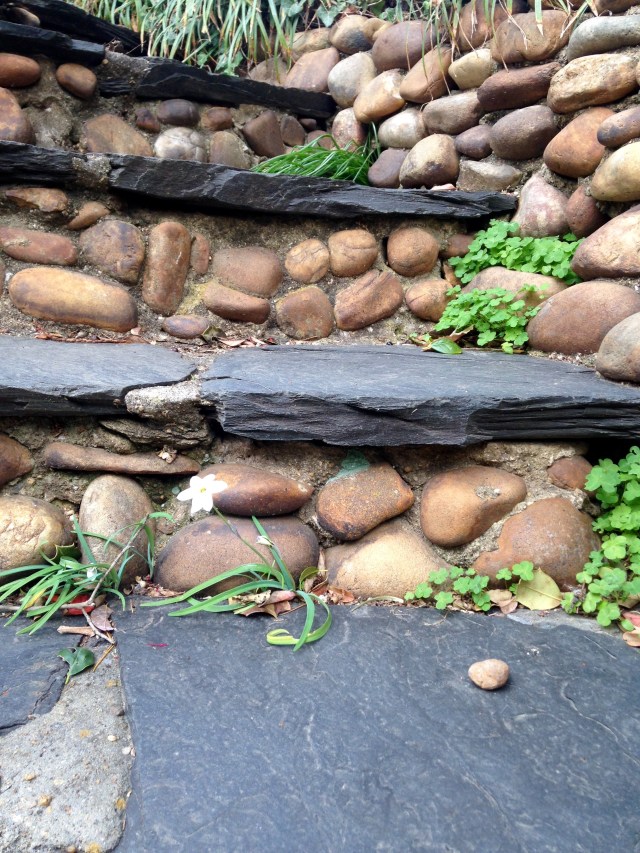
Winding back through the labyrinth, my feet planted me on earth step by step.  I circled back through the paths of the garden, carrying with me a calm stability which lingered in spite of winds and looming storms. My walk back was an entirely new experience.  I now saw every emerging bud on every tree, colors beginning to form under winter’s brown, frost-bitten foliage.  How much had I failed to notice in my journey to get where I thought I was going?  Mid-way through the garden, I stopped in my tracks at the sight of a flower that grew and bloomed in the midst of the stone steps I had walked down without a glance earlier.  One small, white flower was growing through a gap in the stone, seemingly oblivious that all around was rocky and barren.  She had found her place.  She had put down her roots.  She bloomed in a simple yet magnificent beauty.

Now I am left ponder the gifts of drawing near, and being present.  Not for the emergence of the grand, but just so that flower and I could meet, and exchange the silent knowledge that we each had come to know about finding our place, in proximity with each other.

Holy One, with gratitude we find our place in You.


For further reflection: The Place I Want To Get Back To by Mary Oliver

The place I want to get back to
is where
in the pinewoods
in the moments between
the darkness
and first light
two deer
came walking down the hill
and when they saw me
they said to each other, okay,
this one is okay,
let’s see who she is
and why she is sitting
on the ground like that,
so quiet, as if
asleep, or in a dream,
but, anyway, harmless;
and so they came
on their slender legs
and gazed upon me
not unlike the way
I go out to the dunes and look
and look and look
into the faces of the flowers;
and then one of them leaned forward
and nuzzled my hand, and what can my life
bring to me that could exceed
that brief moment?
For twenty years
I have gone every day to the same woods,
not waiting, exactly, just lingering.
Such gifts, bestowed,
can’t be repeated.
If you want to talk about this
come to visit. I live in the house
near the corner, which I have named
Gratitude.

–Mary Oliver
Thirst (Beacon Press, 2006)

fullsizerender-30

Posted in Lent 2017 | Tagged , , , , , , , , , , , , , | Leave a comment

I Am Your Privacy

As someone who craves the luxury of time and space that can only be found in solitude, I find it incredibly exhausting when I’ve been “on” for long periods of time in my rather gregarious and relational life.  As I like to put it, “I need time to think with my own brain.” It was one of those times when my whole day had been filled with people, busy schedules, meetings, students, family…and I admit, I was lingering in the quiet of my upstairs bathroom longer than usual, and far longer than my (then preschool) daughter cared for.  Suddenly, she burst through the bathroom door, excited to tell me something amazing that she had just encountered.  My first response was to draw the line, “Honey…wait outside.  I need my privacy.”

Her big eyes looked up at me, puzzled and confused.  “But Mom” she said, “I am your privacy!”

We’ve laughed about that story for years as one of our classic mother-daughter moments.  But, I think about it a lot, actually.  The child, still not totally differentiated from her nurturing parent, cannot fathom that there could be any possible need or desire for separation or even what that would look like: I am you, and you are me.  Eventually, I am me and you are you, and we relate to each other as individuals. It’s a very (admittedly Western) well-established pattern in developmental psychology.  Individuation is a classic lesson we each learn as we mature, develop and find ourselves becoming the objects and agents of our own lives instead of a fused part of our caregiving system.  Eventually, when it all goes well, we learn how to reconnect deeply with others without having to be fused.  That requires trust, vulnerability, and the hard work of relationship building.  But, it is a goal most of us strive to attain.

But, on this first morning of Lent, that story came to my mind and made me reflect differently on the lesson within, and to ponder a bit more over this idea of proximity around which I am reflecting and writing during this holy season.

I wondered: when was I that small child in my relationship with God?

At some point, psychologically and perhaps theologically, I didn’t have to contend with the socially promulgated idea of a distant and separate God way out there, with whom I was somehow trying to figure out how to be in relationship.  That social message came much later, filled with our human traps of judgment, rules, and obedience to authority.  But, I hold out the possibility that in the depth of my own creation and development, there was and is a depth of unity with the divine in which I came to know that I am so fully known and so fully loved that the idea of “privacy” is, actually, ridiculous.

Later, when my spiritual and intellectual development formed as it does for all of us, I realized I was an independent human being full of agency and free will.  I could differentiate.  I could understand what this “privacy” thing meant, and seek it out, and crave it.  I could use it as a shield, hide behind it, keeping at arm’s length whatever it was that I didn’t want others to see, or what I didn’t want to see myself.  I could say: You can come this close.  But not here.

It occurs to me today, that God’s desire for God’s people…and very specifically, God’s desire for me…is to build comfort with that deep proximity to divine love and grace. It is that return that God seeks, even when we have spent a long time developing ourselves as the individuals that we are capable of being. Proximity involves the intentional, deep giving up of my own privacy, the unlatching of the boxes of stuff in which I pack what I don’t like into, the laying bare of who I am with transparency.  It’s terrifying, and liberating.

How can I be proximal with anyone else, if I cannot be proximal with God, in whose image I am formed and so wonderfully made?

So, on this Ash Wednesday I draw near to God and in so doing, I must necessarily draw near to myself and unpack some of what I have stashed away in the safe-keeping of my thoughts, my fears, my anger, my hurt, my humanness.  All that stuff I like to hide behind…it’s time to drag it out.  I feel reluctant, but there is also an urgency.  I want to set it on fire, to have it burn away and disappear like wafts of smoke drifting off in the wind.  It becomes like ashes, a reminder of all that separation and individuality that we so desire.  Until, that is, we catch a glimpse of just how powerful the oneness of divine love and grace can be.  This is the urgency to return.

Back to that story of my daughter: I remember giving her a hug and telling her: I love you. I didn’t care nearly as much about my privacy as I did about her.

Love is the receiving end of our return to proximity.

Holy One, you are my privacy.  In proximity, I return to you.


For meditation and reflection:  Psalm 139:1-18

O Lord, you have searched me and known me.
You know when I sit down and when I rise up;
you discern my thoughts from far away.
You search out my path and my lying down,
and are acquainted with all my ways.

Even before a word is on my tongue,
O Lord, you know it completely.
You hem me in, behind and before,
and lay your hand upon me.
Such knowledge is too wonderful for me;
it is so high that I cannot attain it.

Where can I go from your spirit?
Or where can I flee from your presence?
If I ascend to heaven, you are there;
if I make my bed in Sheol, you are there.
If I take the wings of the morning
and settle at the farthest limits of the sea,
even there your hand shall lead me,
and your right hand shall hold me fast.

If I say, “Surely the darkness shall cover me,
and the light around me become night,”
even the darkness is not dark to you;
the night is as bright as the day,
for darkness is as light to you.

For it was you who formed my inward parts;
you knit me together in my mother’s womb.
I praise you, for I am fearfully and wonderfully made.
Wonderful are your works;
that I know very well.
My frame was not hidden from you,
when I was being made in secret,
intricately woven in the depths of the earth.
Your eyes beheld my unformed substance.
In your book were written
all the days that were formed for me,
when none of them as yet existed.

How weighty to me are your thoughts, O God!
How vast is the sum of them!
I try to count them—they are more than the sand;
I come to the end—I am still with you.

privacy

Posted in Lent 2017, work and life | Tagged , , , , , , , | Leave a comment

Lent 2017: Proximity

In his book, Just Mercy, Bryan Stevenson extends a powerful quote:

“Proximity has taught me some basic and humbling truths, including this vital lesson: Each of us is more than the worst thing we’ve ever done.”

I’ve had occasion to live into that phrase often during the past several weeks.  When something gnaws at my heart and my soul, I’ve learned that its for a reason.

For the next 40 days, during the holy season of Lent, my life in action and contemplation will live into this theme.  Being proximal…close, engaged, relational…means that in our drawing near to the other, we draw near to the divine spark that rests within each of us and we begin to see the movement of God in our midst.

Like every year, I don’t know at this step where the journey will take me during this foray of relating and writing.  But, feel free to join me in my daily thoughts, inspirations, and challenges.  If you’re fasting from social media and still want to follow me, there is a “follow by email” link below.  Feel free to join me, in prayer or in reading.

Peace,

Sarah

Posted in Lent 2017 | Tagged , , , , , | Leave a comment

In All Our Complexity

A sermon for the Sixth Sunday after the Epiphany, Year A

Matthew 5:21-37

Jesus said, “You have heard that it was said to those of ancient times, ‘You shall not murder’; and ‘whoever murders shall be liable to judgment.’ But I say to you that if you are angry with a brother or sister, you will be liable to judgment; and if you insult a brother or sister, you will be liable to the council; and if you say, ‘You fool,’ you will be liable to the hell of fire. So when you are offering your gift at the altar, if you remember that your brother or sister has something against you, leave your gift there before the altar and go; first be reconciled to your brother or sister, and then come and offer your gift. Come to terms quickly with your accuser while you are on the way to court with him, or your accuser may hand you over to the judge, and the judge to the guard, and you will be thrown into prison. Truly I tell you, you will never get out until you have paid the last penny.

“You have heard that it was said, ‘You shall not commit adultery.’ But I say to you that everyone who looks at a woman with lust has already committed adultery with her in his heart. If your right eye causes you to sin, tear it out and throw it away; it is better for you to lose one of your members than for your whole body to be thrown into hell. And if your right hand causes you to sin, cut it off and throw it away; it is better for you to lose one of your members than for your whole body to go into hell.

“It was also said, ‘Whoever divorces his wife, let him give her a certificate of divorce.’ But I say to you that anyone who divorces his wife, except on the ground of unchastity, causes her to commit adultery; and whoever marries a divorced woman commits adultery.

“Again, you have heard that it was said to those of ancient times, ‘You shall not swear falsely, but carry out the vows you have made to the Lord.’ But I say to you, Do not swear at all, either by heaven, for it is the throne of God, or by the earth, for it is his footstool, or by Jerusalem, for it is the city of the great King. And do not swear by your head, for you cannot make one hair white or black. Let your word be ‘Yes, Yes’ or ‘No, No’; anything more than this comes from the evil one.”

“Blessed are the poor in spirit for theirs is the kingdom of heaven…”

“You are the salt of the earth”; “You are the light of the world”

We’ve been hearing these inspiring passages from Matthew’s Gospel during the past few weeks of post-Epiphany ordinary time, echoes of Jesus the preacher extolling the crowds gathered for what we’ve come to call the “Sermon on the Mount.” But no sooner than all of us…the blessed beacons of light on a hill…follow Jesus into the depths of his own sermon over the course of these recent Sundays, we are met with today’s Gospel where we are confronted by a few less comfortable sermon topics: murder, anger, infidelity, divorce.

It must be time for the seminarian to preach!

But, all joking aside, today’s Gospel really can make us feel like squirming in our seats. So, let’s just get that out of the way right up front. Ordinarily, we might be tempted to pat ourselves on the back if we haven’t blatantly violated the “Big 10” of the decalogue: murder, adultery, bearing false witness which are the specific commandments Jesus references here. But, I don’t know one single human being who hasn’t at some point been overcome by anger, dismissed someone as a fool, harbored a grudge longer than we should have, let our minds wander into flights of wild fantasy, said one thing with our lips while intending another thing entirely. Succinctly and perhaps shockingly, Jesus dismantles our tendency to think of “them” and “us” and reminds us that while we love to think of ourselves as the salt and light, blessed by God, we are also vulnerable and complicated human beings who are all too quickly pulled in to the structures of brokenness, deceit, and unfaithfulness which scar this world.

Jesus knows his people, and he knows our complexity.

I grew up in a small, rural town in upstate New York where there was one stop-light, a Mom & Pop grocery store, two Churches flanking Main Street (Baptists to the West, and Catholics to the East) and where the biggest harbinger of modernization that I remember while growing up was the opening of a Subway…the sandwich shop, not the rapid transit system! The biggest moral decision discussed over the water fountain at school was whether that mass produced sandwich product was tastier, cheaper and/or “better” than the subs at Ronni’s pizza, the fastest food operation that we currently had in town. On the surface, it seems like a delightfully simple and quaint upbringing. But, of course, there were other moral dilemmas. The town’s one manufacturing company was bought out by a massive overseas corporation, so my friends and their families were rapidly experiencing unemployment and economic uncertainty. There were always various and assorted numbers of love triangles and illicit but ever-so-interesting stories spread via local gossip, hushed whispers in hallways and more blatant name-calling. In this quiet, country town where we knew right from wrong…or at least we thought we did…a friend’s gentle spirited younger brother ended his life after relentless adolescent name calling questioning his sexual orientation. And my neighbors across the street both died as a result of a murder–suicide that was quickly hushed up and never discussed, nor was the chronic and persistent presence of untreated mental health and substance abuse which were tearing apart lives and families in this rural community. And that is just one community. Each one of us can run parallel stories that cut through our own lives and experiences.

Our human, communal lives are so much more complicated than we can make them seem on the surface.

Now, I realize that it can be tempting for us in 2017 to think that has something to do with our modern era. We can be critical and even cynical of the world that we see around us where it is difficult to discern whether and how God is in our midst. Our modern lives are so complicated, that we even coined a relationship status on Facebook to declare it to the world.   But, today’s lectionary readings call that assumption into question: the holy scriptures keep it real for us. Let’s start with Moses, who has to explain with great precision to God’s chosen people…who had been led out of slavery in Egypt and who had just been assembled to hear God’s faithful covenant renewed…that there are choices to be made about their own faithfulness and keeping their side of the covenant with God, the consequences of which were life and death; blessings and curses.

And then there’s the Psalm:

“Oh, that my ways were made so direct that I might keep your statutes!

Then I should not be put to shame, when I regard all your commandments.”

It seems that even Moses and the Psalmist knew something about complexity, about how the laws that seem so direct and straightforward for others seem so complicated and unwieldy to us. Its easier to judge others, to keep quiet in our own corner and assume that if no one else knows, then no one is affected. Jesus, the preacher, asks us to check the intentions of our own hearts first which opens us up to a deep, common mercy towards those whose lives are as complicated as our own. We begin to realize it isn’t THEM. It’s US.

There is Good News, even in all of our complexity: God is still with us.

No where in the scriptures do we see God abandoning us in our complexity. In fact, the exhortations and stories in today’s readings invite us to be vulnerable in acknowledging our faults so that we can welcome the presence of God into the complexity of our lives to help us discern the way forward. Our communal lives of prayer, united as the Church, the Body of Christ, are always moving forward with God’s help. The situations that Jesus reveals…our anger, our wistfulness, our deceit, our infidelity, our lying, and our covering all of these things up…this is what we do when we cling to the power we think we have and use it to further our desires and fuel our passions. The invitation to choose life is a different path: to invite God into the complexity of our life’s journey as it emerges step by step, with God’s help.

One of my favorite prayers, from Thomas Merton, captures this deeply human, divinely present yearning:

“My Lord God, I have no idea where I am going. I do not see the road ahead of me. I cannot know for certain where it will end. Nor do I really know myself, and the fact that I think that I am following your will does not mean that I am actually doing so. But I believe that the desire to please you does in fact please you. And I hope I have that desire in all that I am doing. I hope that I will never do anything apart from that desire. And I know that if I do this you will lead me by the right road though I may know nothing about it. Therefore will I trust you always though I may seem to be lost and in the shadow of death. I will not fear, for you are ever with me, and you will never leave me to face my perils alone.”

–Thomas Merton

The image that continues to replay in my mind this week is that of Jesus the preacher. Jesus, who knows our hearts and speaks the words that make us squirm, Jesus who stands on the mount of olives looking out over the crowd, seeing everyone in the midst of their poverty, doubts, bland saltlessness, anger, infidelity and false speech…in short, seeing us exactly as we are. All that vulnerability and frailty. All that complexity. All that potential. And Jesus is right there…right here…with us. The Gospels don’t come with stage directions, but I imagine that there were times during his sermon when Jesus paused to look at the crowd, to really see his congregation. The sense of uncomfortable awkwardness and conviction was probably palpable to him, too. He may have even seen a few people trying to sneak on the side, unnoticed. In the center of this scene, up there on the mount, I imagine Jesus, the human and divine preacher, still remaining present with this crowd who had gathered to hear the Good News. I imagine Jesus delivering these words we read today with the murmur of the opening blessing he had offered to them still resonating in the air and in their minds, landing now as a prayer:

“Blessed are the meek, for they will inherit the earth.
“Blessed are those who hunger and thirst for righteousness, for they will be filled.
“Blessed are the merciful, for they will receive mercy.
“Blessed are the pure in heart, for they will see God. 

You are blessed when you see that I am with you. And I am always with you.

Jesus was right there with the crowd, exactly as they were. Jesus is, in fact, here with us, in all our vulnerability and squirmy human imperfections, too…exactly as we are. The Good News is that none of our complexity, our indecision, or inability to see where we are going keeps us from the knowledge and love of God. In fact, it draws us nearer to God and to each other, to see Jesus Christ who is with us, who remains with us, and who invites us through the ages and amid all the complexity to say a courageous Yes, Yes and choose life together in this God-shaped space, step by step by step.

–February 12, 2017  Grace and Holy Trinity Episcopal Church, Richmond VA

440px-sermon-on-the-mount-tiffany

Image Attribution: Louis Comfort Tiffany Window at Arlington Street Church (Boston), photo by John Stephen Dwyer [CC BY-SA 3.0 (http://creativecommons.org/licenses/by-sa/3.0)%5D, via Wikimedia Commons


Posted in sermons | Tagged , , , , , , , | 1 Comment

Blessed

Matthew 5:1-12

When Jesus saw the crowds, he went up the mountain; and after he sat down, his disciples came to him. Then he began to speak, and taught them, saying:

“Blessed are the poor in spirit, for theirs is the kingdom of heaven.

“Blessed are those who mourn, for they will be comforted.

“Blessed are the meek, for they will inherit the earth.

“Blessed are those who hunger and thirst for righteousness, for they will be filled.

“Blessed are the merciful, for they will receive mercy.

“Blessed are the pure in heart, for they will see God.

“Blessed are the peacemakers, for they will be called children of God.

“Blessed are those who are persecuted for righteousness’ sake, for theirs is the kingdom of heaven.

“Blessed are you when people revile you and persecute you and utter all kinds of evil against you falsely on my account. Rejoice and be glad, for your reward is great in heaven, for in the same way they persecuted the prophets who were before you.”

As someone who doesn’t like crowds, I can always relate to the stories of Jesus where he does what the more introverted people like I do: as moving as the rest of today’s Gospel is, it begins with Jesus pulling away from the noise and confusion.  I don’t think that was just a distaste for crowds.  Sometimes, we need to pull away in order seek out a clear path so that the divine message carried in our words and actions can be heard loud and clear.

Our Gospel reading today is the first part of Jesus’ teaching in what we often call, “The Sermon on the Mount.”  Several chapters of Matthew’s Gospel detail this message and the great wisdom with which it is filled.  What stands out for me today, though, is the way in which this teaching begins.  Jesus sees the crowds.  Jesus sees the people in the crowds.  He sees them.  I imagine in doing so that he also sees the enormity of the need and yearning in those who have gathered.  Whenever there are crowds, there is usually a desire to be seen, and heard, and understood.  That was true for Jesus, and it is true today.

Last weekend, I had my own experience of standing in a crowd.  Like many people, I made my way up to Washington, DC to stand in solidarity with my sisters and brothers who wanted to send a message to our new president.  I was gathered in that crowd not to see a person, but to stand up for the people I know and the issues important to me, and to them.  I was wearing a scarf full of ribbons with the concerns of people I care about: my friend from high school who has adopted children from Guatemala and fears for the lives and well being of other immigrant children in this country; my social worker friends and colleagues who work every day for better resources for housing, mental health care, and meaningful work opportunities that require funding that keeps getting cut.  There is a lot on my mind and in my heart these days.  There was a lot of my mind and my heart as I stood in that crowd.  As I look back I think to myself: how amazing would it have been to be seen; to be heard.  

That amazing thing is, I believe that is exactly what Jesus did.  He saw the needs of the great crowds that began to follow him in these early days of his ministry.  He saw the needs and yearnings of the crowd, and he took them with him to the mountain.  On that mountain, he gathered his disciples around him, and he began to speak:

“Blessed are the poor in spirit, for theirs is the kingdom of heaven.

“Blessed are those who mourn, for they will be comforted.

“Blessed are the meek, for they will inherit the earth.

“Blessed are those who hunger and thirst for righteousness, for they will be filled.

“Blessed are the merciful, for they will receive mercy.

“Blessed are the pure in heart, for they will see God.

“Blessed are the peacemakers, for they will be called children of God.”

These are not vague, abstract promises of what might someday happen for God’s people.  These are the blessings set upon those who are gathered and yearning to be seen.  They set out what God’s promise is for God’s people.  That is as true today as it was during Jesus’ life and ministry.  What are the blessings that Jesus calls upon us, when we gather and look to Him, our hearts filled with yearning?  I suspect that if Jesus was talking today, his blessing might sound something like this:

Blessed are you who yearn; God’s love is right here.

Blessed are you who are grieving; God gives you comfort.

Blessed are you who are quiet; God speaks to you in the stillness.

Blessed are you who seek goodness in a broken world; God will open your eyes to see.

Blessed are you who forgive when you have been hurt; God enfolds you with grace.

Blessed are you who see God in all things; God also sees you.

You see, these blessings…the beatitudes…come at the beginning of a time of Jesus’ great ministry of teaching and healing where he repeatedly and relentlessly tells us something about God’s ever-present reign of love on this earth, which is greater than any political power or economic system.  God’s reign of love transcends what we human beings do to try to manage our limited resources.  God’s reign of love is abundance, the creative and creating power to fill our yearning with an abundance of divine grace.  Later, in this Sermon on the Mount, Jesus will teach his disciples to pray, using the words of the Lord’s prayer which we will also pray in a few minutes.  In that prayer, we pray “Thy kingdom come, thy will be done on earth as it is in heaven.  Our prayer to God is also Jesus’ prayer: bring our earthly life into alignment with the heavenly life.

On this day, we are blessed.  You are blessed.  As we gather together in the name of Jesus, it is Jesus who sees the yearnings of our heart and the brokenness of our world.  It is Jesus that extends to us through time and history a knowledge of God’s abiding presence and blessing upon those who seek a path leading not to power and might the way the world sees it, but to God’s reign of righteousness where those who mourn are comforted, where those who hunger and thirst are filled, where those who seek God are seen, and known, and met with that abundance of divine grace.  Like a great wave, some of us pray.  Some of us advocate.  Some of us are the doers of acts of mercy great and small.  Some are the tellers of the stories of seeing that mercy at work in the world.  Like our story last week of Jesus calling his disciples to bring themselves, to be the fishers of people in this world, we are all called to work of creating God’s kingdom on earth, as it is in heaven.  We do it every day in the way we move through the world, in the way we see each other, in the way that we breathe and move and talk and act out of the abundance of divine grace which enfolds us.

Blessed are we who gather here, for God is in our midst.

Homily prepared for Red Door Healing Service at Grace and Holy Trinity Episcopal Church: Friday, January 27, 2017.

20140412-190219.jpg

Posted in sermons, Uncategorized | Tagged , , , , , , , , | 2 Comments

Feet on the Ground, Not Backing Down

Yesterday, I attended the Women’s March on Washington along with my daughter and marching beside one of the friends who has known me the longest on this earth.  Feminists, unite.  This is me, in the thick of it, wearing the names and causes of over 100 people marching in solidarity with me:

marching

I write and reflect today here, having been re-energized by the vitality of millions of small points of light who ARE and WILL make a global difference.

My enduring reflection from yesterday is this: unshakable unity while embracing diversity. Those who attended had many issues of importance to them, personally and socially. But, we were together and united by a common cause of advancing women’s rights as human rights. Diversity was notable and palpable. This is what my feminist foremothers taught me, and the march reminded me: feminism embraces multiple truths and complicated realities, bound together in the advancement of gender equity. Feminism is artistry, and advocacy. Feminism is intellectual and emotional; empathetic and outward looking to embrace the well being of our sisters everywhere. So grateful for the opportunity to live into that palpably yesterday and today, writing letters to my local, state, and national representatives to let them know I am here and will never be silent while injustice impacts any of my sisters and global siblings.

fullsizerender-28

Today, I am writing letters.  I will say upfront, when I compile the list of people who are my representatives in City, State, and National government I am humbled to be among them.  I have been grateful to elect people I believe are warriors for justice and change-agents in their spheres of influence.  So, I took time to write and remind them that I also have a voice that I will use, and I’m in this with them:

I write on this Sunday after I have witnessed a peaceful transfer of power which is the hallmark of our U.S. Governmental process, and after I have marched in the streets of Washington, DC to advocate for women’s rights as human rights; this demonstration is also the hallmark of our democracy. Today, I write to express to you, my representative, what I hope you will stand for during your terms.

Women constitute more than half of the population of this great country. We bear the children of this country; we contribute economically, socially and politically to the fiber of what makes this nation great. Yet, we are subject to laws which unfairly discriminate against our access to health care by taxing and regulating reproductive health in ways that our brothers do not experience; we do not have the same earning power as our male brothers who are not called into account for these enduring economic sanctions; we do not receive support for roles in leadership without being subject to commentary from men on our clothing, our physical appearance, or other aspects of our bodies. Our intellectual strength is demeaned by over-attention to sexualization and objectification of our bodies without those levelling this patriarchal power being called to accountability. The mothers of this country, especially those in poverty, are bound up in policies which limit their access to family planning while being demonized for bringing more children into this world. It must stop. We must begin to view with equity the social, economic, intellectual, and political strength of women of all races, all socioeconomic strata, and all walks of life.

I write to you as someone with a voice, to remind you that I will use it. I will use my voice as a citizen to craft social policy and work it through the local, state, and federal processes. I will use my voice as a Professor to train the next generation of leaders to understand the social forces which interweave us as human beings beyond ideologies and identity politics and into real, human experience. I will preach from my pulpit the Good News of dignity and worth of every human being. I will be unafraid to publicly support policy which upholds the worth of my sisters and global siblings, and to protest against that which breaks us down. I am your constituent and I shall not be silent. I am grateful for your leadership, and I want to let you know that you have my vote, my voice, and I have your back as you continue your advocacy.

If my voice can be used to amplify equity, call upon me. This is the birth of a movement for equity and I, your constituent, I am on the front lines and ready to stand.

In solidarity with women everywhere,

Sarah

I will write a different letter to Donald J. Trump.

In the meantime, I will keep on teaching and writing and offering pastoral care and tangible support to those experiencing homelessness, to young mothers and children, to those across lines of socioeconomics, race, gender, age, sexual orientation, gender expression, religious affiliation.  I will work preferentially with those who are poor and oppressed, because I learn from them and with them what it means to be human.  I will see God in all spaces, because God is showing Godself to us in those spaces.

Yesterday I marched, today I act.  I implore you to do the same.  Brighten the world with your own presence, all those who are reading.  It is time for us to birth a new movement for light and justice in this world.

img_3838

Here is a bit of inspiration for my title, delivered by the amazing Alicia Keys:

Alicia Keys at the Women’s March on Washington


Posted in work and life | Tagged , , , , , , , , , , | Leave a comment

Pondering…

A reflection for Holy Name, Year A prepared for Red Door Healing Service at Grace and Holy Trinity Episcopal Church

Friday, December 30, 2016

Luke 2:15-21

When the angels had left them and gone into heaven, the shepherds said to one another, “Let us go now to Bethlehem and see this thing that has taken place, which the Lord has made known to us.” So they went with haste and found Mary and Joseph, and the child lying in the manger. When they saw this, they made known what had been told them about this child; and all who heard it were amazed at what the shepherds told them. But Mary treasured all these words and pondered them in her heart. The shepherds returned, glorifying and praising God for all they had heard and seen, as it had been told them. After eight days had passed, it was time to circumcise the child; and he was called Jesus, the name given by the angel before he was conceived in the womb.

This Sunday, we will celebrate the Feast of the Holy Name which on the church calendar is the day when this tiny baby, born to Mary, was given the name that would define his life on this earth.  This holy day is celebrated on January 1 every year, eight days after Christmas.  But this year the Feast of the Holy Name falls on a Sunday, so we celebrate it in our public worship in a way that we don’t always take the time to acknowledge.  As is our custom at Friday’s Red Door service, we always use the upcoming Sunday’s Gospel as our reflection.  So, we are reminded by today’s lesson for the Feast of the Holy Name that this incarnate Jesus whose birth we have just celebrated is both fully human, and fully divine.  Last week, we talked about The Word who became flesh, and who dwells with us.  This week, the scripture that we read together tells us even more specifically about the power of one particular kind of word: the power of a name.

Names are important…so I wonder, do you know where your name came from?  Do you know the story of how you were named?  If you have named someone else, how did you choose that name?  Do you have a name that you try to live in to, or live up to?  Pause to think for a minute about your name, and what it says about you.

The name “Jesus” is from the Hebrew Joshua, or Yehoshuah, “Yahweh is salvation” or “Yahweh will save.”  This name given to infant Jesus was already sourced in divine mystery and future expectation.  Luke tells us a bit earlier in his Gospel the story of how Mary came to know this name during her pending motherhood.  It was her first divine glimpse into who this child was destined to be:

In the sixth month the angel Gabriel was sent by God to a town in Galilee called Nazareth, to a virgin engaged to a man whose name was Joseph, of the house of David. The virgin’s name was Mary. The angel came to her and said, “Greetings, favored one! The Lord is with you.” But she was much perplexed by his words and pondered what sort of greeting this might be. The angel said to her, “Do not be afraid, Mary, for you have found favor with God. And now, you will conceive in your womb and bear a son, and you will name him Jesus. He will be great, and will be called the Son of the Most High, and the Lord God will give to him the throne of his ancestor David. He will reign over the house of Jacob forever, and of his kingdom there will be no end.”  (Luke 1:26-33)

On a first reading of today’s Gospel, it might seem like the circumcision and naming of Jesus are simply cultural and religious actions of an obedient and observant Mary and Joseph.  But, when we consider today’s lesson together with this angelic visit we begin to hear and see that there is so much more to this story.  The language of the story Luke is telling in his Gospel suggests that the unfolding of the story of God’s incarnate and redeeming loving was overflowing, even from this first encounter before Mary had even conceived this child. As we celebrate the feast of the holy name, it is remarkable that even the angel in this story is given a name: “Gabriel.”  And we are told, very clearly, the name of this beloved child of God who is being invited to become an integral part of God’s divine plan: her name is “Mary.”  Names are important; they give us substance and individuality.  They are a recognition that we are invited, known, loved, respected.  In this story, names heighten our awareness that these individual lives matter…that our individual lives matter…as a part of God’s intimate knowledge of us even within the vastness of the divine imagination. This story is as real and specific as our stories: we are known and beloved of God by name.

In both passages from Luke, we are also told that Mary is pondering: first, she ponders the angel’s greeting and intention.  She takes in the power and significance of this divine visit, and having done so, she willingly agrees to participate.  Then, in today’s Gospel passage, we hear her pondering again all the words that she has treasured up during these nine months of expectant pregnancy and throughout this time of the birth of this child: from the declarations of the shepherds, the prophecies of angels and the prayerful, holy expressions of others who have come to kneel before this tiny child that she has nurtured into being during these past nine months.  She ponders in her head and in her heart what these experiences mean because, like us, she isn’t able to fully grasp and comprehend the meaning of the circumstances in which she finds herself.  That takes time; that takes prayerful pondering:

“But Mary treasured all these words and pondered them in her heart.”

When I ponder the words of the stories of Christmas, I always come back to this phrase. As a mother, there are images and words that I hold in the sacred space of my own heart.  There are moments that I knew were important when they first happened, but the real significance of them doesn’t become clear until much later.  The same is true in this life of faith that I lead, and the journey that I am walking now as a child of God, discerning and forming to respond to the call God has set upon my life.  I hold these things that happen to me, and I ponder them.  Usually, pondering for me happens in the middle of the night when I cannot sleep, or in the early hours of the morning when I first wake.  At those moments, sometimes it feels as if it is just me, and God.  At those moments, the most treasured moments and memories of my life feel like they are touchable, as if I could reach out and grasp them.  Sometimes, in those moments where I am profoundly still, I listen deeply and I ponder.

This week, as I have pondered, I have thought of Mary: visited by angels, blessed by her cousin Elisabeth, overwhelmed by the glory of God acting in her life, led on donkey across deserts, giving birth in a barn, struggling to make sense of shepherds following a star to find this tiny baby who she was caring for as best she could under challenging circumstances.  I imagine her pondering as she looked to the bright star of the heavens; as she looked into the eyes of her newborn child, as she nursed him, swayed him and soothed him to sleep.  As she did all these profoundly motherly acts of caregiving, she was treasuring the moments and pondering the mystery and meaning of the words she had been given, wondering how he would live into this holy name spoken by angels.  I think about the ways in which the holy name, which was placed officially on Jesus’ life during the rites of initiation, marked her own journey of faith.  Eight days after he was born, the name of Jesus resounded fully with both humanity and divinity, each time speaking a window into time and space and meaning.  So deeply intimate as a mother’s love for her child, so vastly divine as to be “the Son of the Most High.”  Of course Mary treasured these words, and pondered them in her heart.

Pondering is a holy space.

When you find yourselves pondering the past, or considering the meaning of your present circumstances, or pondering what may still be unfolding for the future: remember, pondering is Godly work.  Pondering can be a prayer, where we open ourselves to God.  Like Mary, we ponder.  And, in our pondering, God meets us there in that most holy space where we are known, loved, and treasured through the holy name of Jesus Christ, who abides with us.

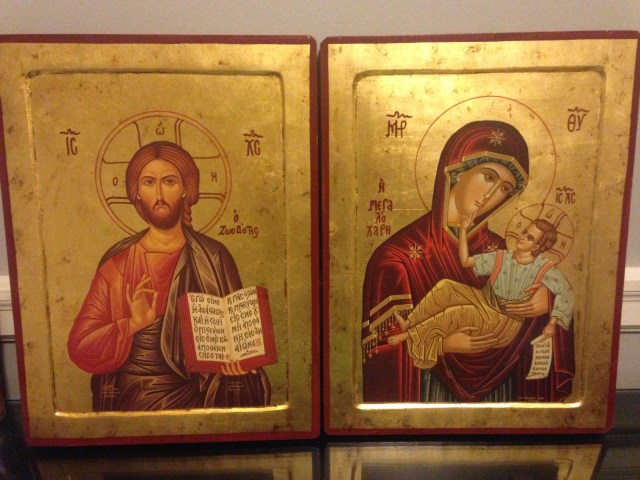
icons.JPG

Posted in sermons | Tagged , , , , , , , , , , , | Leave a comment