Faith from the Margins

Hello friends,

If you are a follower of Small Points of Light, my personal blog, you know that my journey is continuing to evolve and expand as I continue my life as an academic social work professor as well as pursue seminary studies toward ordination in The Episcopal Church.  You have seen me produce virtual faith formation activities, and you may have even seen some of the social justice blogging that I’ve gotten my students involved in.  You have undoubtedly observed that my pace of project impacts how often I write and publish on this site (a situation that I hope will be rectified in time, when I can resume my personal, reflective writing with more frequency!)

So, I invite you to take a look at (and consider following) my latest endeavor, Faith from the Margins to the Web.  This will be a weekly blog, supported through a grant from the Episcopal Evangelism Society, which pairs people across social margins together to reflect on the Gospel lesson for the coming week.  It is a project of deep dignity and justice: bringing us together, providing fair compensation to all authors and contributors, equally proclaiming voices of divine presence that are not hindered by the social marginalization of the world in which we live.  It is a project of deep spirituality and vulnerability where I let go control and allow Spirit to move through the words and experiences of others to the world wide webs of our virtual connection.

This is not replacing my personal blog, but it is an extension of the work and ministry that I am humbled and grateful to be able to do.  Please continue to follow me here, and consider seeing what emerges with Faith from the Margins to the Web, too!

pantry praying hands

Follow Faith from the Margins to the Web on Facebook and Twitter, too!

Posted in work and life | Tagged , , , , , , , , , , , | Leave a comment

Being Called In

A reflection for Proper 18, Year A

Prepared for Red Door healing service, Grace and Holy Trinity Episcopal Church (Richmond, VA)

Matthew 18:15-20

Jesus said, “If another member of the church sins against you, go and point out the fault when the two of you are alone. If the member listens to you, you have regained that one. But if you are not listened to, take one or two others along with you, so that every word may be confirmed by the evidence of two or three witnesses. If the member refuses to listen to them, tell it to the church; and if the offender refuses to listen even to the church, let such a one be to you as a Gentile and a tax collector. Truly I tell you, whatever you bind on earth will be bound in heaven, and whatever you loose on earth will be loosed in heaven. Again, truly I tell you, if two of you agree on earth about anything you ask, it will be done for you by my Father in heaven. For where two or three are gathered in my name, I am there among them.”

A few weeks ago, classes started back up again at VCU. Now, this probably comes as no surprise to any of you, because the streets and sidewalks around campus have gone from occasional strolling visitors to (literally) thousands of people who move en masse from class to class, turning every corner of this city campus into their second home. It’s definitely interesting immersed in an urban campus where when school is back in session, it feels like an entirely different world.

I have a whole new cohort of students that I’m teaching…some graduate students, and some undergraduates. My undergraduate students are sometimes barely more than teenagers…and some of them actually still are! They are trying to figure out everything from how to get up on time for an 8 a.m. class, to how to balance the need to study with the desire to have fun, to how to not use up their entire food budget in the first few weeks of the semester. But, VCU being what it is, the students in my classroom are also really diverse. My students are of various races and ethnicities and blends thereof; they are from different backgrounds and cultures; they have a vast array of identities that help define who they are.  Some of my students come from families with generations of college graduates and professionals who have long encouraged and coached them up to this point, while others are first generation college students who are trying this all out on their own, sometimes without any help…or even support…from their families.

The undergraduate class that I teach is called, “Social Work with Oppressed Groups.” It is a class that helps my students understand from all of these diverse perspectives that in this society in which we live, there are groups of people who are not given equal access to experiences and opportunities. I am helping them confront and grieve the fact that the idealism with which many of them were raised is going to be constantly confronted by injustices that they have to see and name. For some of my students, those injustices are a very real and present part of their every day lives. We learn to call that unfairness what it is: social injustice. We learn to call the ability to turn a blind eye to that injustice what it is: privilege. Sometimes, those are hard lessons.  But they are lessons we have to learn so that we can then strategize how to deal with these issues, individually and collectively.

In my classroom, I spend the first few weeks moving us from a group of distinct individuals who happened to sign up for the same class at the same time, into a community where we can deeply confront, reflect, and together learn and practice ways to make the world a more socially just place. We engage in a number of learning activities to get us there.  And, one of the things that I do is to teach my students a process I like to call “calling in.”  While it might sound familiar, “calling in” is different from that other thing that people often do when confronting injustice: calling out.

Calling in…like it’s cousin “calling out”…is a way to address oppression and injustice when we see it. But, unlike calling out which points out bad behavior in order to set it apart, calling someone “in” means that we pause to point out how something that was said or done doesn’t fit with the norms of justice, equity, and respect that we have agreed to share together. When we pause to call someone “in” it is about offering an opportunity for the person engaging in the problematic behavior to come back into community, for the community to voice their experience of what they heard and what they think happened from their diverse perspectives, and ultimately offering up the opportunity for the person to make amends, with support of the community, so that we can be whole again.

Lo and behold, it would seem that when I read our Gospel lesson for this week, I realized that Jesus was instructing his followers about “calling in” long before any of our modern social justice advocates ever thought of applying the term. In fact, Jesus offers an example so clear and so profound that it is a gift to his followers back then, and to the Church today. Jesus invites us to continually invite each other back into community. First, by having a one-to-one conversation with people who are our church family when something happens that rubs us the wrong way. Jesus doesn’t say, “shout at them and tell them how rotten they are!” Jesus invites us to share with them privately how their behavior impacts us and offer the possibility of reconciliation. Reconciliation is beautiful; Jesus knows that and we know that. In fact, this whole instruction in today’s Gospel is really about getting to that place of reconciliation…of calling each other back in to relationship as people of God…as members of the Body of Christ. Jesus’ invitation to us includes that powerful reminder of what happens when we are reconciled: we recognize God’s presence in our midst.

Think about that. In fact, think about a time when you have experienced reconciliation with someone you love: family, friends, children, parents, partners. We have all been in a place where a relationship that is filled with the love that comes from God becomes disjointed by our human failings: broken trust, dishonesty, slander, hurt, silence…the list goes on. But there are times that with the loving support of a loving God, those human hurts are transformed through healing and reconciliation. Maybe it is reconnecting with a family member who has been outcast, or making things right with a friend. Maybe it is someone extending you another chance, offering up reconnection.  Maybe it is passing the peace with someone who has once wronged us. I guarantee you, when that happens, when two or three are gathered…God is in the the midst.

So, I pose to you this possibility as I ponder of this week’s Gospel: maybe Jesus is calling us in.  Perhaps Jesus is pointing out to us in the still, small voice in our soul the areas where we are in need of growth, and healing, and reconciliation.  Maybe we listen, maybe we don’t.  We are still not lost.  Jesus uses the people around us as second chances to keep practicing how to come back into community.  Perhaps Jesus calls us in to spaces like Red Door where we are met with love, exactly as we are, and reminded of the transforming grace of reconciliation which exceeds our human imagination.  Perhaps Jesus is calling us in, and the way in which we reconcile is by seeing Christ in each other.

This place…right here…where we are gathered in the name of God bringing our prayers for hope, healing and reconciliation…God is here, with us, in our midst.  Offer up that good news to someone today.  God’s grace is calling us in.

IMG_3959


Posted in sermons, work and life | Tagged , , , , , , , , , , , , , , , , , | Leave a comment

Cleanliness and Godliness

A Reflection for Proper 15, Year A.

Homily prepared for Red Door Healing Service, Grace and Holy Trinity Episcopal Church August 18, 2017

Matthew 15: 10-28

Jesus called the crowd to him and said to them, “Listen and understand: it is not what goes into the mouth that defiles a person, but it is what comes out of the mouth that defiles.” Then the disciples approached and said to him, “Do you know that the Pharisees took offense when they heard what you said?” He answered, “Every plant that my heavenly Father has not planted will be uprooted. Let them alone; they are blind guides of the blind. And if one blind person guides another, both will fall into a pit.” But Peter said to him, “Explain this parable to us.” Then he said, “Are you also still without understanding? Do you not see that whatever goes into the mouth enters the stomach, and goes out into the sewer? But what comes out of the mouth proceeds from the heart, and this is what defiles. For out of the heart come evil intentions, murder, adultery, fornication, theft, false witness, slander. These are what defile a person, but to eat with unwashed hands does not defile.”

Jesus left that place and went away to the district of Tyre and Sidon. Just then a Canaanite woman from that region came out and started shouting, “Have mercy on me, Lord, Son of David; my daughter is tormented by a demon.” But he did not answer her at all. And his disciples came and urged him, saying, “Send her away, for she keeps shouting after us.” He answered, “I was sent only to the lost sheep of the house of Israel.” But she came and knelt before him, saying, “Lord, help me.” He answered, “It is not fair to take the children’s food and throw it to the dogs.” She said, “Yes, Lord, yet even the dogs eat the crumbs that fall from their masters’ table.” Then Jesus answered her, “Woman, great is your faith! Let it be done for you as you wish.” And her daughter was healed instantly.


One of the first classes that I took in seminary assigned us to read a book, Unclean, by Richard Beck.  This was a really fascinating read for me because it brought together psychological research about our cognition and behavior…what we think, and what we do…and considered this through the lens of faith.  One of the studies Beck talks about is an experiment conducted by psychologists Zhong and Liljenquist around our associations between physical cleanliness and moral purity.* In the study, the experimental group and the control group were both asked to recall a time when they experienced a moral failure.  To put it more bluntly, they were basically asked to think of some time they felt guilty about what they did or as we might say…to think of some sin they had committed, or a time they fell short of their own moral code.  Then, both groups were asked to voluntarily assist one of the graduate assistants with some tasks.  In other words, they first had to think of a bad thing that they felt defiled them, then they were asked to engage in a good thing, voluntary helping, presumably acting with greater morality.  Now, if you know how behavioral experiments work, one group is usually given some condition which is different than the other.  So, in the experimental group, the participants were given hand wipes.  That’s it.  In between thinking of their moral failure and being invited into positive moral action, they could physically cleanse their hands.  Any guesses as to what happened?

Well, it turns out that those who cleaned their hands physically were much less likely to agree to voluntarily help others.  Only 41% of those who used a wipe to cleanse their hands were likely to volunteer, whereas 74% of those in the control condition volunteered to help.   This held true in multiple repetitions and across groups of people.  It seems that we human beings psychologically associate our physical actions to make ourselves clean as having some moral value, protecting us from our failures and giving us a sense that we are morally cleansed just from the physical act of cleaning our hands.

OK, all this is fascinating, but you may be wondering, what does this have to do with our Gospel reading for today?  I think if we understand this very human association we make between physical behaviors and moral virtue, we can understand Jesus’ teachings…and even his own actions in this portion of the Gospel…a bit better.

When we enter into this portion of scripture, Jesus is in the midst of challenging some very common assumptions among the crowds, wrapped in with their religious and customary practices of the day.  There are many purity codes within religions…in this case, the Jewish religion as this was Jesus’ own context.  These codes and behavioral prohibitions existed for important reasons…to keep the community healthy, strong, and working smoothly.  There is nothing inherently wrong or bad about these codes of conduct.  The lists of behaviors and requirements of action were a part of the culture of this particular people at this particular time.  And it’s no different for us…our personal beliefs, our families, our communities, our religious faith, our culture often give us rules that in a particular context and time may be helpful to keeping the community well.  Jesus didn’t approach the crowd to say, “do whatever you want and toss the rules out the window!” Instead, Jesus was teaching within this rule-following crowd that it isn’t the specific lists of actions and behaviors which defile us…for example, eating the wrong thing, not washing one’s hands or being physically contaminated by something considered impure…but, instead, it is the intentions of the heart from which our actions emerge, “what comes out of the mouth proceeds from the heart, and that is what defiles.”

How much easier is it to cleanse our hands than it is to cleanse our hearts?

Think about that from the perspective of that psychology study.  We all hold onto thoughts and experiences where we know we weren’t exactly pure.  Let’s just be real about that.  Do we really think that a handi-wipe is going to assuage our guilt?  While it isn’t logical, apparently, we do.  It gives us a superficial sense of our worthiness and moral superiority to engage in an action that makes us feel physically clean.  Does this cleanse our hearts?  Of course not.  It just makes us feel better about ourselves.  But the inner intention of the heart…which in the face of actions we regret is often our own selfishness…is allowed to thrive.  Those who conducted that study also asked the two groups follow up questions about their feelings and found that the act of physical cleansing was associated with people feeling less guilty and ended up with people who were generally unhelpful feeling morally justified for not helping.   The moral guilt of the control group, on the other hand, prompted them to reconsider their motives and act in more helpful and altruistic ways.  The state of the heart (in this case, helpfulness and altruism toward another person) had a direct impact on people’s desire to actually help.  But, for some, their self-assurance through physical self-cleansing got in the way.

This, I think, is what Jesus is teaching: sometimes our self-assurance in our own attempts at cleanliness can keep us from experiencing Godliness…what is truly holy.

What follows in this Gospel is a chunk of scripture that I wrestle with, as do many others.  I want to think of Jesus as perfect; I want his divinity to suggest perfection and blamelessness in the face of all that this human life offers.  This story reminds us that Jesus is fully divine and fully a human being, living in a society that like ours where some classes and people are privileged over others.  His encounter is with someone who is socially outcast not on her own merits, but because she is a Canaanite.  And, let’s just call it: she is also a woman.  There were strict codes about how much contact and of what kind someone could have with those who were considered outsiders…defiled…impure.  Both Jesus and his disciples were just going along with the social norms: keeping distance, even reminding the woman of her lesser social standing.  This section really is just as awful as it sounds.  I’ve wondered, as I’ve sat with it this week, if its there because it is so embarrassingly human that we feel the need to minimize and dehumanize other groups of people.  Do I even need to draw the inference that this mirrors plenty of the hate-speak and oppressive talk that we hear today?  Perhaps its inclusion in the canon of the scriptures serves as an awakening moment that none of us…not even Jesus…are immune to the effects of minimizing others in an attempt to reinforce our own goodness.

But in today’s Gospel, something different happens.  This human being…a Canaanite woman…recognizes Jesus as “Son of David” which is shorthand for her acknowledgement of Jesus as Messiah.  She sees the holy within, not the collusion with the social sin that defiles.  When holy meets holy, healing happens.

Healing, it turns out, is inner grace.  Healing rests with God: to heal our brokenness, to realign ourselves with an inner design in the image and likeness of God.  God’s grace is not a handi-wipe offering superficial physical self-cleaning.  God’s grace purifies the soul, and changes all of what comes out of us to reflect actions of healing love.

No matter where you find yourselves in this story…attempting to get all the behaviors just right so that you can feel clean; moving in circles minimizing others to make yourself feel better; socially outcast; reaching out for healing; eating the crumbs of the table others have left for the dogs…it is the inner core of divine healing and grace which presents another way entirely. That holiness can reside in the hearts of people in all of those social spaces, from the high and mighty to those living at the margins.  Holy recognizes holy, and it is in that space that true healing happens.

*Beck, Richard (2011).  Unclean: Meditations on purity, hospitality, and morality.  Eugene, OR: Cascade Books.

hands

Photo by Nheyob (Own work) [CC BY-SA 4.0 (http://creativecommons.org/licenses/by-sa/4.0)%5D, via Wikimedia Commons

Posted in sermons, work and life | Tagged , , , , , , , , , , , , , , | Leave a comment

We must do better

I acknowledge up-front that I have the privilege of stepping into a bubble when I want to.  I’m a white woman, of the kind-and-round-faced variety who generally speaking doesn’t make waves when I walk into unfamiliar spaces.  I often remind someone who doesn’t know me of someone they’ve met before.  People tend to talk to me; apparently, I don’t seem threatening or unapproachable.  My exterior presentation makes it easy for me to slip into places and seem like I belong, so people tend to open up to me.  That, added to my social worker sensibilities, means that I end up having many conversations with many people in spite of my inner longing to introversion.

So, it has been that way this summer in my visits to churches where I haven’t worshipped before: always talking with people, always a sense of welcome, always some new information shared with me, always something to learn.  During these summer months, I am taking some time to visit churches that I haven’t been to before, paying attention to the ways in which people gather and how they worship together.  It’s very relaxed; I have no agenda because I’m not church-shopping or checking out someone who may be looking for a new call, nor am I looking for a call myself.  I will be happily rejoining the parish I serve as seminarian in the Fall, and I am prayerfully aware of my ongoing connection to the parish sponsoring me as I prepare for ordained ministry.  There are beautiful, wonderful people in both those spaces who pray for me, as I pray for them every week.  It will be good to see all of them again soon, since both places feel like home.  But for now, I am intentionally wandering, learning, being church with people in different spaces and different ways and appreciating what I learn.

I expect the good in people, especially in a space of radical love.  Even though that hasn’t always been my experience with organized religion, it is nevertheless what I expect churches to be.

Today, I was at a church that I won’t name.  The space was beautiful, inviting and signs of welcome were everywhere.  The clergy were kind, the people were friendly.  Everyone was well dressed, but not so much that those coming in felt put off.  There were hymns and prayers, and talk of recent mission trips for the youth.  It could be any well-respected church in a suburb near you, working hard at being a place that regular members love to come to and where newcomers feel welcomed.  And, to their credit, I did feel welcomed.

I was standing in the aisle after the service, waiting to say hello to the clergy and making small talk with the friendly older couple I had been sitting with (I had taken “their pew” but instead of being fussy or moving they introduced themselves by saying, “how nice to meet you…I’m glad you’ll be sharing our pew with us!”)  This honesty endeared me, so I was sharing a little bit about myself and making general small talk with them.  A woman just behind us was chatting with someone else about her grand-children and I overheard her mentioning that her grand-son was going to be a senior at a particular high school, which happens to be the school my daughter is about to attend in the Fall.  I was very excited to hear this, especially in a suburban church about a public, city school.  I turned and said, “I’m sorry to interrupt, I’m just visiting and happened to overhear you, but my daughter is going to be starting as a freshman at that school in the Fall.  How has your grand-son enjoyed it?!”

Let me interrupt with the fact that I’m really excited about this school, as is my daughter. We happily live in the city by choice, and the school being discussed is a public, specialty school which is both highly rated and located in what many people would call, “a sketchy neighborhood.”  It has a 99% college acceptance rate and students graduate with millions of dollars in scholarships, collectively.  Its published admission policy is to hold 70% of spaces for students from socio-economic and racial minority backgrounds.  Every student enrolled has been tested, interviewed, and has agreed to academic rigor mixed with extensive community service requirements.  Incidentally, I live very close to this “sketchy neighborhood” and I am thrilled that my daughter was accepted to this school.

What happened next seems small, but it is huge because it is so pervasively ever-present.  The woman who had never met me took my arm, pulled close to me and said, “He’s done well considering the circumstances but, you know dear, our kind is outnumbered there.”

My heart sank.  No, it didn’t sink.  It broke.  Again, and again, and again like it breaks every time I realize for the thousandth time that racism is alive and real, and that in our perpetuated privilege of separating ourselves from the “other,” we are encouraging it to thrive.

In retrospect, I wish I would have been bolder.  I’m kicking myself for a hundred really good come-backs that I only thought about after the fact.  But as a complete stranger, I opted for what seemed like a safe middle ground.  As if I didn’t hear the intent of her remark I said, “Well, what I love about it so far is that the principal seems to be an exceptional leader who sets a priority on building an inclusive community that appreciates every student’s strengths.”  I thought maybe that would be a hint about my value alignment, since the principal is a highly regarded community leader who is a person of color.  But no, she went on; “Well, I will say that he keeps all those kids under control, which likely keeps them out of jail.”

I felt like I might throw up.  At this point I was just relieved to be nearing the exit.  I shook the clergy’s hand and did a quick introduction of myself as a visiting seminarian, then headed out the nearest door as quickly as I could.  I passed the lemonade and cookies and all the middle-class, white children playing on the pretty church playground while their families chatted together.  The safety of the protective layer of whiteness felt overwhelming.  I sat in my car with tear-filled eyes, not just at the blatant racism but at my own privilege and lack of courage.  I looked at the clock and wished I still had time to get to one of the incredible, vibrant parishes I have attended recently where, when I was the person who looked different than everyone else, all I received was love and welcome.  Real welcome, not conditional.  I’m fairly sure I would not have been so lovingly treated at my visit today if my pale face were of a different hue.

I am embarrassed by the injustice and hypocrisy that are painted on me, a layer of privileged whiteness that I cannot scrub off.  “I don’t want to be one of you!” I yelled as I drove out the tree-lined driveway and headed back into the city.  And I know, not every person in that space may have felt the same way.  But somehow, it was perfectly fine to express to a perfect stranger the seemingly sacred space of being in the ethnic “in crowd.”  Truthfully, I am broken-hearted because racial distrust and disrespect are as much engrained in that woman’s life as it is in my own blindness to the privilege I have to easily walk in to somewhere and be perceived immediately as “one of us” whether I want to be or not.  I should have said more.  I should be a better advocate than I am.  I shouldn’t have run away without addressing the elephant in the room.  I am pitifully, painfully human.

White friends, we have to do better.

Why on earth, in 2017, are we still unable to recognize the pain we create by depersonalization of people of color?  Today it was one woman’s racist, classist assumptions spoken to me as “one of us” that rose the ugly head of racism at the end of a service of Holy Eucharist, the coming together of the Body of Christ…which, in case anyone is confused about it, is not white and privileged.  It is broken, reconstituted and comprised of all of us.  All of us.  Racial exclusion is the exact opposite of how Christ lived and taught.

And let me not seem to be pointing a finger at any one person or parish…that is not the point here.  Is it any less racist when people move to suburbs for “better schools” or we fight changes in school zoning to keep “our kids” in the best location?  Or when we selectively choose spaces to worship, play, or socialize that are filled with people who look just like us?  And for me…I am really excited for my daughter’s high school but what would I have done if she wasn’t accepted there and was heading to our zoned high school?  And why would I feel the way that I feel about that?  From where do my assumptions emerge?  How much privilege am I willing to give up to be sure that every person has an equal playing field?  I have to own that and all of the layers of privilege and guilt that come along with it.  Children…human beings who deserve to learn well and be loved…are in every school.  Human beings are in every neighborhood.  The racism, depersonalization and oppression of human beings in the United States has led to structures of perpetuated poverty, class conflict, and couched (as well as blatant) racism that keep us from having to honestly check our assumptions and our privilege.  What do we gain from this?  What are we willing to give up to break this cycle?

These are hard questions, friends.  They are guilt-inducing and we avoid them like the plague and tune in to Netflix and binge-watch something else instead.  But these questions and our white privilege and guilt are not the same as having to fear for our lives, having to fear arrest by profiling, having to face dehumanization and discrimination that people of color in the United States experience every day.

Every. Single. Day.

Today was a wake up call for me.  Friends, it’s not OK to be racist.  Not in church, not in “polite society” and not hiding in the bubble of our own privilege.  Oppression includes these subtle (but no less real) incidents of passive racism and white protectionism.  If I call you out (or “in”) on it, it is because I need to hear it myself and not because I’m making an example of you.  I need to feel it, say it, confront it, change it.  We all do.

Repentance has to come before there is any hope of reconciliation.

Forgive me.  Forgive us.  We have missed the mark, again.  So, we commit, again:

Will you seek and serve Christ in all persons, loving
your neighbor as yourself?
I will, with God’s help.

Will you strive for justice and peace among all
people, and respect the dignity of every human
being?
I will, with God’s help.

–from the Baptismal Covenant, Book of Common Prayer (1979)

Yes, I will, with God’s help.

Amen

Posted in work and life | Tagged , , , , , , , , , , , , | 3 Comments

Now, but not yet…

A reflection for Proper 12, Year A
Prepared for Red Door Healing Service, Grace and Holy Trinity Episcopal Church

Matthew 13:31-33,44-52

Jesus put before the crowds another parable: “The kingdom of heaven is like a mustard seed that someone took and sowed in his field; it is the smallest of all the seeds, but when it has grown it is the greatest of shrubs and becomes a tree, so that the birds of the air come and make nests in its branches.”

He told them another parable: “The kingdom of heaven is like yeast that a woman took and mixed in with three measures of flour until all of it was leavened.”

“The kingdom of heaven is like treasure hidden in a field, which someone found and hid; then in his joy he goes and sells all that he has and buys that field.

“Again, the kingdom of heaven is like a merchant in search of fine pearls; on finding one pearl of great value, he went and sold all that he had and bought it.

“Again, the kingdom of heaven is like a net that was thrown into the sea and caught fish of every kind; when it was full, they drew it ashore, sat down, and put the good into baskets but threw out the bad. So it will be at the end of the age. The angels will come out and separate the evil from the righteous and throw them into the furnace of fire, where there will be weeping and gnashing of teeth.

“Have you understood all this?” They answered, “Yes.” And he said to them, “Therefore every scribe who has been trained for the kingdom of heaven is like the master of a household who brings out of his treasure what is new and what is old.”

“The kingdom of heaven is like…”

Today in this one, short section of the Gospel of Matthew we hear Jesus speak this phrase six different times. Not once; not twice: six.  When someone explains something to me six different times in six different ways, I have to assume that what is being talked about is really important. So, before we can even get to a place where we can talk about the comparisons offered in Jesus’ teachings, I think it might be important to pause and ask ourselves: why is it that explaining the kingdom of heaven is so important to Jesus?

Some of you know that in my seminary studies, I’ve been taking a summer intensive in Biblical Greek. I know you know, because you’ve been checking up on me to be sure that I’m learning…and I appreciate your encouragement! So, you can give me a gold star for applying my learning this week.   As I pondered this Gospel lesson, one of the things I did was to spend some quality time with my Greek New Testament around this phrase, βασιλεία τῶν οὐρανῶν, which yes, is literally, the “kingdom of heaven.” But the words come together in a way that doesn’t speak to a particular place set apart; it’s an expression that compares how things are done as we know them here on earth, and how things are done as God knows them to be.  We might paraphrase it today, “the way things get done in the place where God is.” This kingdom of heaven that Jesus is talking about is the rule of life of the realm of God.

One reason why this teaching may be so important to Jesus is because he is living in two worlds. We understand Jesus to be both fully human, and fully divine.  Fully human Jesus is living in and among the culture and people of this world; he sees and experiences every day how the rule of earthly powers plays out. Simultaneously, fully divine Jesus has knowledge to impart to his followers about the lavish, incomprehensible beauty of God’s love in ways that defy our logic. Consider the way we hear this same phrase spoken of earlier in Matthew’s Gospel in my favorite part of the Beatitudes: “Blessed are the poor in spirit for theirs is the kingdom of heaven.”

The extravagant love of God is quite unlike anything in this world. But occasionally, we do catch a glimpse of that unconditional, lavish love. When Jesus talks to his disciples about the kingdom of heaven, he is speaking of something which is both now…and not yet. This finite, temporal world that Jesus knows is filled with sickness, imperfection, selfishness and death. But God’s presence is not absent in the experience of this world. God was, and is, present.  God is with us, even now, even in this context of our own city filled with its poverty of spirit and scarcity of resources. God’s love isn’t just “out there” or “later on.” God’s reign cuts through the heavens and reaches into our earthly lives, helping us to know there is something larger, greater, and more powerful than only what we can see right now in the limited scope of our individual, human existence. We are moving together toward that hope-filled vision that we pray whenever we pray the Lord’s Prayer together: that God’s reign may come on earth, as it is in heaven.

So, Jesus…who holds this tension between the now and the not yet in his very person…tells his followers a sequence of parables. He does this using the understanding of the context in which they are living, using the ordinary examples of the lives of people around him who garden, who fish, who cook for their families. One of those parables seems to build on those weeds we talked about last week…the tiniest mustard seed (which is, actually, a weed) growing in its fullness to become a shade-giving bird sanctuary. Another reveals how the tiniest amount of yeast is all that is needed to rise bread for baking. There is a comparison with hidden treasure, with the pearl of great price, and with an abundance of fish. But all of these parables are also counter-cultural. They are also the upside-down kingdom, fundamentally altering our understanding of what is good and right and sensible: weeds become life-giving, unclean leaven feeding the multitudes, hidden treasures of unknown value worth selling all one has. Instead of catching only the best fish, all are gathered up in the net together. This isn’t how things usually happen. But, these are examples of how different things are…and a hint about how things will be…when the rule of life becomes the reign of God.

My favorite part of this lesson, though, is the end. After Jesus shares these thought-provoking examples designed to challenge all the normal assumptions of life, he asks his disciples: “Have you understood all this?” and their answer is “Yes.”

I can imagine Jesus smiling a knowing smile. Even smirking or chuckling, perhaps. I can also imagine saying “Yes” because I thought I understood.  Or, perhaps, I understood just enough to know that the answer was supposed to be “Yes.”   And I can imagine saying yes, because it’s always hard to be the one to say, “Actually, I’m not sure that I understand…” That would take courage, authenticity, and a belief that I am actually capable of receiving lavish and unconditional love even when I have no clue why things are happening the way that they are.

I think the better and more truthful answer might have been, “not yet.”

The Gospel writer was scribing these stories after-the-fact, probably 80 or 90 years after Jesus’ death and resurrection. It seems, then, especially appropriate for us to hear one last parable of Good News from Jesus about the kingdom of heaven: “every scribe who has been trained for the kingdom of heaven is like the master of a household who brings out of his treasure what is new and what is old.”

I think that is a parable meant for us.

We sometimes think of the stories of our scriptures as something old, written thousands of years ago. True enough. But what if, like the kingdom of heaven, they are also now…but not yet. We receive glimpses of the reign of God cutting through the unfairness and uncertainty of the world. In the scriptures, we find treasures for our soul which far out-value anything of human wealth. Those treasures emerge now, and continue to emerge until they are fully known to all people. We catch a glimpse in a moment of connection, in a weed, in the breaking of bread, in small glimpses of divine abundance reminding us that there is something more, something greater which is both here, and beyond…now, and not yet.

That tiny grain of God’s truth is perhaps all that we need to grow into our fullness. Where is that truth speaking to you? How are you a scribe for the kingdom of heaven?

I happen to think your stories and God-experiences hold every bit as much truth as these parables. God is still speaking, telling stories of the now and not yet which build our lives of faith. It is a hope-filled tension in which we live, in glimpses of profound beauty our human eyes can see and the hope that fills the eyes of our souls awaiting to see the Kingdom of Heaven.

There are many times in this life when the kingdom of heaven seems very far away.  But there are moments at Red Door when I can palpably feel God breaking into our midst, the “now” glimpse of the kingdom of heaven where all that divides us in this world falls away to reveal our connection together with the God who loves us lavishly.  Together, we hold those moments of God’s nearness in the now, awaiting with hope and prayer the “now but not yet” of God’s kingdom on earth, as it is in heaven.

mustard-1750338_960_720

Posted in sermons | Tagged , , , , , | Leave a comment

The Patient Gardner

A Reflection for Proper 11, Year A
Prepared for the Red Door Healing Service, Grace and Holy Trinity Episcopal Church

Matthew 13:24-30,36-43

Jesus put before the crowd another parable: “The kingdom of heaven may be compared to someone who sowed good seed in his field; but while everybody was asleep, an enemy came and sowed weeds among the wheat, and then went away. So when the plants came up and bore grain, then the weeds appeared as well. And the slaves of the householder came and said to him, ‘Master, did you not sow good seed in your field? Where, then, did these weeds come from?’ He answered, ‘An enemy has done this.’ The slaves said to him, ‘Then do you want us to go and gather them?’ But he replied, ‘No; for in gathering the weeds you would uproot the wheat along with them. Let both of them grow together until the harvest; and at harvest time I will tell the reapers, Collect the weeds first and bind them in bundles to be burned, but gather the wheat into my barn.’”

Then he left the crowds and went into the house. And his disciples approached him, saying, “Explain to us the parable of the weeds of the field.” He answered, “The one who sows the good seed is the Son of Man; the field is the world, and the good seed are the children of the kingdom; the weeds are the children of the evil one, and the enemy who sowed them is the devil; the harvest is the end of the age, and the reapers are angels. Just as the weeds are collected and burned up with fire, so will it be at the end of the age. The Son of Man will send his angels, and they will collect out of his kingdom all causes of sin and all evildoers, and they will throw them into the furnace of fire, where there will be weeping and gnashing of teeth. Then the righteous will shine like the sun in the kingdom of their Father. Let anyone with ears listen!”

When I was young, we lived in a very rural part of upstate New York. First we lived on a farm…it belonged to my grandparents…and then when I started school, we moved to the nearby town, population 1,500 people and probably as many cows. My extended family still lived on or near the farm, the lands and fields around which were part of my family’s property.

My grandfather, before he died, gave each of his children an acre of land on which to build a home. Many of my relatives did this, but my parents moved to town closer to where my mother worked and thus, they had an acre of land sitting unused. My mother…the frugal daughter of a farmer and an elementary school teacher who had summers unscheduled…decided that we would use our acre to plant a garden. There was a well and a pump on the property, so buckets of water could be carried from yards away to water the rows of vegetables even though the garden was miles from our actual house.

At first, I loved this idea of a big, bountiful garden. My uncle plowed up the soil with his farm-sized cultivator and we went to the seed store where there were bins and bins of bulk seeds for peas, beans, and corn. We had onion sets, and potato starters as well as teeny, tiny seeds for carrots, lettuce, swiss chard, and beets. Then there were summer squash, zucchini, and cucumbers which were planted in big mounds instead of rows. Tomatoes were the only things we started from small, seedling plants to give them a head-start in our northern climate. Last, but not least, were the seeds I was going to plant in my own corner of the garden: watermelon seeds, pumpkin seeds and a little package of “Peppermint Patty’s Parsley” that I had gotten as a free surprise inside a bag of wonder bread.

Planting was so much fun. The soil was loose from the cultivator, and plopping the little seeds in their rows and furrows filled me with images of perfect little plants yet to emerge. Better yet was when the seeds started to grow! Tiny seedlings of all these different shapes and sizes. My Mom taught me how to recognize the plants by the shape of their tiny leaves, and the color of their sprouts. This gardening thing was great, I thought.

And then came the weeds.

This acre of garden had been, until that summer, an uncultivated field of wild grasses and weeds. Those weeds, it turns out, also had seeds that had naturally scattered into the garden and some weeds had roots that went further down into the soil than even my Uncle’s cultivator could break up. From the joy and potential of planting in late spring came the arduous summer of the weed. My mother’s morning declaration of, “get dressed, we’re going to work in the garden!” turned from a fun outing to a dreaded task. I’m sure I probably didn’t hide my feelings well, but I knew better than to protest outright. My mother made a deal with me: as soon as I finished taking care of my garden chores, I could walk across the back-lots to get to my Aunt Joyce’s house and go for a dip in the pool. That was a deal I could live with. And it worked, for a few days.

But, kids being kids, I began to think that maybe I could do my chores really fast, thus getting to the pool more quickly. So, one day I started the correct way, by tending to my rows and mounds by hand, carefully avoiding the tiny plants and second plantings of seeds as I removed things that didn’t belong, and watering the plants they were growing. I did this for about fifteen minutes, which probably seemed like half a day. Then, I got a bit more careless and started occasionally ripping away a seeding or two as I removed handfuls of weeds. I justified this, “Mom said some of the new plants might need to be thinned!” This still seemed to be taking too long. So, I found a rake, and started dragging it through the weeds (especially the ones that were prickly), ruthlessly ripping up the soil around them, which included both freshly planted vegetables and their weedy neighbors. My Mom came running when she saw this, and took away my rake. She showed me the little plants that had been cut off at the roots from my overzealous and careless gardening. She didn’t let me go to the pool that day. And, I didn’t feel much like it anyhow. I saw the little plants that we had worked so hard to grow, lying there and withering up in the sun. I felt bad for them, especially my Peppermint Patty Parsley. I tried to stick it back in the soil, but as we know, without roots nothing can continue to grow.

I never did learn to like weeding, but I did learn something about the value of patience.

This week’s Gospel lesson is a parable Jesus uses to teach his followers. It reminds me an awful lot of that story from my childhood. At first read, we might be thrown by some of the language: the furnace of fire and the weeping and gnashing of teeth…but frankly, that part of the passage isn’t really the point Jesus was conveying.  That final destruction of discarded weeds is what happens at a whole different time, after there has been so much tending from the gardener and all of the good fruits of the lovingly planted seeds have been gathered to nourish the family of God. The soil is good, the seeds are filled with potential, and they are lovingly planted, taking root in rich soil that continues to provide nourishment. Our Gardner…the Son of Man…Jesus is diligent and knows the identity and potential of every seed that he planted. He also knows that, like the garden of my childhood, no place on this earth is free from weeds. But it isn’t up to the plants to attack the weeds around them, and it isn’t up to those who work in the gardens to rip out ruthlessly everything that might be a weed, either. Jesus knows all of the potential of each and every good seed planted in that garden and how to help nurture their growth to the fullness of harvest. There is water…like our waters of baptism. There is sunshine, the radiance and energy of resurrection. There is air, the cool wind of spirit. There is support in the firmly planted roots of community and among the rows and mounds of other plants who are also growing together. There is, for all of us plants, the tender attention of the patient and loving gardener to see what fruit is emerging and to know which fruits are ready, exactly when they are needed most in the world.

The workers may get impatient; I know I did and often, I still do. But it is the watchful care of the gardener that keeps us from doing damage to others who are still growing. Jesus does not convey this parable suggesting there is something we should do to fix the garden.  This parable is about the Kingdom of God, which doesn’t need our interference.  It’s as if Jesus is saying to his followers: Listen to me: I’ve got this.  I am in the world, and I know what is here.  I know the plants, and I know the weeds.  In the end, all will be set right.  But right now, your job is to grow.

Our lesson today reminds us that we are plants, who are growing under the care of an attentive and loving God. We are being tended, good seed sown in good soil which is being nurtured into fullness. God never promises us there won’t be weeds growing along beside us. We live on this earth: we see the weeds along with the wheat and worry, perhaps, that the weeds will overpower us. But that is not the story of the Kingdom of God. The patient and loving gardner has a much better plan in mind, and knows all that he has planted. Not to mention the other possibility: what looks like a weed to us may be a plant bearing an entirely different kind of fruit. Their leaves may be bitter, but they have roots filled with the potential to nourish. Our job is to grow, and our reassurance is that in God’s Kingdom, all of the seed that God has sown is loved and cared for. God is the patient gardener of the dry and weedy garden of this world. God revives us with holy waters of new birth in Christ, and cools us with the consolation of the Holy Spirit.

Today, in the fullness of summer, take time to be still, and know that God cares for you. God’s love is tending each one of us, who are growing together into our fullness through the loving attention of our patient gardener, Jesus Christ, who knows all of our potential for growth.

garden

Posted in sermons | Tagged , , , , , , , , , , | 2 Comments

Ascension

A sermon for the Seventh Sunday of Easter (Sunday after Ascension), Year A

Prepared for Grace and Holy Trinity Episcopal Church, Richmond VA

Lectionary Readings

Between my days as a college professor and my evenings as a seminary student, I spend a lot of time with words.  Having just brought both academic years to a close, I can honestly say that I have read thousands of words my students have submitted in terms papers, dissertations, and thesis proposals.  And, frankly, I think I’ve put almost that many words on paper myself in my own seminary coursework.  Maybe it should come as no surprise that the divine inspiration that found me this week hasn’t been through words but instead, through art.
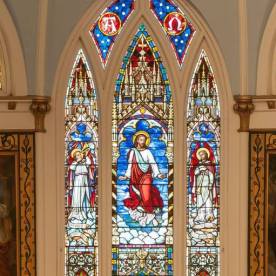
ascension1

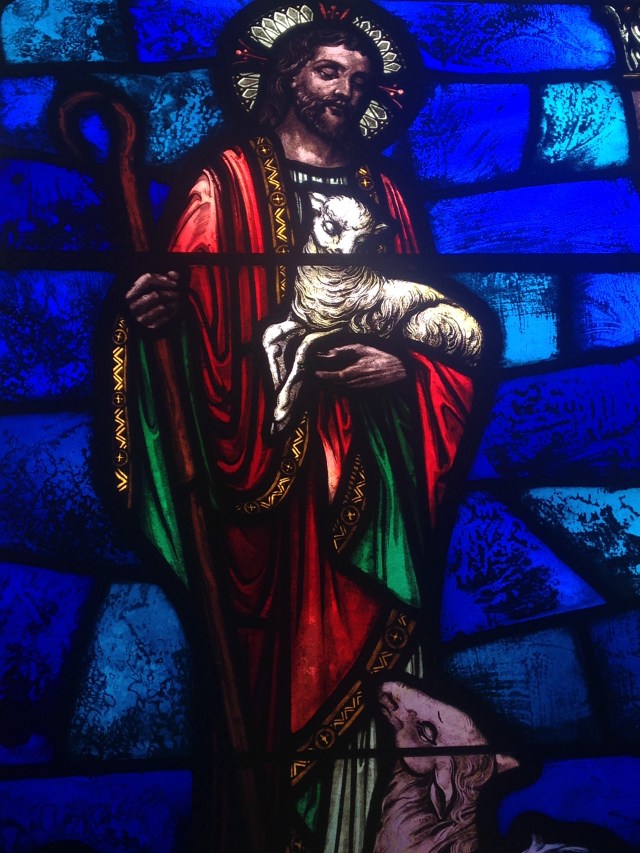
Here at Grace and Holy Trinity, images of the Ascension have been constant companions in my journey of getting to know this parish.  Every time we face the altar, we are drawn into worship by the stained glass image of the ascended Christ.  And for me, my usual seat as lay assistant for the 8:45 service…and for choir at the 11 a.m. is right there…where my front-facing gaze naturally focuses on the mural of the Ascension.

These welcoming and now familiar images have been with me across the churchascension year, as I’ve been learning the liturgy and music and the cadence of parish life.  The images we have here in the midst of our worship together are glorious works of art depicting Jesus lifted up in the clouds, being met by an awaiting triumphant angelic chorus, his disciples banding together, looking skyward with wonder and amazement. These images were chosen for this space with intention by those who pre-date our worship here today by nearly a century.   Each Sunday we, like the disciples, can look with awe and wonder at Christ who is here with us, but also of another realm, in the very presence of and being with God.

After pondering our own parish art, I began to wonder about how these artistic renderings of Christ’s ascension had evolved over the history of our Christian faith.  So, I did a quick search, browsing around for examples of religious art and depictions of Christ’s Ascension across the ages.  When my gallery of images took me to medieval and renaissance art; much to my surprise (and chagrin), I found the most focus on Jesus’ feet.

feet1

Ascension of Christ    15th Century, Italy


Now, in all honesty, I’m not a big fan of feet.  So, I thought maybe these particular foot-focused pieces of art were just a random few that happened to jump out at me.

feet 4 13th century french

13th Century, France

But, no…as I researched this artistic phenomenon a bit more, it seems that particularly in the middle ages, the way in which Christ’s Ascension was portrayed largely focused on the viewpoint of his disciples, looking upward where all that was remaining on the canvas…or the fresco…or the ceiling ornamental were Jesus’ feet, being lifted off this earth, and into the clouds.

This is a very literal, physical portrayal of an event which today might seem to us quite ephemeral, or perhaps even a beautiful, artistic metaphor.  Admittedly, my intellectual curiosity had been piqued, so I found myself being drawn into these renderings of feet and thinking about them as I reflected on what I’ve come to know about Church History and theology over the centuries.  

I immediately thought of another practice of medieval piety, referred to in my studies of liturgy and sacramental theology as “ocular communion” where the gathered faithful would sometimes only glance at the consecrated elements during key moments of the Eucharistic Prayer, believing themselves unworthy of anything but the quickest, passing glance at the real presence of Christ.  This was their communion; they didn’t partake in the distribution of bread and wine, Christ’s body and blood, except with their eyes.  The intensity of the real seemed too much for their vulnerable, ordinary humanity to ingest.  Art and image have the ability to convey meaning beyond words.  Another example, the illuminations of medieval manuscripts…which, by the way, are also filled with images of the feet of the ascended Christ….conveyed a message even to those who had no access to the words of Holy Scripture.  Sacred mystery was conveyed not by intellectual discourse and theological study but also by the very glimpse of that which conveyed the sacramental: the outward and visible sign of an inward and invisible grace.  
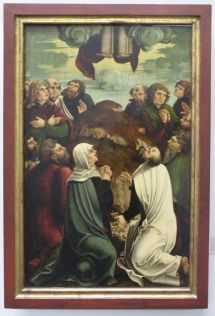
feet 3 16th century german

16th Century, Germany

It’s a challenge for us in our modern lives to draw into ourselves their depth of reverence for sacred mystery.  What strikes me about the ascension, in all of these works of art and images that my eyes have feasted on this week, is that Jesus is never gone.  Our eyes retain a glimpse of the vision of Christ…even if only his feet…as we recognize that our own feet are planted firmly on the ground of this earth.  In art, across the centuries, we are able to catch a glimpse of sacramental presence, even in a story of physical absence.

This realization brings me back around to the Gospel lesson, from the 17th chapter of John.


Today we hear the final portion of Jesus’ farewell discourse with his disciples which John places immediately after the last supper, and before the night on which Jesus was betrayed.

If we draw into the context of that unfolding story, feet also play a prominent role.  At the last supper, it is Jesus who wraps a towel around his waist, who kneels down, and who lovingly washes his disciples feet.  In the boundless, juxtaposed, expectation-altering actions of Jesus it is our human feet that Jesus washes.  And, after the close of this farewell discourse where Jesus offers a gallery of symbolic images and illustrations about divine love and grace…the vine, the way, the truth, the life….we are given Jesus’ parting gift.

Jesus prays for us.  For us.

Jesus isn’t praying just for those specific disciples gathered at that place and time, nor generally praying for all humanity.  Jesus very specifically prays for those who are his followers, who claim their identity and discipleship as people of Christ:

“Holy Father, protect them in your name that you have given me, so that they may be one, as we are one.”

Jesus’ parting gift to us is to pray for holy oneness, in the name of Christ.

feet 5 nave vault Ascension York Minister

Nave Vault, Ascension York Minster

I come back to this image of the Ascension, as we stand together with those other disciples, called in Jesus’ name, awestruck and perhaps a bit terrified as we gaze heavenward, trying to catch that last, parting glimpse of Jesus who is brought into the eternal glory of all that is God.  Our reading from Acts gives us a sense of how those early followers of Christ responded.  As the gathered disciples are gazing heavenward, two messengers of God join them to relay a divine message: “why do you stand, looking up toward heaven?”  or maybe, I could paraphrase that: “why do you keep staring at Jesus’ feet?”  They are reassured again, in that moment, of the two-way, continuing relationship initiated by God and revealed in the unfolding of Jesus’ reign on earth, as it is in heaven.

feet2 queen mary psalter

Ascension, Queen Mary Psalter

This band of awestruck followers returns to Jerusalem, together.  They set out, of course, on foot. They enter the place that they share together as a house of worship and community.  They devote themselves, constantly, to prayer.  They hold with them the knowledge that they are the hands and feet, the eyes and ears and mouth of Jesus.  They share in this holy oneness of common prayer, pondering the ways in which they might live into Christian life not only in their own community but in the whole world.  The awe of the ascension and the fervor of their prayers fill us with great anticipation of the birth of what we will come to know as the Church.  

But that is a sermon topic for next week, so I don’t want to step on any toes, literally or figuratively!

Today, we are standing together in the glory of the ascended Christ, caught between our desire to look heavenward with awe, and our exhortation to be the feet that walk the Good News of Christ into all corners of the world.  

Jesus’ prayer for us is the invitation to holy oneness, with each other, through the power of the resurrected and ascended Christ.  

Stop staring at Jesus’ feet.  Pray, eat, and be transformed.  Be Christ to the world.  

Do this together, as Jesus reminds us, in remembrance of me.

Amen.

IMG_2861

Ascension Window, Grace and Holy Trinity Episcopal Church

Posted in sermons | Tagged , , , , , , , , , , , , | Leave a comment

Advocate

A homily for Easter 6, Year A prepared for the Red Door Healing Service, Grace and Holy Trinity Episcopal Church
John 14:15-21

Jesus said, ”If you love me, you will keep my commandments. And I will ask the Father, and he will give you another Advocate, to be with you forever. This is the Spirit of truth, whom the world cannot receive, because it neither sees him nor knows him. You know him, because he abides with you, and he will be in you.

”I will not leave you orphaned; I am coming to you. In a little while the world will no longer see me, but you will see me; because I live, you also will live. On that day you will know that I am in my Father, and you in me, and I in you. They who have my commandments and keep them are those who love me; and those who love me will be loved by my Father, and I will love them and reveal myself to them.”

I was talking with a friend this week, describing the kind of support that I wanted and needed in some areas of my life.  It was one of those conversations where I started squirming part-way through; I worried that I seemed needy, perhaps even whining a bit too much about what I wish I had, when I already have so much.  But my friend didn’t hear it that way.  What she said…or at least, what I heard in her words was this: sometimes it does have to be about me.  Sometimes I am the one who is vulnerable, who doesn’t have everything that she needs.  Sometimes I am the one who needs an advocate.  In other words, my need wasn’t a privilege I got to brush off and pretend that everything was under control.  It was a need on which my own life and well-being depends.

That was hard for me to hear.  At the same time, it was a gift.  You see, it’s a whole lot easier for me to take care of other people, to focus on the challenges I see in the world around me than it is to stand in a vulnerable and authentic state where I realize: I can’t fix all that is broken; I can’t do this on my own.

But I can’t.  And you can’t.  This world, this life, this human existence does not exist in a perfect state where we can mend the brokenness, fix the pain, and make all the systems work together.  Sometimes, we need an advocate.  No…it’s more than that, even.  All of us; all of the time:  we need an advocate.

Now, I think the word “advocate” is interesting.  I’m preparing to take a class in New Testament Greek this summer, when I go away to seminary.  So, I am fascinated by this word and the way it is used in the Gospel, and I am equally fascinated about how this word gets used in my everyday life and work outside the church, where I am a social worker and a teacher…both roles where I advocate for others, and talk a lot about what it means to be an advocate.  In my own common usage, an “advocate” is someone who gets on the same side of the issue as someone else.  An advocate is not impartial and never neutral.  An advocate, instead, is linked to someone else through a depth of relationship…whether personal, professional, or both…where they will take on the cause of that person as their own.  I know advocates for social justice, for human rights, for racial reconciliation, for fair wages and equal treatment.  Sometimes the advocate has a lot more power than the one on whose behalf they are advocating; but always, the advocate uses any power not for their own benefit, but for the benefit of the person whose issue and life they carry as their own.

In the New Testament Greek, the word is similar: Παράκλητον (Paraklēton ).  In some versions of the Bible, that gets translated as “Helper” or “Comforter” and of course it can mean something like that, too…but in the Greek there is also this sense of one with something more than we have, coming to our aid and adding to our wholeness.  In these days between Jesus’ resurrection (Easter) and the coming of the Holy Spirit (Pentecost) Jesus prepares those whom he loves to live strong and to put their faith not in their own strength but in the eternal presence of God…evident in so many ways…as steadfast and active in our lives..

In today’s Gospel lesson, this is how I hear the words of Jesus being spoken to us: If you have love large enough to include me, which I know that you do, you will take what I am saying into your heart, and you will know that I will advocate for you.  I can’t always be here where you can see me, but I will bring into the presence of God my knowledge and experience of your love and your potential.  And even when I cannot be here with you, God will send to you an Advocate that you don’t even need to see.  You will see me in each other.  You will be able to be still, and listen, and know that your Advocate is with you, and the one who you know is with you, and in you, and working through you so that this circle of love goes unbroken.

On days where you…and I…feel that we need an advocate, we are exactly right.  We do.  That isn’t because we have failed; that is because we are profoundly loved, and held up by a loving and relational God who is here with us, and for us.  The stirring of God’s Holy Spirit in our lives is evidence of that love; the way in which we as Church move to enfold each other in a spirit of inclusive love and radical hospitality is evidence of that love; the way in which we…you and I…each one of us are touched by each other, and give of ourselves to each other through prayer, through relationship, through the sharing of what we have with what others may need.  This is our participation in God’s realm which is so much larger than any of us, so much greater than we can ask or imagine.

We are not alone; we are never alone.  We have our advocate.  Be still, and know, that advocate is with us, and for us, and works through us even in this space and in those of us gathered today.

FullSizeRender 39.jpg

Posted in sermons | Tagged , , , , , , , , , | Leave a comment

Who am I?

Homily prepared for Red Door Healing Service, Grace and Holy Trinity Episcopal Church
4th Sunday of Easter, Year A

John 10:1-10

Jesus said, “Very truly, I tell you, anyone who does not enter the sheepfold by the gate but climbs in by another way is a thief and a bandit. The one who enters by the gate is the shepherd of the sheep. The gatekeeper opens the gate for him, and the sheep hear his voice. He calls his own sheep by name and leads them out. When he has brought out all his own, he goes ahead of them, and the sheep follow him because they know his voice. They will not follow a stranger, but they will run from him because they do not know the voice of strangers.” Jesus used this figure of speech with them, but they did not understand what he was saying to them.

So again Jesus said to them, “Very truly, I tell you, I am the gate for the sheep. All who came before me are thieves and bandits; but the sheep did not listen to them. I am the gate. Whoever enters by me will be saved, and will come in and go out and find pasture. The thief comes only to steal and kill and destroy. I came that they may have life, and have it abundantly.”

This week’s set of readings, which include this passage from the Gospel according to John as well as the 23rd Psalm which we also just read, are the reasons why we sometimes call this “Good Shepherd Sunday.”  But, it just so happens that about a month ago, we had another week featuring the same psalm where I talked about the way that Jesus shepherds us.  So, I’m not going to repeat that today!  Instead, I’m opening up the gate (something else Jesus refers to himself as in today’s Gospel) to do something very different.  I would like to invite us to do what Jesus has done in this passage: to use the situations common to our lives to help describe what God is for us, so that together we might come to more deeply understand and appreciate God’s presence in our lives.

In this passage, Jesus offers two images and metaphors for God:  a shepherd, who calls the sheep and keeps watch, who knows his sheep so well that they recognize his voice and follow him.  I know that we don’t all do a lot of sheep-herding today…or at least, I don’t…but I do completely relate that that feeling of hearing a familiar voice, knowing that I can have trust in the depth of that relationship.  That voice tells me I am known, and I am loved.  Following that voice is an act of trust, devotion, and a response to love.

Then, Jesus says: “I am the gate.”  This is a switch…from the Good Shepherd who enters the gate, to the gate itself.  Gates may be to keep out, or to let in.  They are a central entry into a particular space which could either protect, or control.  But Jesus is not trying to contain us.  Jesus is specific, “I am the gate for the sheep.”  Jesus, who knows and loves us…the sheep…Jesus aligns with us.  He is our guardian, the one who knows us.  Always, whether Shepherd or gatekeeper, Jesus has his eye on his sheep.

This scripture gives us an invitation to think about we experience that same loving, trusting, present God even in right here as we go about our everyday lives.  I’m going to run with that, and trust the Holy Spirit in what will emerge.  Today, I’ve been asking our Red Door volunteers and guests…including many of you as you came in…to tell me about where you see and how you experience God.  I’ve been writing as people have shared, and your own images of God have created the poetry that I am about to read.  I’ll conclude with some stanzas from a poem that is one of my personal favorites, written by Jane Kenyon, “Briefly It Enters and Briefly Speaks.”  This is an invitation for us to hear where God is in our midst:

I see God…

…in the faces of the people we serve on Fridays.

…in moments of serendipity, in small coincidences.

…in the face of the person that I love.

…in the mountains at Shrine Mont.

…in the renewal of spring, the budding of the plants.

…in the simple trust of nature to supply us what we need.

I see God, and I feel God in the wind brushing against my face.

I see God in my heart, and I know with my heart it is God who sees me.

I see Jesus when I am sick.  I can see the kingdom of God, and righteousness..

I hear God saying, “I am a blessing God, an understanding God.”

I want people to know, and see, and recognize God.

I see God at 3 a.m., in my peaceful and quiet house,
when everyone is asleep and all is safe and calm.

[the next stanzas from Briefly It Enters and Briefly Speaks, by Jane Kenyon]

“I am the blossom pressed in a book,
found again after two hundred years…

I am the maker, the lover, and the keeper…

When the young girl who starves
sites down to a table
she will sit beside me…

I am food on the prisoner’s plate…

I am water rushing to the wellhead,
filling the pitcher until it spills…

I am the patient gardener
of the dry and weedy garden…

I am the stone step,
the latch, and the working hinge…

I am the heart contracted by joy…
the longest hair, white
before the rest…

I am there in the basket of fruit
presented to the widow…

I am the musk rose opening
unattended, the fern on the boggy summit…

I am the one whose love
overcomes you, already with you
when you think to call my name…”

These are holy images of our daily ordinary, in which God meets us. God meets you today…in this space, in the steps that you take as you leave. The Good Shepherd knows you by name, and calls you. Know that the Lord is your shepherd; the gate for the sheep who is present for us in all these images, in the midst of our everyday lives, and in so many more ways remaining for us to see.


IMG_3959

Posted in Poetry and verse, sermons | Tagged , , , , , , , , , , , , , | Leave a comment

The Road Home

Homily prepared for Friday Red Door Healing Service, Grace and Holy Trinity Episcopal Church. 

Third Sunday of Easter, Year A

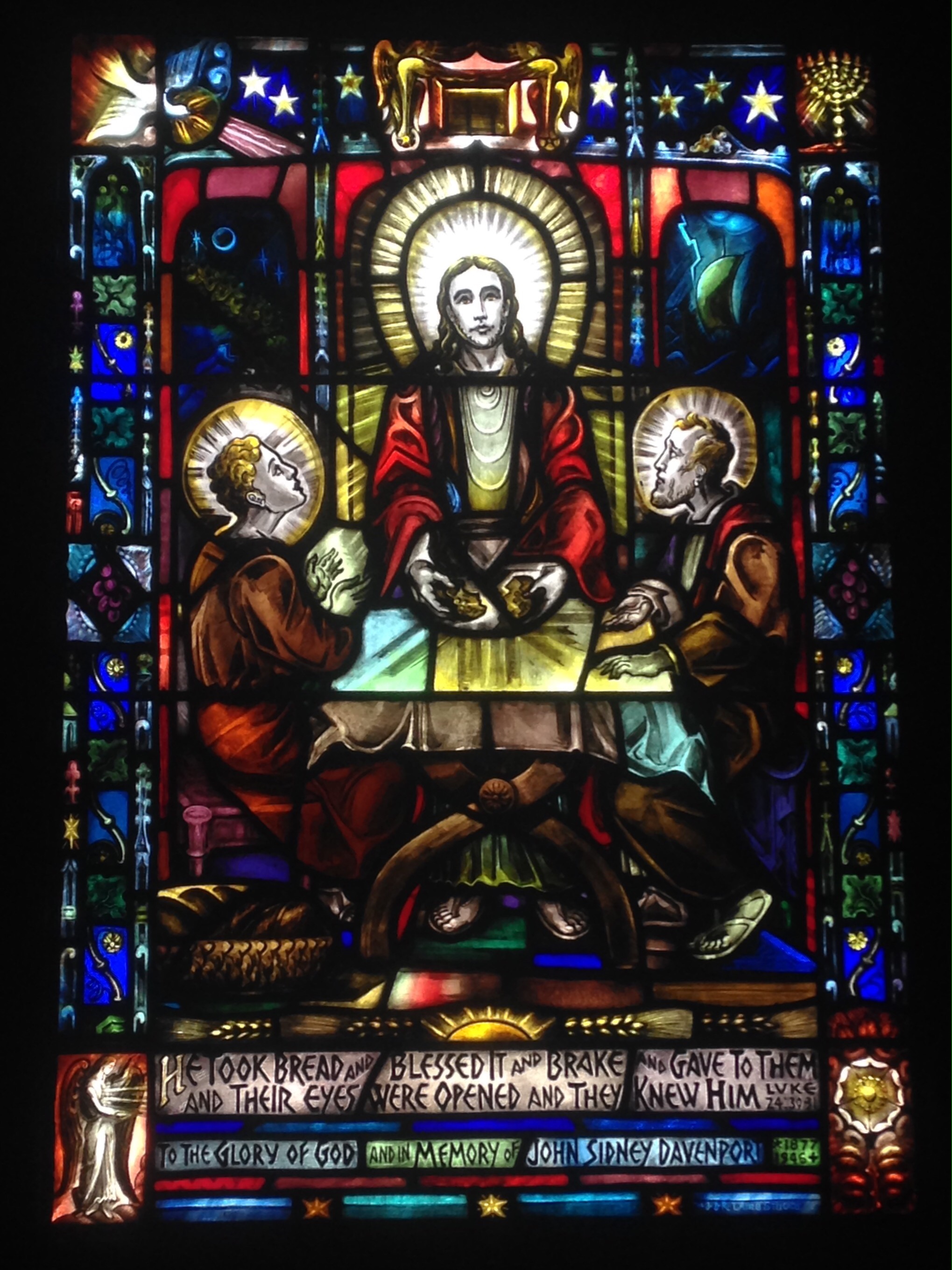
Luke 24:13-35

Now on that same day two of Jesus’ disciples were going to a village called Emmaus, about seven miles from Jerusalem, and talking with each other about all these things that had happened. While they were talking and discussing, Jesus himself came near and went with them, but their eyes were kept from recognizing him. And he said to them, “What are you discussing with each other while you walk along?” They stood still, looking sad. Then one of them, whose name was Cleopas, answered him, “Are you the only stranger in Jerusalem who does not know the things that have taken place there in these days?” He asked them, “What things?” They replied, “The things about Jesus of Nazareth, who was a prophet mighty in deed and word before God and all the people, and how our chief priests and leaders handed him over to be condemned to death and crucified him. But we had hoped that he was the one to redeem Israel. Yes, and besides all this, it is now the third day since these things took place. Moreover, some women of our group astounded us. They were at the tomb early this morning, and when they did not find his body there, they came back and told us that they had indeed seen a vision of angels who said that he was alive. Some of those who were with us went to the tomb and found it just as the women had said; but they did not see him.” Then he said to them, “Oh, how foolish you are, and how slow of heart to believe all that the prophets have declared! Was it not necessary that the Messiah should suffer these things and then enter into his glory?” Then beginning with Moses and all the prophets, he interpreted to them the things about himself in all the scriptures

As they came near the village to which they were going, he walked ahead as if he were going on. But they urged him strongly, saying, “Stay with us, because it is almost evening and the day is now nearly over.” So he went in to stay with them. When he was at the table with them, he took bread, blessed and broke it, and gave it to them. Then their eyes were opened, and they recognized him; and he vanished from their sight. They said to each other, “Were not our hearts burning within us while he was talking to us on the road, while he was opening the scriptures to us?” That same hour they got up and returned to Jerusalem; and they found the eleven and their companions gathered together. They were saying, “The Lord has risen indeed, and he has appeared to Simon!” Then they told what had happened on the road, and how he had been made known to them in the breaking of the bread.


The seminary where I study and this city where I live are on two different coasts of this country.  So, traveling has become a frequent companion in my life.  There is one thing that I have realized in all my cross-country schlepping around: the trip home often seems like the longest part of the journey.  

So, as I read and prayed with this passage from Luke’s Gospel this week, I kept imagining myself heading back toward home on that road to Emmaus.  The stretch of road that these two disciples of Jesus were walking is a seven-mile stretch from Jerusalem.  What an adventure that Passover trip had been: time in the city where all of the events of Passover had just taken place; all of those narratives unfolding from Palm Sunday through Holy Week and Easter.  This was the road back home, a place they had travelled many times without incident. But, this journey back home felt different.  They likely had set out together for Jerusalem what seemed like a week and a lifetime ago, full of anticipation about promises of redemption and liberation swirling around their teacher, Jesus of Nazareth.  The intensity of their emotions surged with the events unfolding that week.  And then, it all changed.  I can feel their disappointment, their confusion, their bewilderment and grief still raw from the death of Jesus, mixed with their dumbfounded amazement and awestruck disbelief at the rumors that Jesus had been seen alive that very morning, as they prepared to depart home.  If they were certain Jesus was alive, if they knew then what we know now then perhaps they would have just stayed in Jerusalem.  But, they headed for home.  As I try to walk that seven miles in their shoes, what I feel is the weight of their persistent and deliberate steps slowly moving toward home after what must have felt like the most surreal, unimaginable week of their lives.  They were reliving it with each other, even as a stranger approached them.  Their world had been so jarred, it was hard to fathom that anyone could not know what had taken place. The way the story is told in this Gospel invites us to speculate about why it is that these two disciples could not recognize this stranger, who we know to be Jesus.  It stirs in us the timeless question: is Jesus also walking beside us when we don’t even recognize him?

But, before I can even ask that question, I have to examine my steps.  Exactly where am I walking toward with such deliberate intention that my eyes cannot be opened to see who is with me on the journey?   Where is my Emmaus and what I am hoping to find there?

That is a harder question, especially when we are taught to be goal-directed, to keep our eyes on the prize.  As someone here at Red Door was talking with me about a few weeks ago, there are so many well-meaning people who set out a path before us: do this, go here, follow this road and you will eventually get home.  I’m here to say to you that there is great truth and purpose in that, because often the services of this world are set up in exactly that way.  The idea of “home” carries with it feelings of security, family, comfort.  But Jesus is both of this world, and of another world.  Even in this Gospel, when Jesus shows up it isn’t to lead or distract the disciples on the road to Emmaus from their journey home.  He shows up just to be with them.

Let that sink it:  Jesus isn’t the one who appears to tell us where to go.  Jesus shows up where we are, just to be present with us.

Our lives are filled with steps, some of which are goal directed or walked in search of home, and others of which are off the beaten path.  Today’s Gospel isn’t a road map about how to get from one place to another in our lives.  Today’s Gospel is here to remind us that even when we don’t realize it, the risen Christ is in our midst, walking with us.  Sometimes our eyes must be opened so that we can see, to respond to the fire burning in our hearts to remind us that God is near, working through the words and lives of others journeying with us.  Our eyes don’t have to constantly search for God; it is God who opens our eyes so that we can see with the clear vision of divine presence by our side.

The disciples eventually do arrive home, and when they do, they invite the stranger to remain with them.  That stranger of the road…who we know to be Jesus…accepts that invitation.  He takes bread, blesses it, breaks it, and gives it to the disciples who have welcomed him to the table.  Jesus transforms a simple meal of hospitality into divine communion.  And this is when his disciples truly come home.  They recognize him: they know him in the breaking of the bread.  That recognition revives and transforms them, even when the risen Christ disappears from their midst.  They are not alone; they know they have been in the presence of the Holy One.  Back on the road…seven miles later…they are reunited again with Jesus’ other disciples, sharing the good news and giving thanks.  Maybe the journey home doesn’t always lead to where we think it will.

I happen to think that this is not just a story of something that happened one time, back in those first days after the resurrection.  This happens every time we gather.  This story is church.  We gather and give thanks in the sacramental meal of Holy Communion, a time in which Jesus Christ is made known to us.  In the taking, blessing, breaking and sharing of food, Jesus Christ is present in our midst, even here during our Friday Red Door lunch.  Perhaps most especially then.  With the resurrected Christ in our midst, we are home.

The roads we walk in search of home are not the end of journey.  The road to Emmaus is a reminder that no matter what path we are journeying on, Jesus Christ is with us, sometimes taking forms that we may not even recognize.  We have an invitation to the table, to seeing and deeply sharing in Christ’s presence with us, right in the daily ordinariness of our lives.  We have a powerful reminder that our human eyes cannot see all that is divine, but that our God opens our eyes to see what is around us and right here with us.  In that knowledge, we give thanks and we allow ourselves to be transformed…not only in our own lives, but to go back and rejoin those with whom we share the good news.  We go forth together on the roads and pathways of our lives in the knowledge and love of Christ’s presence with us as we journey and break bread together.  Step by step, we begin to realize that home is where the risen Christ is made known to us. 


Posted in sermons | Tagged , , , , , , , , , | Leave a comment