
Homily for the Third Sunday in Lent, Year B
St. Mark’s Episcopal Church
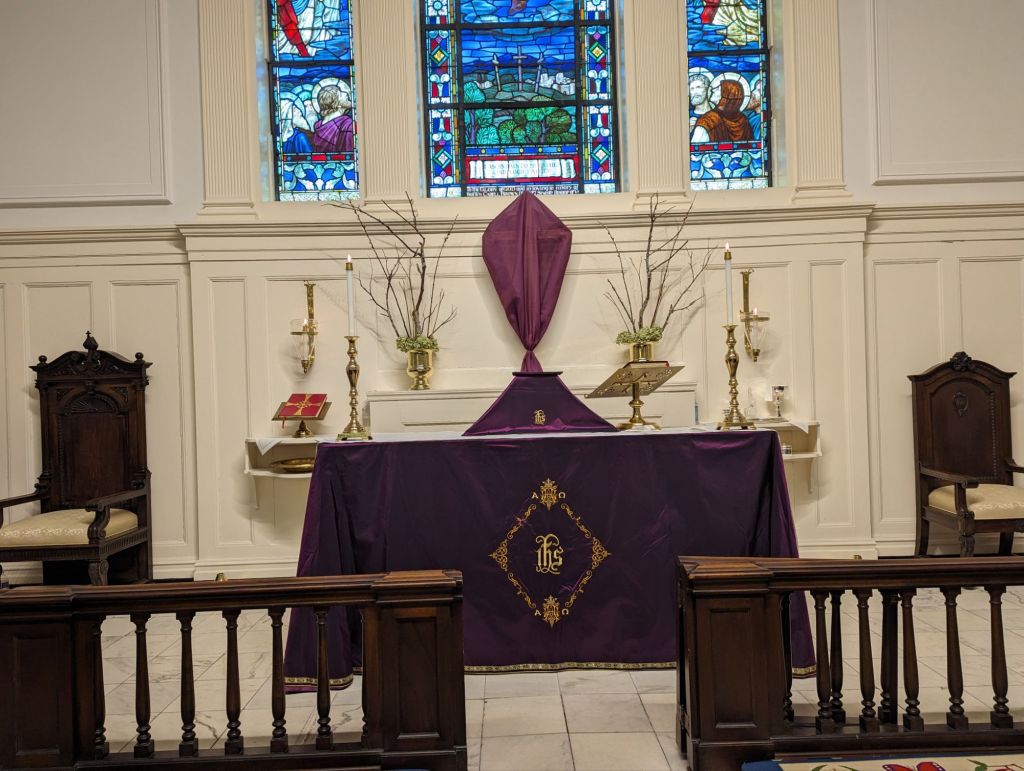
There’s no mistaking it now: we are in the midst of Lent. Branches have replaced flowers; certain words beginning with “A” have fallen from our collective liturgical voice; we have knelt at the beginning of our worship to offer our confession, hearing the words of God’s law spoken and responding with our collective assent. This morning, our appointed lesson from Exodus invites us to hear again God’s words spoken to God’s chosen people, outlining the Covenant which framed their relationship. These ten commandments reflect two intersecting pillars of the law, instructing us how to live out our love for God, and how we live out our love and respect for others who bear the image of God for us. Love God. Love Your Neighbor. As Presiding Bishop Michael Curry notes repeatedly, that is the heart of our life in Christ.
This two-fold way of being that was first given to our spiritual ancestors is profound. We are bound to God through love, and we are bound with each other through actions which display that love. How we respond to this covenant matters: we can see each commandment at face value, offering a catalog of “do’s” and “don’ts” or we can see this Covenant for the depth of life-giving love it conveys: in the words of the psalmist “the law of the lord is perfect and revives the soul.” I hope we can focus on that latter understanding this morning.
Living into the love language of the ten commandments is a transforming proposition. As much as these commandments seem directed as instructions for our individual lives, it’s important to remember the source and inspiration for the giving of the law: these commandments from God were given to a community of people who had been exiled and enslaved in order for that community to see and experience their common identity as God’s chosen and beloved people. Together, they speak to what it means to live together in a Beloved Community, the flow of divine love giving us the fuel to liberate our common identity in loving ways with one another. This message of profound love is what we also are given in the story of Jesus’ death and resurrection: the divine flow of love overflows in the arms outstretched on the hard wood of the cross, extending that love of God as revealed in Jesus Christ for the benefit of all of humanity. That message of the cross, notes our Epistle, is the power of God for those of us being made new through that liberating and life-giving love. Without God’s love to guide us, adhering to these laws and Jesus’ profound embodiment of them might truly seem like foolishness.
Our prayers and scriptures this morning all seem to come together around this intersection of love for God and love for our neighbor. And then, enter our Gospel lesson to jar us as we meet an angry Jesus, making a whip out of cords, dumping out the coins of the money changers and overturning tables in the temple.
How do we make sense of this?
I think it helps to go back to the beginning, to the story of God’s Covenant with God’s people. If we read more of the story from the book of Exodus conveyed in our Old Testament lesson, we might recall that while Moses was on the mountaintop caught up in this holy inscription of the liberating love of God who had saved the people of Israel from bondage in Egypt, the beloved people for whom God’s covenant was intended became impatient. They took things into their own hands and created a golden calf to worship as their god, in the erroneous belief that they, of their own making, could create a god that provided for them in the ways that they understood to mean prosperity. When word of this reached Moses, we are told that anger consumed him and he threw the tablets of the covenant to the ground, burned down the calf they had built and ground it to a powder which he scattered on the water and then, he made the people drink it.
Don’t mess with Moses!
I think anyone who encountered Jesus in the temple likely felt the same.
But here’s the important message: in both of these accounts, the visible actions of anger destroying that which is not of God completely up-ends the status quo. And in doing so, it breaks open a renewed outpouring of God’s liberating and transforming love.
Anger in these stories of our faith is a means for purging away that which enslaves us: in the case of the people of Israel, perhaps that included the remnants of their captivity that made them distrust their belovedness reflected in a divine-human covenant. Their distrust needed to be destroyed before authentic trust could be rebuilt. Jesus references this pattern of destruction and rebuilding as well, even in the midst of anger. It is a foreshadowing of his death and resurrection, and also a reminder to us that not everything that we think we need to cling to ultimately serves us. Sometimes, we end up clinging to a vestige of something that is enslaving us and keeping us from full immersion into divine love and grace. We want to trust in God, but that golden calf is something that we can see right here and now. We want to believe in the vision of a temple for all people to worship, but we put up barriers to full participation as we try to manage the fear and scarcity that we keep clinging to.
We want to believe the message of the cross and embrace the liberating joy and power of salvation, but we keep focusing on our doubts, our fear of not having enough or being enough, our worries that the church is dying or the world as we know it is ending. And the message of the cross and its divine love and grace overflowing into a genuine outpouring of love for our neighbor can even begin to feel like foolishness when we fall into the spiral descent of cynicism, perishing in our doubts and fears.
We may find ourselves starting to construct our own golden calves of justification to fan our fears and soon we find our courtyards filled with moneychangers who can collect what we believe we have coming to us just so we can survive.
And then, a season like Lent comes to upend our status quo and break us open from the fear and distrust that enslave us. We are reminded in all kinds of ways during this holy season that God’s love is more powerful than our fears, our anxieties, our self-doubt and our impatience.
Perhaps that purging comes to us as a conviction in spirit, the proverbial “dark night of the soul” that wakes us and shakes us and in which we finally find ourselves letting go and being held in the hands of a loving God who has been there all along. Perhaps that purging comes when someone we least expect responds to us with a love that we don’t deserve; when we see God present in that grace, it breaks our hearts open and expands them three or even four sizes more putting even the Grinch that Stole Christmas to shame. Perhaps we are extended forgiveness whether or not we deserve it. Or perhaps in the midst of our own rage against the injustices of the world we suddenly feel a deep peace of presence and we choose to trust it in spite of all evidence to the contrary. It doesn’t negate our rage; it places it in the hands of a loving God.
And perhaps the images of this Gospel can remind us that the purging of the evils of the world that interfere with the powerful, liberating love of God is the message of the cross which ends not with death, but in resurrection. People continue to be oppressed; greed and power enslave us; the fears instilled in us by the world in which we live convince us that we will never have enough and that survival and success depend upon the diminishment of others for our own gain. Meanwhile, in God’s economy we are filled to overflowing with the gifts of the Spirit.
We know so much violence in our communities that we no longer trust the safety of sacred spaces. In this courtyard of commodification, unconditional love is made to seem like weakness and a spirit of gentleness is mocked. But in the cross and resurrection, violence does not have the last word.
Perhaps the power of Jesus does need to knock over some tables and purge away that which doesn’t serve the holy in this world. Our faith tells us that God hears the lament of the oppressed, and God acts. This purging and upending isn’t with an intent to destroy; it is with the intent to make room for regrowth and resurrection. This my friends is the Good News.
God’s covenant with God’s people is one of love, and God’s commandment is that we live that out in relationship with our siblings in Christ and the whole human family. Our anger at injustice is something that is known to a loving God. We can feel that anger, we can name that anger: but it does not have the last word. This image of Jesus in the temple reassures us that even when the moneychangers seem to have taken over the prayerful places of our own lives, a complete overturn of heart is always possible, with God’s help.
I’ve been reading this beautiful book during Lent: Cole Arthur Riley’s Black Liturgies: Prayers, Poems and Meditations for Staying Human. In the section of her book speaking of the holiness of rage, she concludes with this Benediction. In her prayer, she offers precisely the words that want to offer up to God and leave with you today:
Awake, awake oh sleeper. Be reminded that the world deserves so much more than apathy in the presence of injustice. Go with anger, not as enemy but as guardian. A sacred protector in a world of so much hatred, reminding us we deserve to be protected. We breath, we feel. And we befriend our anger as if the liberation of our world depends on it. May it be so.


