What Sticks

Like many University faculty members around the US, the last days of July bring with them a palpable realization that summer is drawing to a close. Those elusive three months of summer…you know, the ones the rest of the world actually believes we are “off”…are when we have been writing, researching, and possibly cleaning through stacks of papers to find our desks again. I actually enjoy being an academic, so that is not a complaint. But, academic life has a unique cadence of heating up without ever really slowing down on its own. Academics exercise a lot of free will, including working ourselves into a nonstop frenzy. Admittedly, “August” has the same effect on me as a yellow stop light. I know I either have to speed forward, eyes ahead and get through the intersection as quickly as possible, or brake now and come to a complete stop, convincing myself that I can step on the gas when the light turns green and make up my speed later.

Pardon the pun, but this year I need a break.

Since I am planning to indulge in some time off for a few weeks, this has been my week to prep my course syllabi and wrap my thoughts around my teaching next semester. I will have a new course to prep each semester this year, but both are courses I have looked forward to teaching for a while. Readings, assignments, textbooks, grading scales, learning management systems vs. open sourcing…these are the thoughts that are occupying my days this week. But, as I was prepping, a different thought crossed my mind: what are my most memorable moments from being a student? What sticks??

It’s funny what crossed my mind. I vividly remember to this day than in 1990, a family of four in the United States was at the poverty threshold if they made less than $13,359. Dr. Shirley Lord made that point clear in my Social Dynamics of Poverty class in my BSW program. She wrote it on the board, said it out loud, and made us repeat it like a mantra. We were becoming social workers…we needed to clearly understand the number and its significance. When she made us take that number and consider it within our own finances and our own family of origin’s finances, it really hit home. I was a self-supporting undergraduate, and I made $5.85/hr working at a skilled nursing facility for 24 hours per week. That brought me to a whopping $7,300 annual income. I shared a two bedroom apartment with three other people, drove a junky car, and ate ramen noodles for dinner often barely making ends meet without any social life other than free concerts in the park. That was just me, not a family of four.

That lesson stuck with me.

Then, I remembered a moment from high school. It was Mr. Hardy’s 9th grade social studies class…which in New York State at that time was Asian and African studies. I remember exactly two things: first, watching a film about cultural groups on the African continent where he pointed out repeatedly “these are the people with the peppercorn hair!” (I think that stuck because I kept thinking: is that what this culture really wants to be known for?). The thing that really stuck, though, was at the very end of that year. Mr. Hardy pulled a stunt that I have replicated on occasion in my own classes. He gave us 15 minutes to ask him any question, whatsoever. He was trying to see if we could stump him; I am generally trying to get the emerging social workers in my classes to ask a really solid, probing question. Either way, it has a similar effect. After a few stupid questions and wise cracks, and a couple actual review questions about the material, it was one of the brightest students in the class who asked, “when will I die?” He immediately said, “everyone be quiet.” The room was completely still. We wanted to hear what he would say. After what seemed like a long time, the big, white wall clock let out a loud, “click” as it moved one more minute forward. “You’re all one minute closer” was his reply.

That also stuck.

There are other important moments and lessons from across my classroom learning over the years, too. But truthfully, I don’t actually recall most of what I wrote in the graded papers I was assigned, and I would be hard pressed to remember any specific test question that ever came before me. There are whole semesters of classes where I either apparently integrated everything I learned seamlessly…or retained none of it. But there are also moments like those I just described that stick, seemingly hot-glued to my cerebral cortex.

I am looking at my own syllabus now, and pulling myself out of the forest. What is it that I really want to stick for my students with this course?

I write myself a mantra across the draft syllabus for Social Work with Oppressed Groups that I will be teaching in the Fall. It says:

Liberation = Praxis

This is my shorthand for what I think is one of the powerful quotes from Paulo Friere in Pedagogy of the Oppressed: “Liberation is a praxis: action and reflection upon the world in order to transform it.” I will write it, everywhere. We will say it, breathe it, practice it, live it in the 2 hours and 40 minutes we share each week. The rest of the course…assignments, grades, lectures, discussions…that detail will fall into place weekly as it needs to. But, as an educator, I know what needs to stick.

So, as I drift through a couple weeks of leisure time before I am in the thick of my semester, I will keep that mantra close. Liberation…the kind of liberation we need in a world so deeply impacted by oppression…that liberation doesn’t take a vacation. It is my praxis not only when I teach, but also when I beach. It is my praxis in the grocery store and the food pantry, at the movies and on street corners. When the praxis of liberation becomes that which we engage in with all of humanity, we will truly be both educators and educated at all times.

That, across my career, is what sticks.

“Education either functions as an instrument which is used to facilitate integration of the younger generation into the logic of the present system and bring about conformity or it becomes the practice of freedom, the means by which men and women deal critically and creatively with reality and discover how to participate in the transformation of their world.”
-Paulo Friere, Pedagogy of the Oppressed
Posted in work and life | Tagged , , , , , , , , , , , | Leave a comment

Cup of Salvation

I am in the midst of gathering stories, quotes, and photographs from my friends in the congregation at St. Thomas Episcopal Church in order to compile a summertime, “God at St. Thomas” virtual calendar. One of my friends said, “you have to tell the story of the cup” and as soon as she said that, I knew that this was exactly the story I wanted to share. This story reflects the uniqueness of how God is experienced in this little urban community of faith and radical welcome that many of us are grateful to call home.

St. Thomas is a 100+ year old church built in the Northside of Richmond Virginia. In its time, it was a mission church for a newly developing neighborhood that had been expanding as the city’s residents stretched out to find more affordable places to build. Our homes and our church are old; that old-ness is charming on many of our back streets where we work to maintain leaks and keep our homes and our turn-of-century church in good repair. Any number of big, older rundown homes on the primary road heading north out of the city have now been converted into apartments, or sometimes split up into unregulated “board and care” homes for those who are physically well but have some significant cognitive, intellectual, or mental health challenges. These homes are a bed, a roof, and sometimes food but offer little else. At St. Thomas, our doors are open and our congregation welcomes all. So, any number of board and care home residents also make their faith home here with us on any given Sunday and at our programs throughout the week.

On this particular Sunday morning, last summer, a few of us were gathered early to rehearse for summer choir. Often, there is coffee brewing and we might grab a cup or top off a travel mug from home. But over the summer, we decided to keep it simple and only have refreshments after church. We had been diligently rehearsing our notes in the choir room and began making our way to practice in the choir loft with the organ. We walked together through the parish hall, chatting and catching up on our week. One of our elder residents from a nearby group home had been in the parish hall looking for some coffee and, just like the choir members, was a little disappointed not to find any. We explained that it was summer and we were trying to keep things simple so there wasn’t any made yet, but that we would have food and coffee after the service if she wanted to stay. She nodded and found a seat in the couches in the foyer.

Typical for me, I got hung up talking to our new interim rector in the robing room as I was cutting through on my way to the choir loft. My choir director was “patiently” waiting for us, but we were loitering about and talking as we tend to do. Finally, we started to coalesce into a singing group when down the stairs from the altar walked our elder neighbor, carrying a cup she was drinking from which everyone she had walked by thus far had presumed to be coffee. She wondered out loud if she could be directed to a table where she could sit and finish her drink. She walked between our Interim Rector and I toward the door where one of our always kind and patient priests was waving her into the parish hall to find a table. It suddenly became quite clear that it wasn’t coffee in her cup.

I looked over to the helpful priest who was taking her by the arm to walk with her to the parish hall and mouthed, “that isn’t coffee!” at the same time our new Interim Rector asked, “where did she find coffee?” then immediately catching a waft of its aroma exclaiming, “oh, that isn’t coffee!”

The priest walking with her ever-so-gently asked where she had found something to fill her cup and she explained it was from the silver pitchers in the back of the church, the ones that we had nicely left out for people who needed a drink.

Exactly.

In a quick flash of divine calmness, the priest walking with her began to say…”oh my…well, that wasn’t meant for you to drink…” and the, almost immediately, “well, actually it IS for you. It’s for EVERYONE, actually. Just not right now…we all share that together during the service.”

Exactly, once again.

With her tumbler still half-filled with the not-yet-sanctified tawny port waiting to be brought to the communion table, our elder neighbor and our priest meandered together into the parish hall. There, she received some ice water, a few crackers and some coffee was put on to brew to help level out the quantity she had already consumed and make her a bit less wobbly. Our interim rector, wide eyed at the moments of unexpected grace and radical welcome that fill these walls daily, set immediately off for the sacristy to replenish the communion wine supply before the service.

I was late to choir rehearsal…in trouble, of course…and holding back laughter and tears. The crazy grace of yet another God at St. Thomas moment unfolding.

The cup of salvation, indeed.

Posted in work and life | Tagged , , , , , , , , | 1 Comment

Refuge on the Path

The Lord is my light, my salvation;
whom shall I fear?

The Lord is the refuge of my life;
of whom shall I be afraid?

In the shadow of Your wings
I will sing Your praises, O Lord.

One thing I ask of the Lord,
one thing I seek;
to dwell in the presence of my God,
to gaze on Your holy place.

20140726-213840-77920804.jpg

Posted in quotations and reflections | Tagged , , , , , , , | Leave a comment

Stay on the Path

Today was one of those beautiful summer days that follows a night of thunderstorms. I woke early for my morning walk, taking notice of the lush green cathedral of branches arching above me on the oldest block in my neighborhood where the tallest trees grow. I was feeling grateful for many things, not the least of which was that my Friday only held one meeting first thing in the morning, followed by time to catch up on all the unfinished business of the week stacked up on my desk.

My morning meeting was one I was looking forward to as well. It was taking me to one of my favorite places, a retreat center where I have spent time both in my own vocational discernment as well as supporting their educational programs around social justice and racial reconciliation. Today, I was meeting about connecting my students with these educational opportunities. But, I followed my inner urge to seize opportunity and arrive early in the hopes of spending a little quality time in the gardens pre-meeting.

Or, as my inner voice prompted me as I drove through downtown, to walk the labyrinth.

I arrived early enough to do both, and as I rang for entry I ran almost immediately into my colleague. Because we are cut from a similar cloth and have spent a fair amount of time talking about our respective spiritual journeys, I told him why I was early and he told me where to meet him after my labyrinth walk. But, before he sent me on my way he wanted to show me the latest arrival, a black stone sculpture of Madonna and child set in the back garden. We walked the path toward this magnificent and moving art work, and I was able to hear the story of her origins and installation. She was so completely captivating on such a beautiful morning in that garden, I could have easily spent my whole day in that space.

I felt a pull to the labyrinth, though, and knew I wanted to travel on this step-by-step reminder of my vocational journey. My journey which, in many ways, has been formed by contemplative walks over several years along these particular brick pathways. Whenever I am at Richmond Hill, I feel compelled to pay my respects for being the kind of welcoming space where the daily meets the divine.

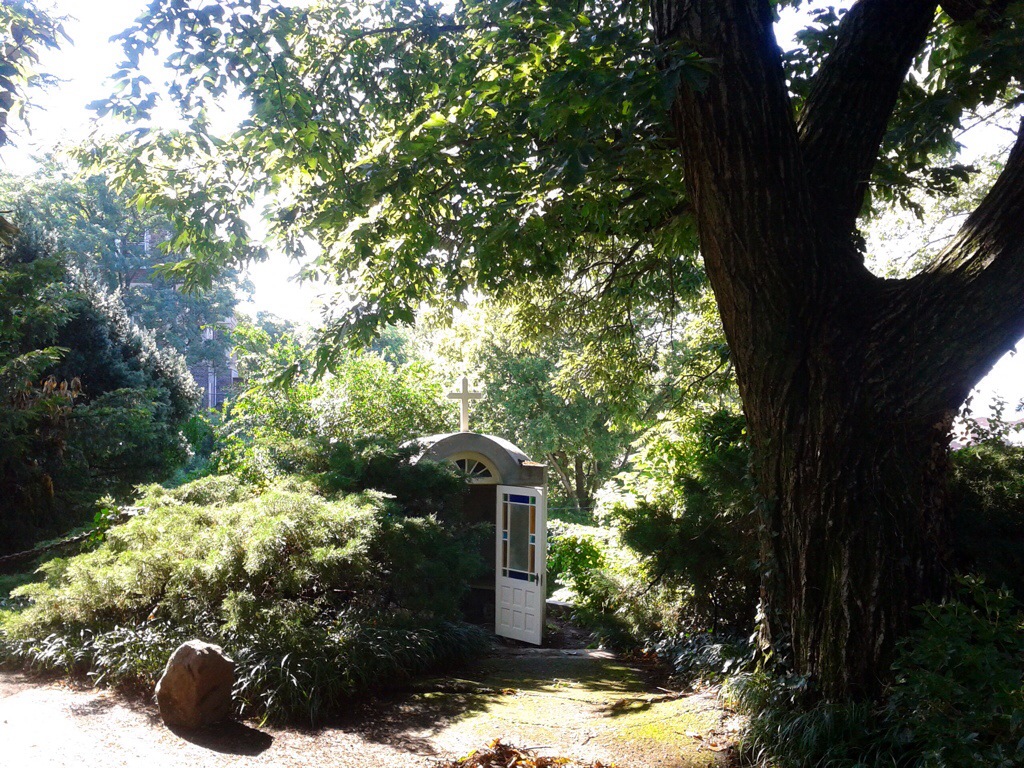
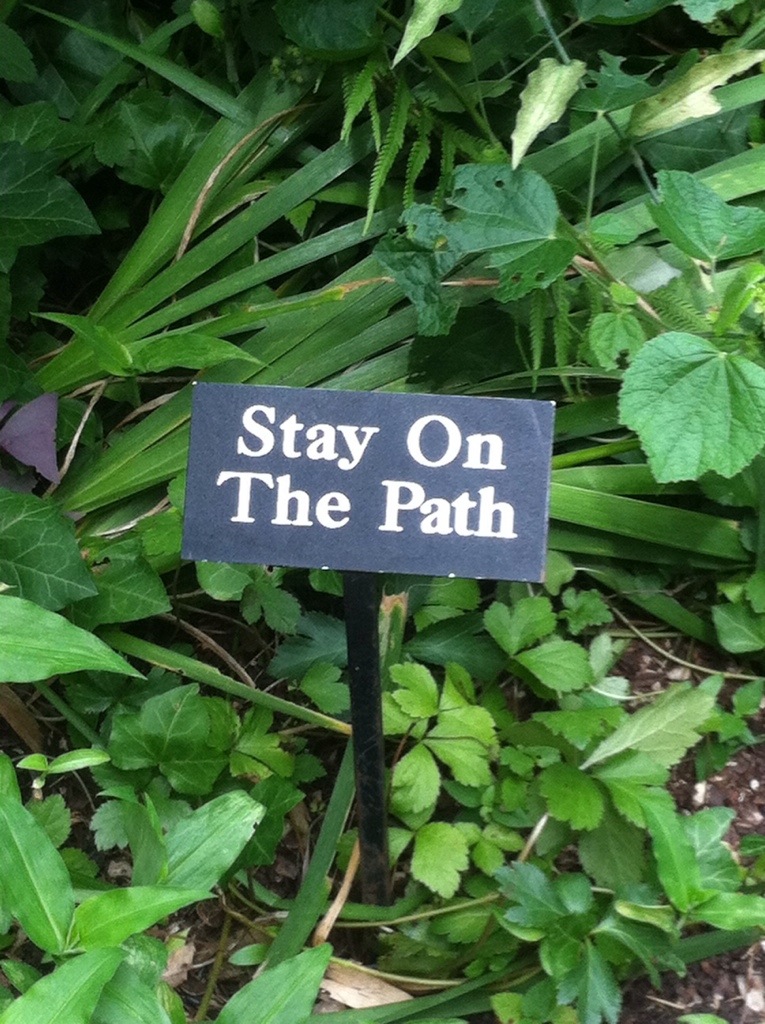
I finished walking my winding path of contemplative prayer, and I followed the shady pathway back through the garden toward my meeting. I was in awe of the beauty of the day, of the replaced stained glass and refinished simple glory of a cloistered prayer cell at the edge of the grounds, of the light and shadows marking the foot-path. I arrived at my meeting exactly on time and we had a great discussion about vocational and educational programs as we had planned to do. At some point we got into a conversation about planning vs. journeying. It led to the sharing of a photo my colleague had received from a friend. It was an inadvertent life message in the form of a polite sign that essentially was saying, “Keep off the grass.” Instead, as you can see below, it offers the perfect advice:

20140725-205740-75460698.jpg

I immediately thought of all the paths I had followed that morning…my neighborhood walk, my early arriving drive to my meeting destination, the path to Madonna and child, my one step after the other walk to the center of the labyrinth and back where I received clarity and insight as I always do. Now, I was sitting in even deeper awareness of how my own journeys of people and places and calling and vocation are winding paths that intersect with each other in the most graceful and beautiful ways. The wonder and joy of that journey is that I am not controlling it. The journey is unfolding step by step as I follow that sage advice: stay on the path.

Posted in Spiritual journey, work and life | Tagged , , , , , , , , , | Leave a comment

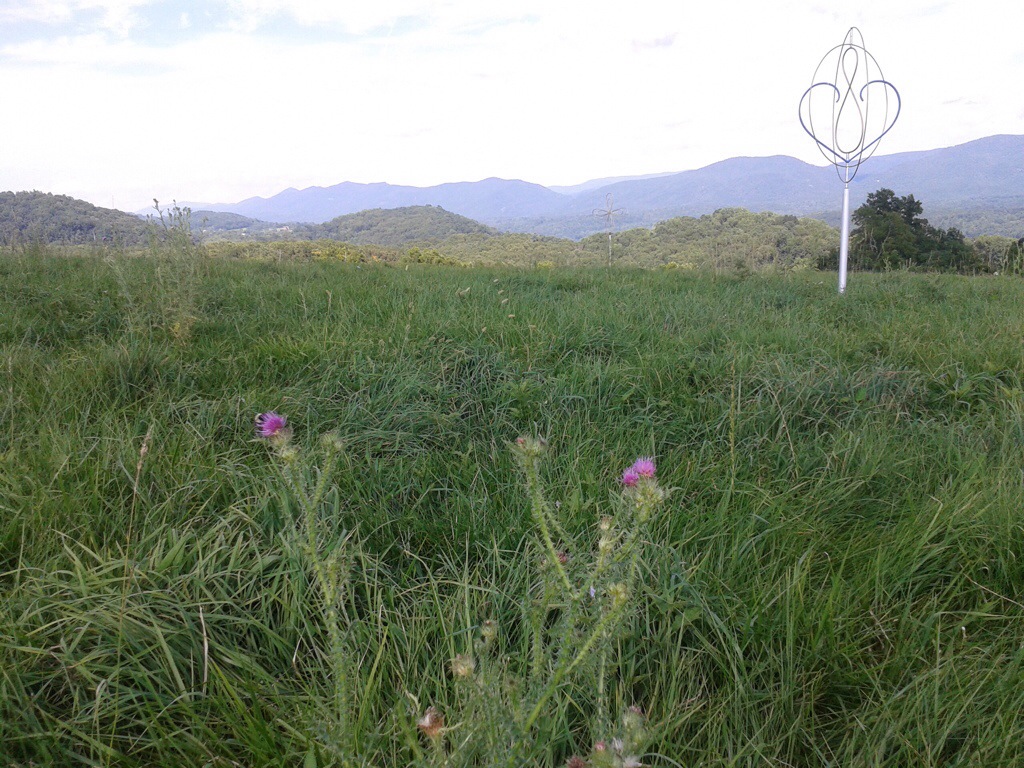
In the Field

“Out beyond ideas of wrongdoing
and rightdoing there is a field.
I’ll meet you there.

When the soul lies down in that grass
the world is too full to talk about.”
― Rumi

20140723-213556-77756722.jpg

Posted in quotations and reflections | Tagged , , , , , , | Leave a comment

Feast of Mary Magdalene


504px-Sarto,_Andrea_del_-_Pietà_with_Saints_-_1523

Andrea del Sarto, Pieta with Saints  (1523)

Feast Day: Saint Mary Magdalene

Mary Magdalene has always held a special place of honor in my expressions of faith.  She is, quintessentially, the misunderstood woman.  Her strength and her stories have been the subject of theological exploration as well as mystical speculation, and I suspect much of that is intertwined with our cultural comfort with women’s leadership in spiritual traditions.  Tonight, though, I post this tribute to one particular attribute of Mary Magdalene, in the  midst of her wholeness, which resonates with me: she is a griever, a mourner, a leader in the care and keeping of the sacred space of the tomb in which the body of Jesus was placed after his death on the cross.

It takes strength and leadership to be a mourner, and to lead the way of the grieving to pay respects and share their feelings of loss.  I celebrate this gift on her feast day, and share the following prayer as I close my day in stillness and reflection.  Thank you, Mary Magdalene, for the small points of light you shed on the paths of the grieving.  It is no surprise to me at all that you were the first to see the first light of the dawning resurrection.

Good Jesus, Saint Mary Magdalene was one of the women who assisted you and the apostles during your public ministry. She cried with the Blessed Mother and Saint John at the foot of your cross, and she helped to bury your dead body. For serving you with such devotion, she was the first to see you resurrected. I ask her to pray for me when I have opportunities to assist others as they approach death or grieve the death of loved ones. Inspire me, O God, in giving them your comfort, in helping them accept salvation, and in guiding the survivors to release their loved ones into your arms.

Posted in Poetry and verse, Uncategorized | Tagged , , | Leave a comment

Dancing with Oppression

I have been immersed in oppression today. Oppression overflowed on my Facebook news feed, and filled the airwaves of NPR. I had a few brushes with people feeling oppressed before I could even get about the work of my day which, for a large part of it, involved working on the syllabus for the undergraduate course on Oppressed Groups that I will be teaching in the Fall.

While I was working on the syllabus for that class, adding in Paulo Friere’s Pedagogy of the Oppressed as recommended reading, I began to think not about oppression itself, but about our relationship with it. My own relationship with it, specifically. I wondered how the world might be different if we willingly danced with oppression, instead of avoiding it. Touched it. Looked it in its proverbial eyes and realized that we might be moving together to the same beat. Its uncomfortable, I know. But, as Friere pointed out time and again across his career…if we are not schooled and educated by oppression, we will never be liberated from it nor can we liberate anyone else.

So, I decided dancing with oppression would be my writing theme today. This exercise is about immersion, not rhetoric. No sides will be taken. We will simply immerse. And dance.

Let’s just go for the gusto with our first dance and begin in Gaza. My Facebook news feed has some strong voices pointing out many important points on both sides of the conflict. But, mostly, those points come down to how the other side is misconstruing the violence. Consider, for just a moment, that everyone in this situation is both oppressed, and an oppressor. Let’s dance with the possibility that everyone is actually correct, and deep hurt that cuts through history, spirituality, culture and philosophy does exist. It exists for Israelis and Palestinians; it exists for Muslims and Jews and Christians, each group in their own way with their own history of being both oppressed and oppressor. The dance of oppressor and oppressed wages on and people die. Every day, real human beings die. Human beings…who at the deepest core of my professional ethics, and my baptismal covenant to preserve the dignity and worth of every human being…are killed. When I dance with this oppression, I could be staring death in the eye. But, there is even in Gaza a glimmer of hope. I give you this music to dance to tonight, from an Israeli-Palestinian group of youth seeking only to see the humanity in each other. This, title translated, is their video “When Pigs Fly”:

Heartbeat: Bukra Fi Mishmish (Arabic for “when pigs fly” or for when the impossible happens)

Let’s move a little closer to my home, to a dance I still travel in my own heart. I have lost people I love dearly to AIDS, and I have both HIV+ and HIV- people whom I love who have been hit hard by the oppression of a label. It is still too easy for us to oppress those who (we assume) have some control over their health status. It is easy to internalize this oppression and allow it to stand in the way of one’s own sense of integrity, dignity, and life. So, our second dance tonight will be with our own status. Do you know if you are HIV+ or HIV-? Are you making assumptions about yourself, your partner, or people around you based on looks or actions or a perceived category to which it might seem she or he belongs? We are going to dance a difference dance, one that is unconditional, and asks us to step aside from this oppression and move to a common health goal of disease prevention and treatment, instead of oppression and silence:

UNICEF’s Show Your Love Campaign: Katy Perry ” Unconditionally”

One last dance for tonight. There is no one of us, not one, who has not danced with oppression in our lives. Maybe we were the lead, maybe the follower, or maybe circles were danced around us. One truth remains: we can all change. We are capable of growth, and a divine light of human dignity shines in each and every one of us. So, draw a breathe as we dance together. How can I change? How can each of us contribute to undoing injustice, and bringing a small point of light into our individual corners of the world. Think on that for this last dance tonight.

Tracy Chapman will send us out on this dance together, spinning our small points of light in our lives and communities…

Tracy Chapman, “Change”

Posted in work and life | Tagged , , , , , , , , , , | Leave a comment

Christ as a Light

20140720-213745-77865913.jpg

Canticle (Prayer of St. Patrick)

Christ, as a light
illumine and guide me.
Christ, as a shield
overshadow me.
Christ under me;
Christ over me;
Christ beside me
on my left and my right.
This day be within and without me,
lowly and meek, yet all-powerful.
Be in the heart of each to whom I speak;
in the mouth of each who speaks unto me.
This day be within and without me,
lowly and meek, yet all-powerful.
Christ as a light;
Christ as a shield;
Christ beside me
on my left and my right.
(Source: http://www.northumbriacommunity.org)

Posted in quotations and reflections | Tagged , , , , , , , , , | 2 Comments

Amish Country

When I was growing up, we spent many family vacations traveling to “Amish country” in Pennsylvania and Ohio. Our little pull behind trailer would follow our van to a KOA campground where our little 12 x 20 space of the earth would be home for a week. The first night was always exciting; we would build a campfire, cook a meal from among the week-planned cans and assorted fresh produce we had brought with us. If I was lucky, there would be s’mores or at least some marshmallows skewered on sticks. The days (and meals) admittedly began to drag on a bit as the week went on, but it was still a change in pace, and a break from routine.

Looking back as an adult, I find it ironic that my already simple, country, religious family would go even more deeply into a simpler, more rural and even stricter religious community to vacation. Those trips defined my childhood and youth, though, with perhaps an amusement park tacked on in one direction or the other. The only two city trips we ever made were later, when I was in high school: Toronto and Montreal. Then, it truly did feel like we went to visit a new world. Visiting Amish country felt in many ways like spending time with a more intensified version of our current life.

So what did I learn from my family’s time in Amish country?

First, I learned that the Amish are no more or no less happy than any of the rest of us. I didn’t see constantly gleeful children, nor horribly sad ones. I saw a lot of children working at chores, or walking around “just being” (which is what my daughter professes to do, too). Some adults generally groused about weather or chores, some spoke cheerfully of things they enjoyed. A general pragmatism prevailed in Amish country that was very similar to the farming life that was all around me. I suspect that was part of the draw for my family’s visits, actually. I remain unconvinced that simplicity itself makes us happier. I believed then, and I believe now, that its a much more complex equation than that.

I learned that community really does matter. I actually have seen most of a building structure emerge in a week with everyone pitching in to help. It is pretty amazing. There is a sense of mutual support that is palpable, I will admit.

The Amish taught me immediately about something that would mark my career: the role of insiders, and outsiders. It is crystal clear in Amish country who the outsiders are: everyone else. It doesn’t matter how many bonnets we buy or cinnamon rolls and churned butter we consume: we are all outsiders. You can be liked, trusted, befriended, or merely tolerated: you will still be an outsider. Even at a young age, I felt this profoundly. What I liked was that no one among the Amish was trying to convince me to be Amish. They were who they were, and we were who we were. That was enough for them. It was the rest of us trying to be like the Amish, without really wanting to be the Amish that made me a bit nutty. It was refreshingly peaceful to just be the outsider, and to know that was perfectly OK.

I do think, on some days, that it would be an improvement to have only one color of clothing to launder. Boring, but easier. I respect the practical wisdom in that communal decision.

One day, my family and I took an Amish horse and buggy ride. I had to sit in front with the driver and I was so anxious I could have crawled out of my skin. It was like I had a flash in that seat of how not Amish I was, and how not Amish I would ever be. I could also feel, like a sixth sense cutting through me, that it wasn’t that the Amish chose to be Amish. It was that they were born Amish and chose to remain Amish, and deferred finding out or questioning what all the other options were. The Amish life was good, because it was what life offered. Nonresistance, the hallmark of their anabaptist faith tradition, also applied to their life choices. I knew I was not cut from that blue cloth.

When our day with the Amish finished, we would come back to the campground, sit around the campfire eating s’mores and I would ponder, as I watched the embers flicker, exactly who I was meant to be. That question has never ended for me: who am I, and how do I move through this world being my truest self? My answer keeps changing, as I am exposed to the diversity of human experience. I love that I have the privilege to keep knowing more about the diversity of this amazing world, to ask the questions of my mind and my soul, to keep my intellectual curiosity flowing and my spiritual quest continuing.

Today, on a summer day that reminds me of those days in Amish country, I realize that I have followed the kind of meandering path that a wandering and questioning spirit like I am needs to walk in this lifetime. For me, wandering isn’t necessarily to the ends of the earth, but into the depths and diversity of what makes us human. I would probably be the one to sneak a peek under the lid from Pandora’s box, or pick and eat the fruit from the mythical tree of the knowledge of good and evil with or without the encouragement of a slithering reptile. I admit it…if it’s there, then it calls to me to be explored. The small points of light that I have found are in places that some people would rather not even care to know existed, and God has met me there. That inquisitiveness of my spirit is as blessed by Divine Presence as is the simplicity of other people of other faiths and walks of life whose faith would preclude them from even waiting to know. What gets in the way on any path we tread is doubt, second-guessing, and needing to make ourselves feel we are in the “right” by boxing others into the “wrong.”

Visiting Amish country sent me a clear message: we don’t need to all be Amish. We simply need to be true to who we are. That is the lesson that remains with me, along with an occasional craving for shoo-fly pie.

Posted in work and life | Tagged , , , , , , | Leave a comment

Rainy Night

At the risk of sounding like Eddie Rabbitt, I do really love a rainy night. This is especially true when rain comes at the end of a streak of hot and humid, seemingly endless summer days in the south. I am sitting with my back door open and listening to the rain fall, smelling the freshness of cleansed air and feeling coolness against my skin. Such a welcome relief after a few days of heat. I can practically hear the ground taking gulps.

Water has rushed down around me in recent days, like torrents of emotion. This continues to be an intense time, with many friends and loved ones for whom I am holding deep emotion in the midst of life’s challenges. But, on nights like this I remember that the same water that cascades like an emotional avalanche also nourishes and cleanses. I don’t think that is an accident; there is a reason that water is essential for our life. I believe that applies to our souls, not just our bodies. Rain releases; rain replenishes.

I was thinking about rain tonight, and in my meanderings came across a poem that I hadn’t read before. I am sharing it because it resonates with my own thoughts tonight…and his imagery here draws me in:

Rain

By Kazim Ali

With thick strokes of ink the sky fills with rain.
Pretending to run for cover but secretly praying for more rain.

Over the echo of the water, I hear a voice saying my name.
No one in the city moves under the quick sightless rain.

The pages of my notebook soak, then curl. I’ve written:
“Yogis opened their mouths for hours to drink the rain.”

The sky is a bowl of dark water, rinsing your face.
The window trembles; liquid glass could shatter into rain.

I am a dark bowl, waiting to be filled.
If I open my mouth now, I could drown in the rain.

I hurry home as though someone is there waiting for me.
The night collapses into your skin. I am the rain.

20140715-214946-78586817.jpg

Posted in quotations and reflections | Tagged , , , , , | Leave a comment