
Homily for the Third Sunday in Lent, Year A
March 8, 2026
St. Francis Great Falls – Icon Sunday
I am grateful for the opportunity to be present with you all on this day we are calling Icon Sunday. I’m especially grateful to Weston and to Marilee for their inspiration and work to bring this together. I hope that as your guest preacher today, I can begin our foray together into this particular sacred, devotional art by drawing a line…or perhaps better said, painting a connection…between this sacred devotional art and our Gospel lessons..
As we begin, I think it is fitting to ask you to come on a journey with me.
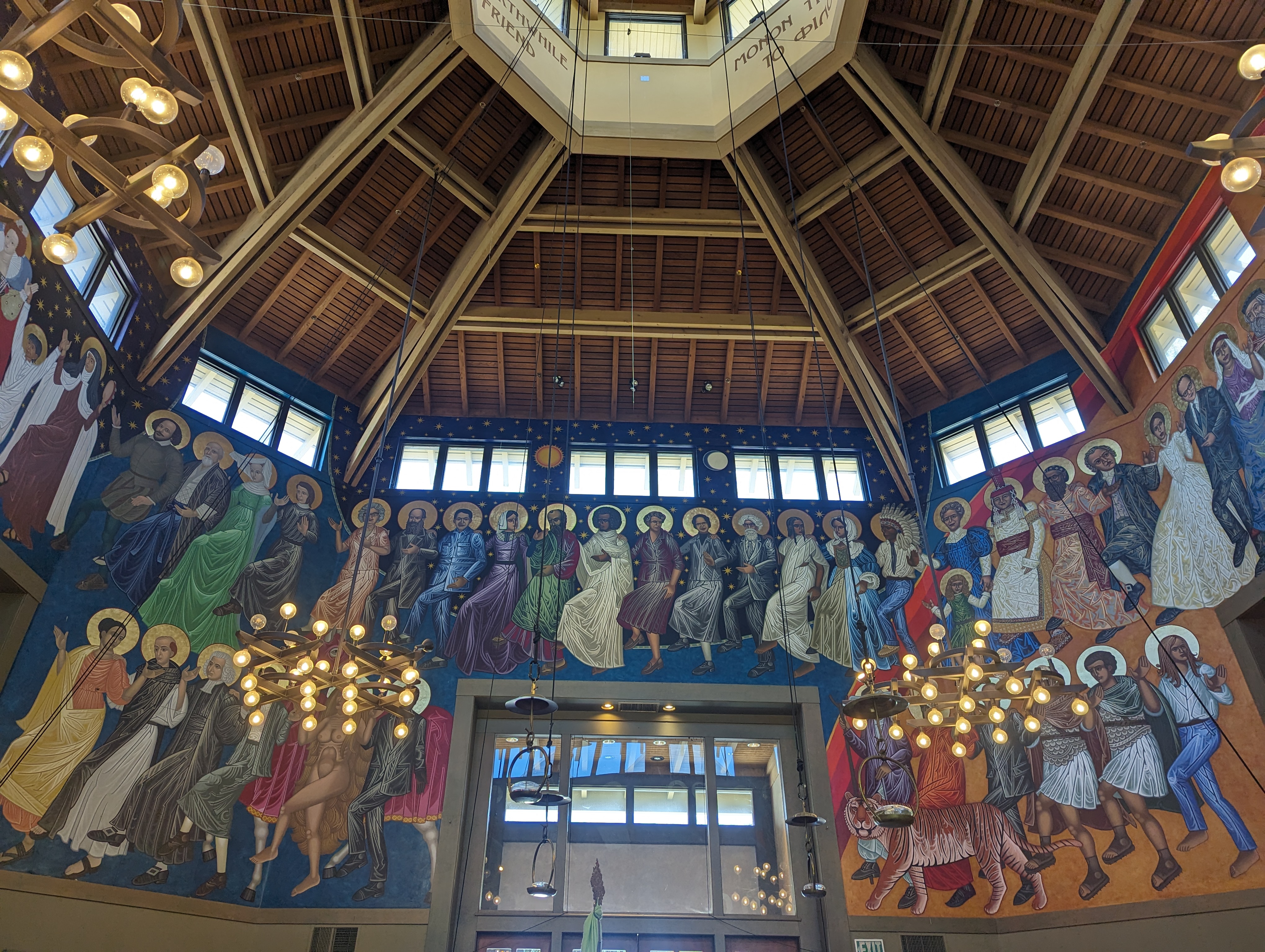
We begin our journey on the other coast, in San Francisco, moving through the industrial-becoming-residential mission district. We are passing warehouses and lofts, and a large industrial brewery. As we pull up Potrero Hill, we begin to see a unique building in the midst of this urban landscape, complete with a steepled dome peeking from among multi-story housing and warehouse spaces. We approach the front steps half way up the slope of the hill, approach two large wooden doors, painted red and carved with swimming fish, opening up to the street. I’m eager to draw you inside, to show you this most unique Episcopal Church called St. Gregory of Nyssa. Whenever I bring people with me, I am filled with the same wonder and awe I had when I first encountered this space and its community.
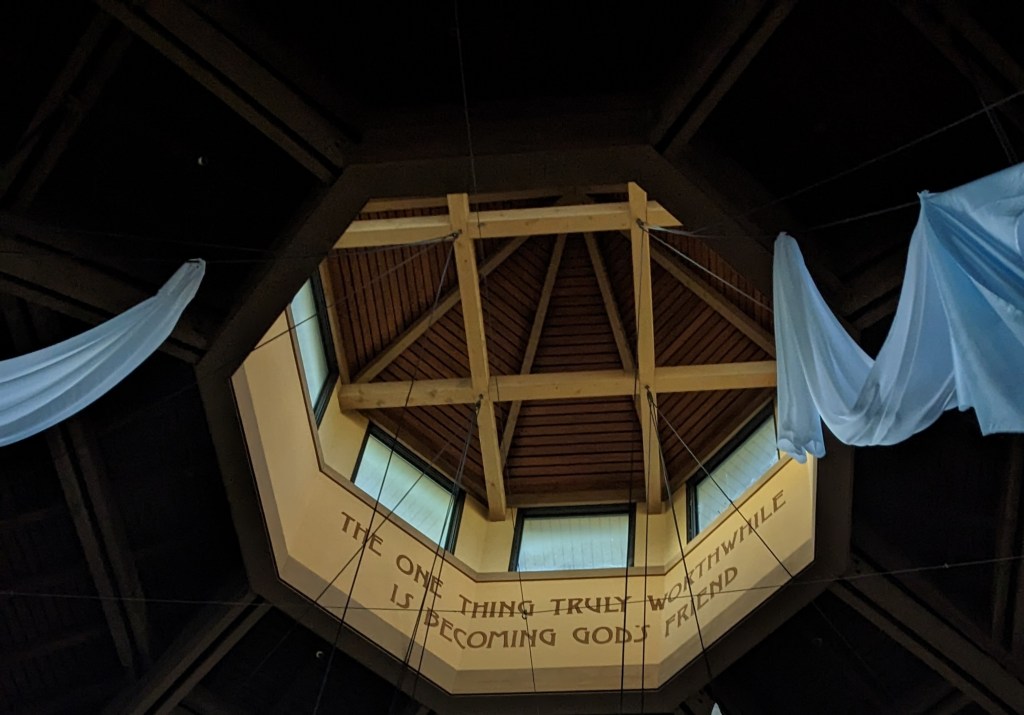
As we move through the open doors, we first see two icons on cloth-draped stands greeting us, set out for this Sunday. The first shows Jesus in the desert, the weariness of his fast event on his gaunt frame during this time of wandering and temptation; but we see his eyes filled with love, his expression beckoning us to continue to journey with Jesus through our Lenten season. Next to it is a lively image, depicting the Samaritan Woman at the Well. The well she stands next to reminds us of an ancient baptismal font. She is holding a large jar in one hand and the rope for the well in the other. She is looking eye-to-eye with Jesus, engaging in animated conversation. Jesus sits on the other side of the well from her, reclining on a large stone, fully engaged in conversion. We can practically hear the words that we can sense are passing between then; the scene may be painted on a flat surface but the story seems to come alive, revealing the Gospel lesson we just heard with a renewed clarity. As our eyes shift from the entry icons to the worship space, we notice sunlight streaming through the windows of the dome revealing what looks like a whole circular heaven of brightly painted dancing saints, led by dancing Jesus! Saints old and young, dressed in ancient clothes as well modern dresses and suits, as fitting for their lives of faith. We walk inside, still taking in the wonder of the display as we approach the round, wooden altar table sitting in the center of this light-filled rotunda. We stand at that altar and look up towards heaven, surrounded by the icons of our great cloud of witnesses. There, we notice the inscription written on the inside of that rotunda, a quote from St. Gregory of Nyssa: “The one thing truly worthwhile is becoming God’s friend.”
I am transported, just thinking myself into that thin place.
My time began as a seminarian, and I am grateful whenever I can go back to visit. For me, it is a place where the veil between heaven and earth feels thin, like I might take one step and suddenly be caught up in the joyful dance of the saints praising God, dancing to Jesus’ lead.
Even as we stand there in awe, we hear the motion of water. The doors across from the entry open onto the back of the property, an oasis of rock and greenery in the midst of the otherwise urban landscape. Water flows from the fountain outside leading to the living, flowing water of the baptismal font. I can almost hear the words, “give me this water, so that I may never thirst.”
Those words from the Gospel re-ground us now and we slowly settle back into our Sunday morning here in Virginia. The vibrancy, the color, the light, the water…they remain with us, imprinting an invitation on our souls to come back any time. Surely, the Lord is near to us, the words of God echoing in our hearts and on our lips. Perhaps we feel transformed by the experience, eager to share the good news, to invite others into the depth of relationship and holy mystery that God desires to share with us.
Because the one thing truly worthwhile is becoming God’s friend.
This journey, this meditation is also the essence of the icon, a sacred art which has been part of our Chrtian tradition for centuries, and remains a core component of worshipping tradition, especially in the East, for our Orthodox siblings in Christ. Like our meditation that spanned distance and time, icons also transport us into a glimpse of God’s eternal connection and love for all people, in all places, at all times. Icons as sacred art are layered with meaning, filled with symbolism and offer us thin spaces for prayer and worship unhindered by time and transcending space. Heaven and earth seem to touch and allow us to see with the eyes of our heart, catching a glimpse of eternity.
This Sunday of the Samaritan Woman at the Well is perfect for Icon Sunday. The Holy Spirit must have known that when it was the date the serendipitously worked for all of us. The Gospel lesson itself is filled with symbolism and meaning: Jesus, In a city where he is an outsider, in the heat of mid-day, sitting and resting on a rock and encountering a woman….tradition has named her Photini, the enlightened one…who comes to the well to draw water. She, too, is an outsider. She js there alone, not with others; she is drawing water at an inopportune time perhaps to avoid the scornful gaze of others. She has known the pain of being cast aside. She is also, because it takes one to know one, an outspoken woman.
The Samaritan people were close cousins to the Jewish people, so like rival teams, their tension with each other was as much cultural as ideological. They descended from the tribes of Israel, but they had intermarried and taken on customs that were more pagan than pure according to Jewish law. To Jewish people, they were less than. People went out of their way to avoid walking into the territory of Samaria. And this Samaritan woman was carrying her own social shame in the midst of all those cultural dynamics as well.
But in the midst of all that, there is Jesus. He travels of his own free will; he pauses to rest. And then he speaks with this woman as if she is family, asking her to draw water for him so that he might drink. Jesus stretches his embrace of love beyond the inner circle to welcome all.
In iconography, the symbolism typically drawn into the image of the Samaritan Women at the Well is that of Christ and the Church, drawn together in the waters of Baptism. Mutually recognizing that each is essential to the other; wrapped together in conversation and relationship; the water drawn from the earth becoming the Living Water through which we are sustained and the nourishment of God’s reign being lived out in the lives of those who believe and share the Good News. The whole image comes alive with possibility.
In our Gospel lesson, the woman at the well cannot wait to spread the Good News. She returns to her village with exuberance and many come to hear, see, and believe in Jesus themselves not only through her words, but through their own experiences. In tradition, Photini is regarded as the first Evangelist and in Orthodox tradition, Equal among the Apostles. She was transformed by that encounter and continued to tirelessly share the Good News of Jesus Christ throughout and beyond that region, until her own martyrdom.
Photini lived her life by the words we hear in the Gospel lesson: The water that I will give will become in them a spring of water gushing up to eternal life.
I invite you into our worship and conversation today with a spirit of curiosity. Like Photini, we are invited to have an encounter with Jesus Christ that changes and transforms us. We celebrate Holy Eucharist with the elements of this life: bread, wine, water, ourselves being transformed to be the Body of Christ in the world. As you consider the sacred art that has been brought into this space, how does it help you deepen into your own relationship with Jesus Christ? What are the images conveying to you? What deeper conversations are you drawn to have with Jesus in your own encounter? How does that inspire you own sharing of the Good News? The icons that are here for you to gaze upon and pray with are incredible sacred images that hold so much holiness. Enjoy them. Rest in their presence. Welcome whatever Jesus speaks to your soul.
And I’m eager to share about what it is like to pray an icon into becoming, using the elements of this world to slowly be transformed into a glimpse into the world beyond, like walking into that thin space at St. Gregory’s. I brought materials with me that you can touch, feel and even paint some brush strokes with because sometimes we need that tractile contact to truly take in the experience. I am happy to talk about what it is like to immerse into multiple days of iconography on retreat as a total beginner, and I can tell you what it is like to open up to the learning, to keep following the yearning to learn more and to engage the slow and steady practice of iconography on my own time as I continue to grow, practice, learn and pray. It has been and is such a holy practice for me, so I look forward to sharing time and conversation with you about that.
Led by the example of Jesus and Photini, let’s continue this holy conversation.
Because the one thing truly worthwhile is becoming God’s friend.

 small points of light