
Homily preached at St. Mark’s Episcopal Church
The Last Sunday after Pentecost, Year B
Christ the King
The year was 1925. In the aftermath of World War I, the people of Italy were struggling with economic deprivation, street violence between rival gangs and rampant right wing nationalism fueled by fear of a communist revolution. In January, Benito Mussolini, the newly appointed Prime Minister, stood up to deliver a speech to the Italian parliament. Without mincing words, he asserted his right to supreme power and effectively secured singular, unilateral power in Italy ushering in decades of fascist dictatorship.
In February, an epidemic of diphtheria was spreading across Alaska, and a dog-sled brigade was deployed to allay the spread by bringing anti-toxin immunizations across that territory to its most rural reaches, a public health victory after over half of the population of Alaska had fallen victim to the Influenza epidemic of 1918. In March, the deadliest tornado ever recorded crossed a tri-state area of the mid-west United States, killing almost 700 people and wounding 2,000 others while across the world, days after a 7.0 Earthquake struck the Yunnan province in China, killing 5,000 people. In April, a communist assault on St. Nedelya Church claimed roughly 150 lives in Sofia, Bulgaria. Later that spring, F. Scott Fitzgerald would publish The Great Gatsby and later that summer, the United States would be in the international spotlight during the infamous Scopes Monkey Trial, pitting religious fundamentalism and scientific modernism against each other in shows of public mockery.
That was all happening immediately before Adolf Hitler published the first volume of Mein Kampf in Germany in July, and the Klu Klux Klan sent 35,000 marchers to a public parade through Washington, DC in August. And then, amid Lakota territory in the Black Hills of South Dakota, Gutzon Borglum who was an avowed member of that same Klan who had also been instrumental in designing the “Shrine of the Confederacy” in Georgia was commissioned to start on a budding new sculptural project which would be underway until 1941, carving the faces of George Washington, Thomas Jefferson, Abraham Lincoln and Theodore Roosevelt into the ancient stone of the mountain formerly known as the Seven Grandfathers of the Black Hills. Indigenous communities objected to the overall plan from the very beginning, describing it as a desecration of their sacred lands. They were overruled.
In the year just prior to these secular displays of power, a Roman Catholic Cardinal who was the former director of the Vatican Library and a historian of political and religious movements was selected by his peers to serve as Pope, following the death of Pope Benedict XV. The new Pope assumed the name Pius at his consecration. His chosen motto was: “The peace of Christ in the reign of Christ.”
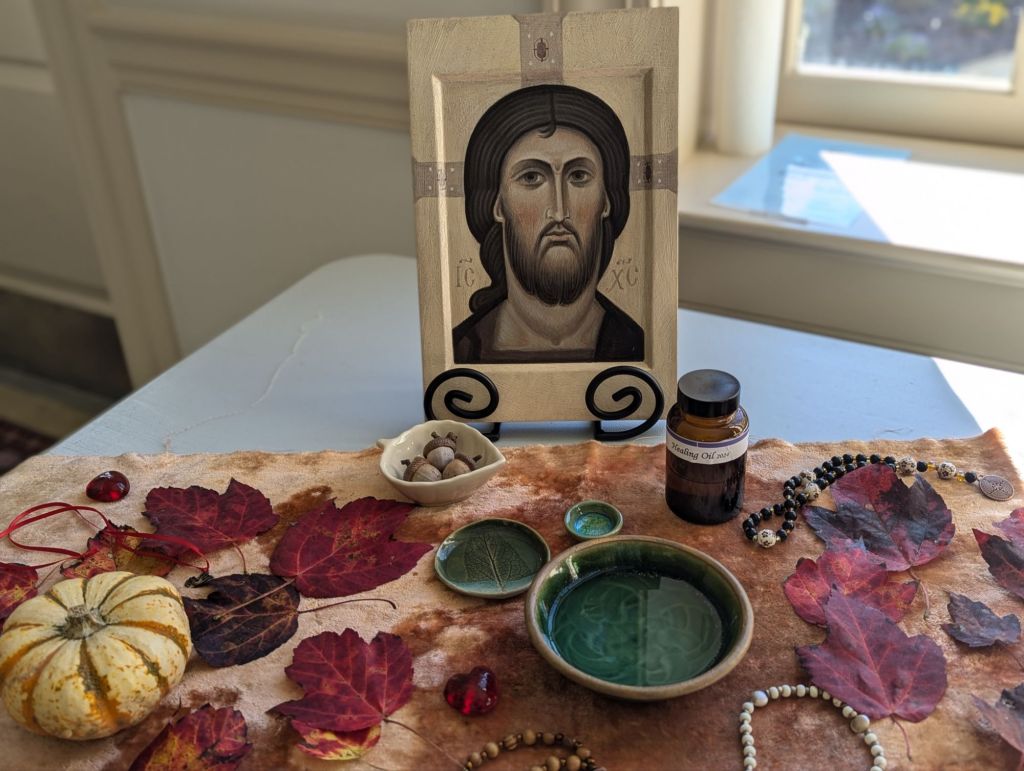
Just before Advent in 1925, the new Pope Pius XI issued a message to the Church known as the Papal Encyclical Quas Primas (“In the First”) which decried these rampant waves of secularism, atheism and nationalistic power that placed ideology and partisan politics over the love and peace of Jesus Christ. And he asked that a new holy day be added to the church calendar to re-center the Church’s attention to the only true and lasting source of peace: Jesus Christ. In his directive, he instructed that a Mass was to be celebrated annually: the Solemnity of Our Lord Jesus Christ, King of the Universe, or as often shortened, Christ the King. And for those of us for whom “Kingship” still conjures up way too many patriarchal images of power, I might invite you to the alternate description of this Sunday in the spirit of Pope Pius’ own motto: The Reign of Christ.
In our Episcopal calendar, this day is concurrent with the last Sunday of Pentecost, just before the beginning of Advent. It brings what we call Ordinary Time into its completion. In keeping with our Anglican identity, we bring this liturgical history from our catholicity while also holding to our protestant leanings: it isn’t a designated feast and there are no required celebrations, but the readings for this Sunday of the Reign of Christ are appointed in the Revised Common Lectionary so that we are singing in harmony with our Roman Catholic, Lutheran and other denominational siblings.
Required or not, I happen to believe that it is a feast worth celebrating and a history that, once fully known, is vital to understanding how the Church can live into our calling to be a force for counter-cultural good, pushing back against the tides of Empire as we have done since the earliest days. The first followers of the Way of Christ gathered at tables and built loving communities outsidr of the sight of the Roman Empire as well as the religious authorities and temple police. It is in our DNA as followers of Christ to see that the powers of this world are of no match for the reconciling love and grace of Jesus Christ who reigns with unabashed love, who dines with sinners, who feeds the hungry, who calls the most unlikely to teach and lead, who will rescue the lost sheep and regard the widow’s mite as more mighty than the almighty dollar. Every. Single. Time.
The Reign of Christ is counter-cultural; I’m completely unapologetic about that and I invite you to be, too. The Reign of Christ would be rejected by economists, pundits, politicians, business leaders and social entrepreneurs today. And the way I see it, that’s another reason to cling to it. The Reign of Christ comes to unsettle us, to knock us out of our secular complacency or obsessions, to tell us to stop allowing our politics and ideology to become idolatrous and to re-center our vision on divine love and grace, preparing for the coming of the One whose whole property is to have mercy.
Not vindication. Not military might. Not outspending wealth. Not political prowess.
Mercy.
In today’s short but mighty Gospel lesson, Jesus is stripped of everything: clothing, dignity, power, friends, institutional support. He stands before Pilate who has all of these things in spades: royal garments, political and institutional authority, armed guards, absolute power. And Jesus asserts when asked, “My kingdom is not of this world…you say that I am a king. For this I was born, and for this I came into the world, to testify to the truth. Everyone who belongs to the truth listens to my voice.”
What do we hear when we listen to the voice of Jesus?
Perhaps we hear the beatitudes: “Blessed are the poor in spirit, for theirs is the kingdom of heaven; Blessed are those who mourn, for they will be comforted; Blessed are the meek, for they will inherit the earth; Blessed are those who hunger and thirst for righteousness, for they will be filled;‘Blessed are the merciful, for they will receive mercy; ‘Blessed are the pure in heart, for they will see God;‘Blessed are the peacemakers, for they will be called children of God.”
Perhaps we hear the words spoken about Mary, sitting at Jesus’ feet and taking in his teaching: “You have chosen the better part.”
Perhaps we hear the parables which instruct us metaphorically about the Kingdom of God, the Reign of Christ: a mustard seed of great faith; the pearl of wisdom that is greater than any price; the tiny amount of leaven that rises the whole loaf; the abundant love and grace that can welcome back the Prodigal Son, the compassion with which the wounded man on the side of the road is carried to shelter and safety by the Good Samaritan, the upside-down economy that gives to the last one chosen as much as the first, or perhaps even more.
Perhaps we hear the words of thanks-giving for the healing grace given freely to those cast out by society, “Your faith has made you well” or perhaps we hear the words Jesus speaks to bless, break and share the simple gifts offered that were enough to feed the multitudes with seven baskets left over. Or perhaps we hear those same words of blessing, breaking and sharing with his friends on the night of his last supper with them, before he was betrayed and crucified.
Perhaps we hear the words spoken from the cross to the repentant criminal, “Today, you will be with me in paradise.”
Perhaps we hear with loving gentleness what it means to be known and recognized by the risen Christ as Mary did that Easter morning when Jesus spoke her name.
Whatever you hear, hold those words in your heart. They are the holy and life-giving message that Jesus speaks to you.
The Reign of Christ is not of this world. It was not in the Year of our Lord 33, it was not in 1925, it is not in 2024 and it will not be no matter which rulers rise and fall, no matter what forces of injustice and oppression seek to usurp power and abuse the marginalized. The Reign of Christ doesn’t depend on our temporal circumstances, but in the eternal words, the life, the ministry of Jesus Christ who was, and is and is to come.
And we are invited to be full participants in that Divine love, mercy and grace.
In Christ’s Reign we are invited to share with each other in love, enfolded in the confidence that whatever this world may throw at us we have a greater authority who has given us…who keeps giving us…everything that we need.
My kingdom is not of this world, says Jesus.
And yet, the Reign of Christ is persistent. The Reign of Christ continues to break through into this world: in the sacraments we celebrate, in the love that we share, in the abundance of grace through which we impart to those in this world who need it most, in the ways in which we are Church with one another no matter what this world can throw at us. The Reign of Christ looks like the smile of the person sitting next to you; the connections that we make as we share in communion and in fellowship; the gentleness that we show to the world as the love of Christ flows through us; the radical love that casts our fear. The Reign of Christ is both the now and the not yet; it has been and continues to be revealed until that time when we experience the realm of God on earth, as it is in heaven.
We pray that it is so, and we work together to make it so.
Take heart, no matter what the world throws at you.
The realm of Christ the King is not of this world.
And there is nothing in this world that can stand in the way of Christ’s transforming love for us, and for the whole world.

 small points of light