
Homily for Proper 13 Year B
St. Mark’s Episcopal Church
Lectionary Texts/Scripture References:
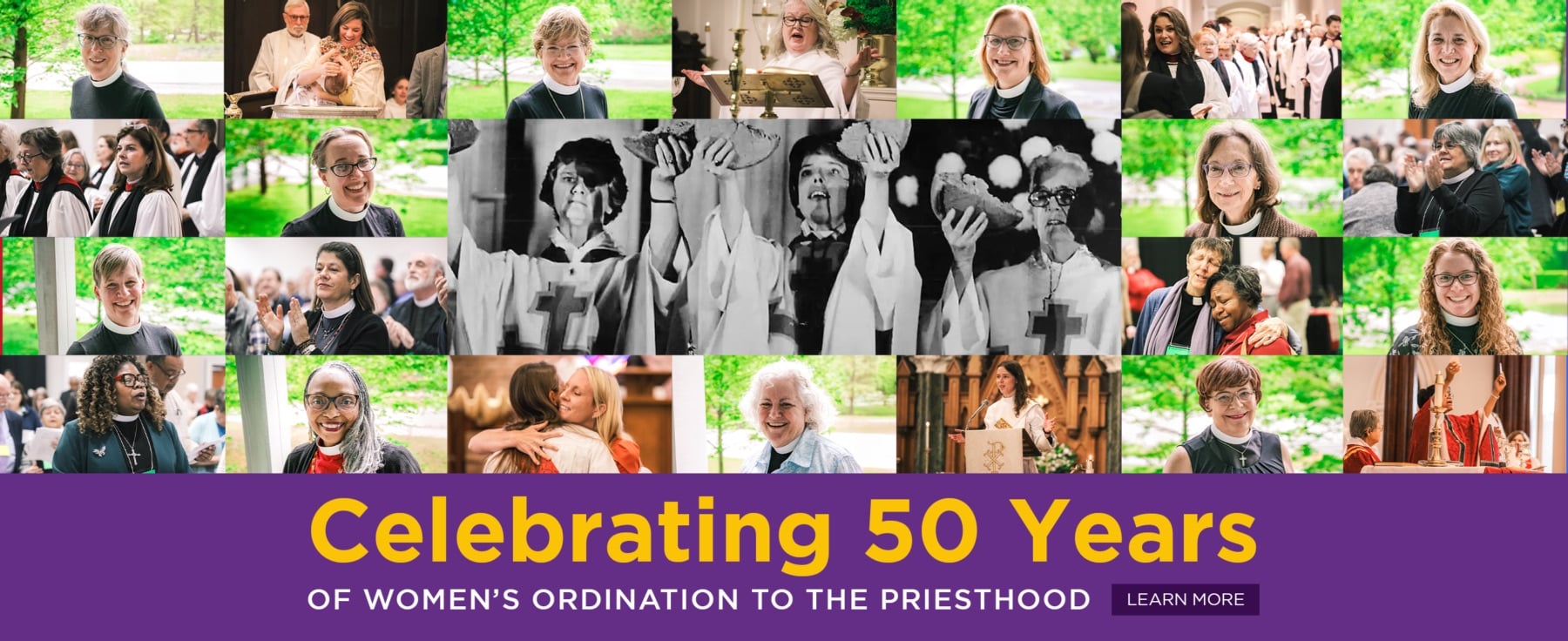
If you take a look at the website for the Episcopal Diocese of Virginia, you will see a photo collage of ordained women of the diocese…including a few familiar faces…all surrounding a black and white historical image of three women…Allison Cheek, Carter Heywood and Jeannette Pickard…three women of different ages and backgrounds, standing together with arms outstretched holding up broken loaves of Eucharistic bread. This picture was taken during the first public celebration of Holy Eucharist presided over by newly ordained priests…who were women…at Riverside Church in New York City. This first celebration was an intentionally ecumenical service; it was neither safe nor allowable for them to celebrate Holy Eucharist in the Episcopal Church in spite of their ordination. These three trailblazing women were among the group we have come to know as The Philadelphia Eleven, women who were ordained to the Priesthood on July 29, 1974 by three courageous, retired Episcopal Bishops. The Bishops who ordained them were sanctioned; the women were prohibited from celebrating the sacraments, including Holy Eucharist and the rectors of the parishes that eventually allowed them to do so were given Godly Admonitions by their Bishops and removed from their positions. After atrocious, unholy backlash for several years, The Episcopal Church eventually passed legislation to canonize the ordination of women at the following General Convention in 1976.
I think about these women a lot, and not just because of this recent big anniversary that we are celebrating. It was the strength of their convictions and the perseverance of their ministry and the ministry of other groups of women who came after them which created the momentum for changes that would span several decades, paving the way for people like me. That change is now written into the institutional canon of The Episcopal Church: the language to guarantee that Ordination is and will be open to all people, first applying that to mean both men and women and later barring discrimination based on gender and sexual orientation altogether. The road was challenging and the journey was long. And in many ways, we still hold that tension both locally and across the Global Anglican Communion. Critics might say this action split the church apart, but I would quote the late Bishop Barbara Harris and say: the church was already split apart, and that is why these courageous women needed to do this.
In these recent months leading up to this 50th Anniversary of that first ordination, I’ve had the opportunity to watch The Philadelphia Eleven documentary several times and to lead discussions with those in formation preparing to become deacons and priests about the history leading up to, during and following that event. And every time I step further into that history…every single time…I come away with an ever deeper awareness and appreciation for how these women were sustained and nurtured not by their own merits or based on their own egos, but through a strength and conviction of faith that could only have come from God.
I have been thinking this week especially about the nature and strength of the call to which this group of women responded and the courage that it took them to be the first, amid threats and violence and discrimination within the same institutional framework that they were making a vow to uphold. Historically, yes…it has been fifty years since that first ordination…but unless we remember the fierceness of their struggle and focus our attention on the holiness of their convictions in spite of all the oppressive backlash of that time, we’re only telling part of the story. The Ordination of the Philadelphia Eleven was and is one of those moments in history where acting in good faith also meant risking everything…not only in their own personal lives, but also in challenging the very structures upon which they were supported. And in that photo, I see three priests who believed in the strength of Jesus Christ and the transforming power of the sacrament of Holy Eucharist to change the structures of the Church and the whole world.
This week, as I pull up that picture of those three women celebrating Holy Eucharist, it feels like a visual personification of the words in our Gospel lesson: “Give us this bread, always.”
To understand the magnitude of the Philadelphia Eleven’s gift to the church, I think it helps to put oneself in the position of the 5,000 people who had just been fed during Jesus’ teaching ministry. Those gathered on the hillside had just had an experience of Jesus’ ministry demonstrating the abundance of God’s care for all of God’s people even in the midst of seeming scarcity of resources. They moved from being hungry to being fed, from being individual seekers to a community nourished together in body, mind and spirit. They went looking for Jesus and found him, and the exchange that unfolds begins a discourse that we will continue over the next several Sundays where Jesus holds up this image of being the Bread of Life, “Whoever comes to me will never be hungry, and whoever believes in me will never be thirsty.”
Imagine that crowd of 5,000 as the church…all of us…moving together with our need for healing, our desire to learn and grow and our growing awareness of each other all being seen and our needs met by the One who took the communal offering of loaves and fishes, gave thanks, broke it and shared it so that holy abundance could be experienced and shared by all. It was glorious; it was a miracle; they were satisfied and filled. But the next day they were empty again and couldn’t find Jesus or the disciples. So they set sail to find them and upon doing so, this exchange happens. It’s as if Jesus is holding up a mirror, asking them to see their own intentions first and then, after that, to see Jesus as so much more than a purveyor of holy picnics. Jesus was and is the Bread of Life, nourishing us far beyond our basic needs.
And so it is with us, the Church. We have caught glimpses of Jesus’ transforming love over the ages. We are fed, we give thanks…but then we go forth into a broken world empty of that love and we can get in our own way of seeing the fullness of Jesus’ transforming love not only in the meal with which we are fed, but in ourselves as living members of the Body of Christ, the Bread of the world. The Church and the world both struggle with power, privilege, assumptions of worth and resistance to our readiness to do that which is truly right, good and holy especially when it means embracing change that is counter-cultural to the way things always have been. Maintaining the status quo is the easy way…but it doesn’t always give us life. Believing in Jesus’ power to nourish, transform and fuel us to do the loving, life-giving work of change is the hard, holy and life-giving work that Church is given to do, first by being fed, nourished and transformed here and then going forth into the world.
I hope that when presented with that work of transformation, we will also be ready to say: “Give me this bread, always.”
What might that work look like? I think Paul’s letter to the Ephesians gives us the framework we need to understand the fullness of our lives in Christ that has been set out for us:
“…lead a life worthy of the calling to which you have been called, with all humility and gentleness, with patience, bearing with one another in love, making every effort to maintain the unity of the Spirit in the bond of peace.
“…each of us was given grace according to the measure of Christ’s gift…some would be apostles, some prophets, some evangelists, some pastors and teachers, to equip the saints for the work of ministry, for building up the body of Christ, until all of us come to the unity of the faith and of the knowledge of the Son of God, to maturity, to the measure of the full stature of Christ.”
We, the Church, are one Body and one Spirit in God’s call to us. That is how God sees us, even if we see our differences. We are invited into unity and not into division; challenged to set aside the power plays and the privilege games. We are asked to discern our gifts and then use them for our common ministry, for building up the body of Christ. God equips us, each of us uniquely, to engage that work of ministry. And it all starts here, as we are fed, nourished and transformed.
I give thanks today that 50 years ago, eleven women chose to align their lives into the calling to which they had been called, whether the church was ready for them or not. Their lives bore witness to love that doesn’t always go along with the status quo, but demonstrates steadfastness even in the midst of hate. Their witness helped the Church glimpse a unity that surpassed the divisions humanly defined. Their perseverance built up the body of Christ even as it took a toll on some of their individual lives. They were and are seen, and loved, and to be commended for living into the work of ministry to which they had been called.
Apostles, prophets, evangelists, pastors, teachers…all are necessary to equip us for the work of ministry. Thanks be to God for those who proclaimed the Good News, taught and cared for God’s people, gave prophetic voice to a future unity that had not yet been realized and held in their hands the Bread of Life, broken for the world so that all might come to know the fullness of His mercy, love and grace.
And for all of us whose lives have been inspired by them, the question is now ours: as we prepare to receive the blessed Bread of Life through the sacrament of Jesus’ mercy, love and grace, how are we being equipped to do the works of ministry to which we have been called, bringing us ever closer to living in the fullness of the Body of Christ?
I invite you to hold this image, this story and this prayer in your heart today: Give us this bread, always.

 small points of light