
A homily given at the July 13, 2024 Ordination of Deacons (transitional) in the Episcopal Diocese of Virginia hosted at St. Andrew’s Episcopal Church, Burke VA. Dedicated to Becki Casey, Reggie Hayes and Caroline Mitchell, with whom I have been honored to walk through their vocational journey.
Ordination Readings:
Ecclesiasticus (Sirach) 39:1-8; Psalm 119:33-40
2 Corinthians 4:1-12; Luke 22:24-27
Almighty and eternal God, so draw our hearts to you, so guide our minds, so fill our imaginations, so control our wills, that we may be wholly yours, utterly dedicated unto you; and then use us, we pray, as you will, and always to your glory and the welfare of your people; through our Lord and Savior Jesus Christ. Amen.
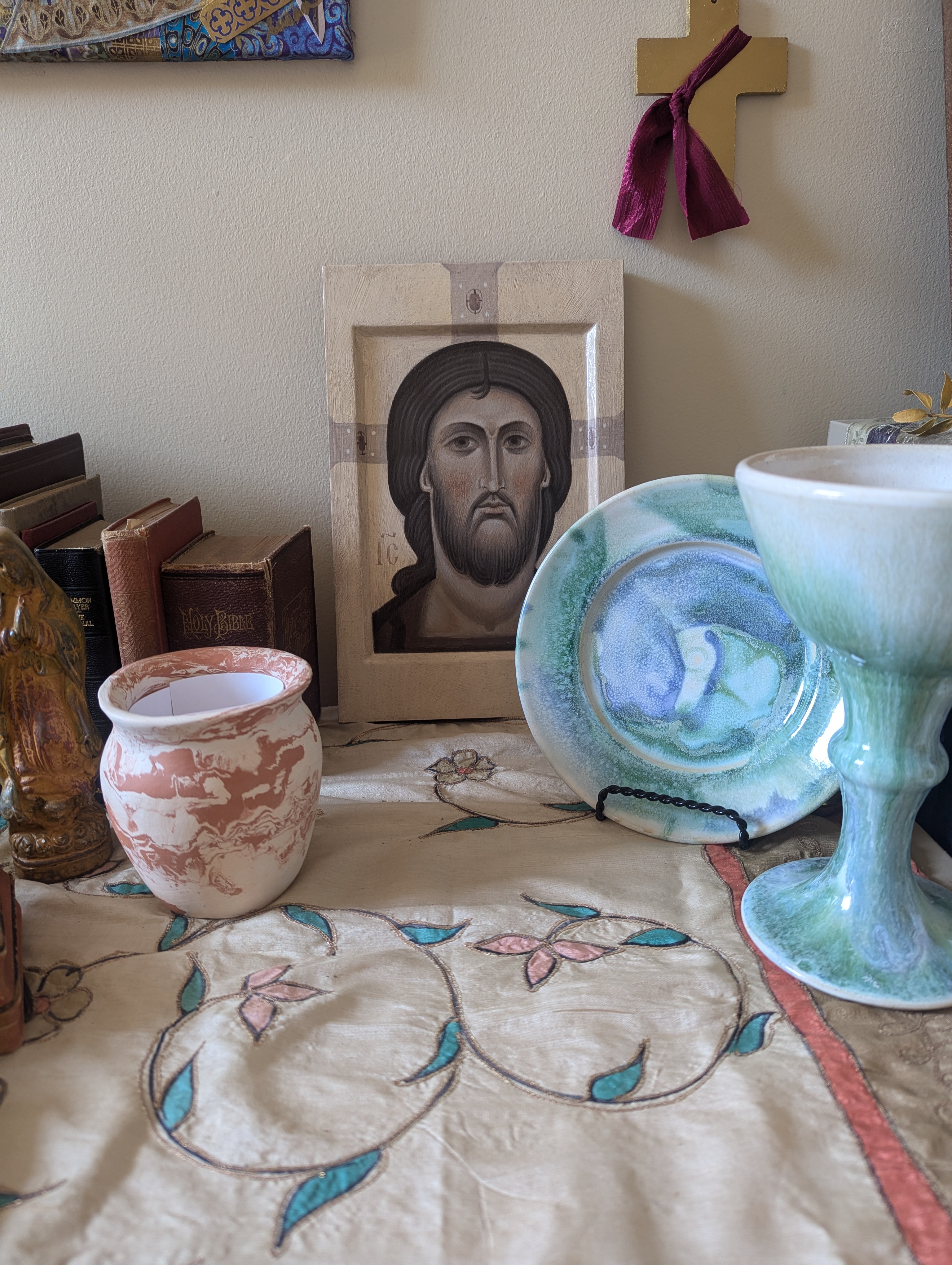
Step into my office with me for a moment as those in vocations process sometimes do. Against the wall there is a very large filing cabinet; over the cabinet I’ve spread a colorful scarf…you know, trying to tone down the bureaucracy a touch. On top of the scarf, there is an icon of Jesus Christ, Pantocrator…Jesus, the Teacher. It was painted by the hand of the teacher from whom I am beginning to learn the holy art of iconography; it reminds me that the face of the holy emerges with prayer, patience, love and grace. Next to the icon, there is a hand-made paten and chalice given to me on the occasion of my ordination by a mentor and made by a member of her community; it reminds me that every day I learn more about what it means to live out my vows of word and sacrament, and community is essential to that learning. Next to the paten and chalice there is a small, hand-made jar made of clay. And tucked inside the clay jar there is a handwritten note reminding me of its origin: Mattaponi river clay pottery handmade by June Redwing Langston. The jar was a gift from a former social work student upon defense of her doctoral dissertation, which she completed with and among the tribal elders of the Mattaponi people. The lessons held within that jar are richer than anything the filing cabinet could hold; it reminds me that every day, I am learning more fully what it means to be a human being made in the image and likeness of God: all of us, jars of clay formed from the dust of the earth by the loving hands of our Creator.
The icons I am learning to paint, the vows I am learning to live, the mind, body and soul of this person that I am are all composite layers, formed and forged from learning, and mistakes, and grace. So much grace. And in that, I take heart, knowing that God is still at work in me.
Ordinations are an outward and visible sign of that same grace. And in that, we take heart, knowing that God is still at work in the Church and in the souls that are called into this ministry.
Therefore, since it is by God’s mercy that we are engaged in this ministry, we do not lose heart.
The Church in Corinth had begun to lose heart. They had a lot of clay jars in their midst, not the least of whom was the Apostle Paul. As far as church planters go, it seems Paul didn’t get the “set yourself up for success” memo. His enthusiasm for spreading the Gospel of Jesus Christ overwhelmed his logic and of course, that gave rise to situations filled with both human shortcomings and divine grace: both of which proliferate throughout the stories and letters conveyed in our holy scriptures.
Some of us here today might appreciate that Paul’s initial travel to Corinth was a bit of a multi-vocational venture: he was staying with friends Priscilla and Aquila with whom he was engaged in a common trade: tent-making. His intention was to make tents and preach in the synagogue but when his message didn’t go over well with the temple authorities, God drew his attention instead to all the other people surrounding him…the outsiders, the gentiles. These were the people in Corinth Paul didn’t think of himself as called to serve but, as God reminded him, they had already begun to follow the Way of Jesus and they were all God’s children. Just like Paul, the people of Corinth were clay pots filled with the treasure of the divine spark of love and grace. With this new light breaking through, Paul acquiesced and expanded his circle of ministry. The Church in Corinth began to grow and eventually Paul was able to pass the torch and continue on his missionary journeys in the direction of Rome.
But planting churches amid a very cosmopolitan port city not exactly known for its piety led to a whole host of challenges. Paul draws attention to these issues in his pastoral letters, epistles written in subsequent years during Paul’s travels and carried back to the churches. Paul’s letters to the Church in Corinth were filled with exhortations about piety, conflict, relationships, human sexuality, core doctrine, identity and arguments over death and the nature of the resurrection. That isn’t because those were the most important topics. It is because these issues and challenges consumed the attention of the church and pulled them away from seeing Christ fully in each other. In the section of the second letter written to the Church in Corinth which we read today, Paul seizes a pastoral moment amid his exhortations. Perhaps one might say he pulls his listeners into his own proverbial office. And in this pastoral conversation, we see through the cracks of Paul’s own experience of grace and learn how he, too, has come to see light in the midst of darkness:
For we do not proclaim ourselves; we proclaim Jesus Christ as Lord and ourselves as your slaves for Jesus’s sake. For it is the God who said, “Light will shine out of darkness,” who has shone in our hearts to give the light of the knowledge of the glory of God in the face of Christ.
I might argue that Paul’s word choices here are not hyperbole and should not be made more gentle for our modern ears. For Paul, his call to minister in places he would rather not go, do things he would rather not do, and serve people he once considered to be outcasts spoke to his forfeiture of personal freedom for the sake of the Gospel.
The word we translate in English as slave, the Greek term doulos refers to a person either by choice or force becoming the property of another. The church in Corinth would know that term, because they encountered people every day in that particular social circumstance, for a whole host of reasons. The state of being doulos in ancient Greece was about agency, not worth or essential humanness: one’s actions were lived out in total deference to another for a period of time or even a lifetime. Perhaps it was to pay a debt, to settle a score, to right a wrong. In Paul’s reference, his enslavement to ministry is for the sake of Jesus and the proliferation of the Gospel. The state of doulos offers insight into how he views the clay jar of his own humanity, fired by blinding light on the road to damascus. Paul still fights with his ego…we definitely see that…but we also see someone whose zeal has been transformed from persecutor to disciple, coming back around time and again to re-experience the grace and abundant love which is the Good News of Jesus Christ and allowing that message to filter through him and enlighten those he encountered.
But we’ve come here today in the 21st Century Church, in the Episcopal Branch of the Jesus Movement as our Presiding Bishop Michael Curry might say, to ordain three human beings as deacons…diakonos…on their path to the ordained ministry as priests in the church. In our Episcopal tradition all priests…and bishops…are first ordained and serve as deacons. And while diakonia is also about one’s willingness to step into the role of servanthood, it’s not the same thing. Doulos and Diakonos were different states of being in the biblical narrative. The ministry of a deacon…of the diakonos…was and is one of ministry and service performed voluntarily, often as an outgrowth of devotion and love.
And we see the ultimate expression of the diakonos in the life and ministry of Jesus.
I need to set the stage a little bit here to from our Gospel passage from Luke. Jesus and his disciples were in Jerusalem. It was Passover; they had just dined together and Jesus had shared the bread and wine with them in what we now call the Institution of the Lord’s Supper. It’s a profoundly holy scene, filled with devotion and love. And then, a dispute broke out among them about who was the greatest.
Talk about a giant crack forming in the clay jar of humanity.
The Light of the World, Jesus, doesn’t try to patch up that crack but instead breaks through to his disciples with divine light and speaks to them of God’s vision of greatness and love, describing in both word and active example the diakonia of holy servanthood. And Luke’s Gospel points to Jesus, himself, coming into the world as diakonos, the one who serves.
Jesus the Light of the World. Jesus the teacher and messiah. Jesus the deacon.
The gift of deacons in the church is to have visible and present icons of Jesus’ own servanthood. As deacons in the church, as it is said in the vows you are about to take, “At all times, your life and teaching are to show Christ’s people that in serving the helpless they are serving Christ himself.” Every deacon holds within their ministry the servanthood of diakonia lived out in the life and ministry of Jesus. And every priest and bishop also holds within their ministry the icon of Jesus’ own diakonia of service.
Becki, Reggie, Caroline: In this time in your ministry that you will serve in Christ’s own diakonia of ministry and in all the years of your ministry that will follow, you will undoubtedly encounter surprises and situations you had not expected. But I know the three of you pretty well at this point, so I know you are up for the adventure.
At times, the clay jars of your humanity might start to feel pretty fragile. You may even begin to crack. While holding the light of Christ’s servanthood is a treasure, I want to remind you that light isn’t actually meant to be contained. I’ve come to think that holding that treasure of Christ’s profound love and grace in the fragile clay jars of our humanity is actually how it was always intended to be. When we feel ourselves cracking open during times when the needs and hopes and concerns of the world begin to seem overwhelming, it is then that the light of Christ’s own diakonia of servanthood can come pouring out of us.
The world needs to see that those needs, hopes and concerns can and will crack us open but we don’t fall apart, or give up, or lose heart. We allow Christ’s light to pour forth from the cracks in the clay jar of our humanity. These cracks are the cost of loving and caring deeply for God’s creation, and they are also the conduits that allow the outpouring of God’s love and grace.
With great respect to Leonard Cohen, there isn’t only a crack in everything for the light to get in; there are cracks in the clay jars of our humanity so that Christ’s love and light can come pouring out.
…we have this treasure in clay jars, so that it may be made clear that this extraordinary power belongs to God and does not come from us. We are afflicted in every way but not crushed, perplexed but not driven to despair, persecuted but not forsaken, struck down but not destroyed, always carrying around in the body the death of Jesus, so that the life of Jesus may also be made visible in our bodies.”
To our three soon-to-be deacons: my prayer for you is that the diakonia of your ministry allows you to be cracked open for the Light of Christ to show forth in the world: in the students that you mentor and teach, the people and parishes with whom you will be called to minister, with the communities and first responders where you offer calm and solace in the midst of disaster; to your children, spouses, families and friends; on pickle-ball courts, in the halls of Bishop Walker School and the fields and campsites of Wild Goose; in music and song, liturgy and incense, coffee and conversation. The paths that each of you travel are as diverse as the beautiful jars of clay that God formed you to be. Everyone in this place and watching this livestream are going to be waiting to see the amazing, unexpected, wild and beautiful ways that the Holy Spirit will be moving in your lives and ministries as you serve as Deacons in God’s church.
And you can walk into my office and share your stories with me any time you like.
The Light of Christ is the treasure that we all hold in these clay jars of our humanity. These three soon to be deacons are about to receive the gift of the Holy Spirit and the blessing of the Church to empower them for ministry. That gift will not only break them open, but through them all of us will be broken open, too. May the diakonia of Jesus and the light of His love spread forth from you to fill the world with love and grace, on this day and in all the days to come.

Caroline, Reggie and Becky with me just before their Ordination

 small points of light