
Homily for Advent 2, Year B
St. Mark’s Episcopal Church, Richmond VA
December 10, 2023
Gospel Lesson: Mark 1:1-8
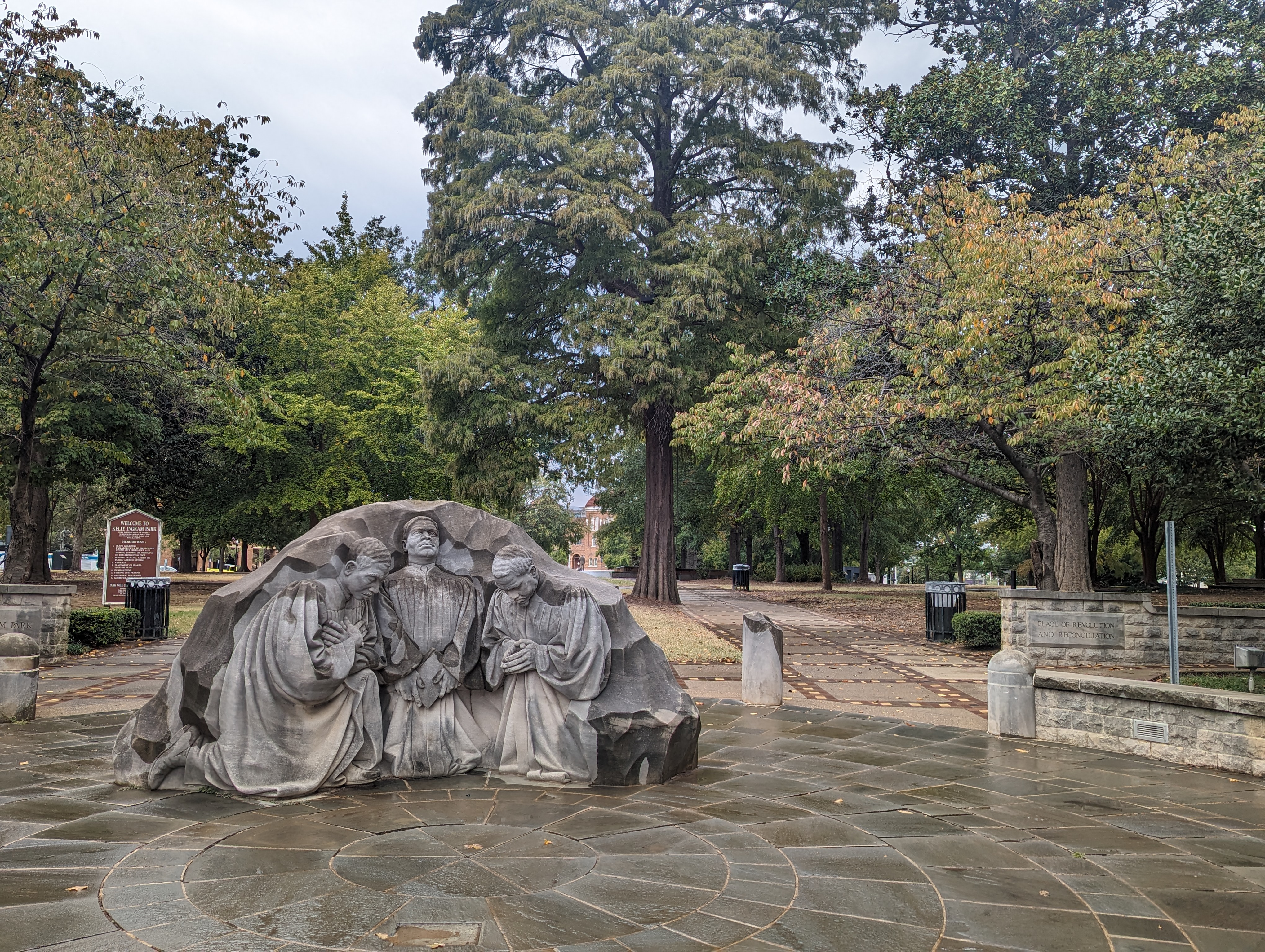
On a misty autumn afternoon in Birmingham, Alabama, I first met Marcus. I was traveling with our diocesan racial justice bus pilgrimage group this past October, and we had taken a break for lunch after which we were to gather at the Sixteenth Street Baptist Church for our afternoon pilgrimage site visits to both the historic church and the Birmingham Civil Rights Museum. One of my companion pilgrims, Deacon Susie, had suggested that we pack up a few granola bars and water bottles in our backpacks, foregoing a sit-down lunch in order to spend some extra time at Kelly Ingram park, which was directly across from the church. That park, as you may recall, was the site of the May 1963 attacks by city fire and police officials on civil rights activists including thousands of school children marching for racial justice. The city park contains a walking tour of statues and monuments reflecting this critical and bone-chillingly horrific time of civil rights history, as well as moving statues memorializing the four young girls, Addie Mae Collins, Cynthia Wesley, Carol Robertson and Denise McNair who were killed when a terrorist bomb planted by the Klu Klux Klan exploded just outside the Sixteenth Street Baptist Church, caving in the wall to a room where they were preparing to participate in Youth Sunday. It is a lot to take in. And on that day, we were both drawn to enter this particular urban wilderness to make our pilgrimage of remembrance, repentance and healing.
I entered the park and began reading one of the self-directed tour markers. After a few minutes in the park, a thin, African American man wearing clothing that was too large for his frame and a winter stocking hat perched on top of his head came up to me and introduced himself: “My name is Marcus” he said, “And I can give you a tour of this place and tell you some of the stories that you won’t hear about, unless you hear them from where I walk, on the street.” I asked him where he stayed most days and he turned his head and with his chin nodded to a place in an older section of the park where there was evidence of several people who had taken up residence under an old gazebo. “Over there, until they tell us to go” was his response. “Did you eat lunch?” I asked, and he shook his head. I said, “I was going to eat and walk, do you want some?” He looked over our granola bar stash, trying to find something that didn’t have a lot of nuts and landed on a blueberry-oatmeal bar which he thought looked good. I picked cherry-chocolate granola and we headed for the next monument.
Marcus proceeded to tell us a story that was a mix of his personal recollections of his mother’s life, wound in with the civil rights narrative of her world in the 1960’s, intermingled with the lives and events that had taken place in that park. His mother’s story wove together with other young people taking a stand against racial hatred, including of the lesser known history of two young black men who died in incidents of racial violence on the same day as the church bombing: Johnny Robinson, killed by a white police officer and Virgil Ware, killed by a white teenager. Until that day in Kelly Ingram park, I hadn’t heard about the two young men. So often it is that our narratives are limited to who the storytellers are and how much distance…social and geographic…there is between the events and our more privileged and protected lives. We were learning about history in that park in a way that no museum or newspaper could ever teach us.
Marcus was unfolding his own story, too. I learned a lot about Birmingham from him, and about what life is like for a man with injuries and mental health challenges and addictions and recoveries and a mother that loved him unconditionally, until she was no longer in this world to care for him. And because we entered that wilderness with our eyes and hearts open and were met by one of its residents, we learned something real in words and beyond words about the day-to-day of street life, living off the food leftover by strangers, surviving on the proverbial wild locusts and honey of fast-food restaurant cast-offs and shared granola bars.
As we wove in and out of monuments in the park, Marcus would exit and talk with others and then circle back around, adding some more details as his mind was prompted by specific monuments. Lest you think this scene was too serene, there were also plentiful other people in the park, some colorful characters, some tourists, some avoiding Marcus and others living unhoused by making big changes in course to get from one side of the park to the other without eye contact. And there were people who I know thought we were crazy and others who told us outright that we were not safe. But they didn’t know our story or our draw to that particular journey into the wilderness any more than they knew Marcus’ story. I work with the saints of the street on the regular, as does Deacon Susie. And because that is part of my call, I have also learned about addiction, mental health, and about my own humanity and our collective humility when we enter the sacred space of encountering God’s presence on the social margins of this world. So, when I was mostly done with this most unusual of tours and Marcus said to me, “I want to ask you for one more thing” there was a part of me that was mentally searching through my wallet to determine what cash I had and what appropriate compensation for his time I would offer before we parted ways but there was also a part of me that heard the Holy Spirit whispering: you need to just listen.
And so, I listened. And before we closed our time together Marcus said, “will you pray with me.” And I said, “yes, if you will pray with me.”
And there in a city park, on a misty afternoon in Birmingham, I stood with Marcus and we prayed. Words poured out of both of us about the thanks we gave to God, and the places where we most needed healing in our lives. I don’t remember what words I prayed or what Marcus prayed because it was like we had a bit of an open channel with the divine in that moment together, meeting us exactly where we were at.
A voice calling out in the wilderness has a particular and profound connection with God.
When we read this Gospel lesson from the comfort of our modern surroundings and only think historically about John the Baptist, we hear part of the Advent message. But imagine, if you will, that there is a prophetic voice calling us into this story across time and distance. Imagine the people from the Judean countryside and the whole city of Jerusalem leaving their daily routines and making a choice to enter the wilderness and seek out the prayer and prophetic counsel of a wilderness wanderer wearing a rough, camel hair tunic held up with a belt around the waist. Something compelled them toward the wilderness and away from whatever was defined as safe and comfortable. They were drawn to John and through him their ears were attuned to hear not only his voice but that of the Messiah, Jesus, who was coming after him, who would also present himself to John to be baptized. And the ears and eyes of their hearts may have sensed the voice of God breaking open from heaven in that profound and holy moment. These are the same people, at least some of them, who would follow Jesus up the Judean countryside listening to his teaching and preaching. These are the same people, at least some of them, who would find themselves on the other side of their own baptism in the Jordan River experiencing a transformation unlike anything they imagined, their hearts burning with anticipation for an encounter with the Messiah, the incarnate Word-made flesh.
What was the yearning that drew them into the wilderness? What is it that we yearn for that draws us into the wilderness this Advent?
Perhaps it is a yearning for liberation that comes when we push past our complacency and start confronting the truth. Perhaps for us it is the liberation that comes with confronting the hard history that we’ve realized needs to be spoken. Perhaps it is our desire to lay down the trappings and baggage that weigh us down in this world, to be renewed and reborn and transformed with God’s help. Perhaps it is release from the hurt we carry from being in this world, the hurt inflicted on us and the hurt we see inflicted on others. Perhaps we yearn for forgiveness from the hurt we have done to others, whether or not we ever intended to do so.
“The voice of one crying out in the wilderness, prepare the way of the Lord”
The wilderness is a place where only the essentials matter, and the extraneous no longer serves us. This preparation we are called to in the season of Advent is not one of storing up, but of letting go. It brings us, individually and collectively, into a time and place where nothing else matters but the outpouring of our hearts to God as we make room to welcome Christ anew.
Deacon Susie and I were together again at the end of that day in Birmingham, sitting at a picnic table outside of a Mexican restaurant with a long waiting line. As we were talking and catching up about the day that had passed, I saw Susie look up. Her face lit up with recognition at someone she saw beyond where I was sitting, “Well, look who it is!” she exclaimed. I turned, expecting to see someone else from our group who might have been craving chips and salsa. And who did I see: Marcus. No hat this time, and a little bit cleaned up from earlier in the day. “I told you, I know how to walk and get everywhere in this city!” he said to us. We made room at our table, and he sat down with us for a bit, helping us understand the proximity of the park where we were earlier to this restaurant where we were at now, and how all that related to the parts of the city that he felt were important to know. And we shared that sacred space together for a while, until it was time for him to move on while we continued to wait for our dinner.
We laughed at the serendipity of another encounter and at the same time, none of us were really surprised that we found ourselves together again. Church is like that. Amid all our differences and even in the wilderness of our lives, we find one another. We wait with expectation knowing that Christ is always in our midst, drawing us together into holy moments and encounters not only in our familiar spaces, but with the people and places that we least expect.
We just need to open our hearts to make room.

 small points of light