
Commencement Address for VCU School of Social Work (December 2023)
The first day I realized that I might be a social worker, I hadn’t even taken a class yet. I was working as a CNA in a skilled nursing facility, which I’d started to do right after high school. I enjoyed taking care of the residents but I wasn’t particularly fast at my tasks, which means I wasn’t considered “good” at my job. Often I found myself at the receiving end of an unhappy glance from my charge nurse. During the fall, I started taking some classes intending to find my career in the medical field. But let’s just say that I wasn’t feeling optimistic about that career path after a semester of anatomy and physiology. One day over winter break, I went into work and learned that one of the residents I often cared for had experienced the death of her spouse. She wasn’t on my assignment that day, but I decided to go visit her on my break. So, later that afternoon, I knocked on her door and she welcomed me in. We sat together, looking at her old photos. She reminisced, I listened. I remember feeling comfortable, just being present.
Suddenly, my charge nurse was at the door. She grabbed my arm and pulled me out to the hallway. With a stern look on her face, she began to lecture me about sitting around on the job, and I reminded her: I was on my break. She immediately said, “if you’re going to waste your break sitting around, at least do something productive like scrub the sink.” Then, she added: “If you want to talk with people so damn much, why don’t you go be a social worker!”
I know she meant it as an insult. And believe me, I felt it. But little did she know, she had just changed my world.
That next semester, I signed up to take “Intro to Social Work.” And that’s where I learned to apply terminology, theory and strategy around this part of my identity that longed to center relationships, to foster people’s ability to create changes in their own lives within the systems that impact their everyday experiences, and to advocate for just policies and systems that protected the fundamental rights and responsibilities of our collective care for one another.
During my BSW program and my MSW program there were ups and downs, and challenges, and papers and tests and more papers and tests. I know you all know something about that! Eventually, there was a PhD in my future with a really, really big paper…and there have been many more classes and papers since then. All along the way, I have met people who have challenged me and mentors who have inspired me by giving me examples of how they put their social work skills into practice: in health care, in child welfare, in mental health, in government, in academia, as organizational leaders, as candidates for elected office, with their clients, colleagues, co-workers and community partners.
I hope that it’s been the same for you during your studies: My hope is that social work learning took place not only within your textbooks and lectures and discussion boards and assignments, but also with your peers, your professors, your mentors and most importantly, with your clients.
From the clients, classes and mentors I encountered on my own journey, I learned to nurture social work not just as a field of study, but as vocation: that place where my deep fulfillment meets the world’s deep needs. My vocational identity as a social worker has been front and center when I worked in health care, hospice, education, community practice, non-profits, in a school of social work and now within the organizational structure of a religious institution. In all the settings where we live and work, the values and ethics of our vocation are more than just professional guidelines: we have the opportunity to live into them every single day.
And that’s what I really want to talk with you about: How do we choose, each and every day, to embody what it means to be social workers?
I’m going to suggest three ways: Commitment, Colleagues and Community
Commitment: Social workers commit to ethics and values every day and keep pushing our profession forward. It isn’t good enough to have skimmed through the NASW Code of Ethics like a one-and-done assignment. It also isn’t good enough to assume that the historic context of social work contained in that statement offers us everything we need in 2023, or 2024 or 2035. Instead, if we understand the core and continuing values of our profession as emerging from the intersecting movements of social casework, the settlement house movement and mutual aid among members of oppressed groups then we can continue to ask critical questions that guide our actions where systems, communities and the voices of those marginalized by social structures come together. If we intentionally center the voices of those sidelined by society then we can make a counter-cultural impact in this divisive and stratified society. If we commit to center human relationships then we will make tangible changes in our own lives, as well as effectively broker and advocate for change with our clients. A value-driven profession is not “less than” scientific: A value-driven profession participates in the great experiment and rises to the grand challenge of believing that change is not only possible, but imperative.
Colleagues: Social workers center human relationships. We are our best professional selves with colleagues who share our values; who can support and challenge us when we hit rough patches; who can call us in with love to be sure that we aren’t becoming jaded, burned-out or overwhelmed by systems of oppression. We need diverse colleagues who can see things from different vantage points and social locations so that we are not lulled into thinking that our way of thinking is the only perspective. Maybe we’re lucky and we find our social work colleagues in the same place as our social work employment. But, we may be practicing social workers in interdisciplinary settings, or we may apply our social work skills and values in paid and voluntary settings outside of traditional social services altogether. In every setting where we work and every job title we hold, we are social workers. Being a relationship-centered social worker compels us to intentionally build colleague networks that reinforce our values and build each other up. Make and keep up the relationships that you have forged here; change jobs if you want, but keep the colleagues who help you be the best social worker that you can be! A cherished colleague group is the best prevention for burnout and the first ingredient in professional self-care.
Community: Social workers create community. Community is bigger than family, friends, or even colleagues. Some communities are place- or system-defined: where we live, where we went to school, where others see us “fitting” ideologically, politically or demographically. We may find communities of identity who help us build up strength in numbers, especially if we are a minority group in a larger system. As social workers, we can also create community. Creating social work community means intentionally expanding our circle to include those who are different from us because we see strength in diversity. Creating social work community means practicing affirmation and inclusion because we value what everyone brings to the table exactly as they are. Creating social work community means setting extra places at the table or pulling up a whole other table to make sure that there are plentiful seats. Creating social work community means noticing exclusivity then acting on our discomfort to create inclusive opportunities. Living in social work community means it’s not all about us: it’s about ALL of US.
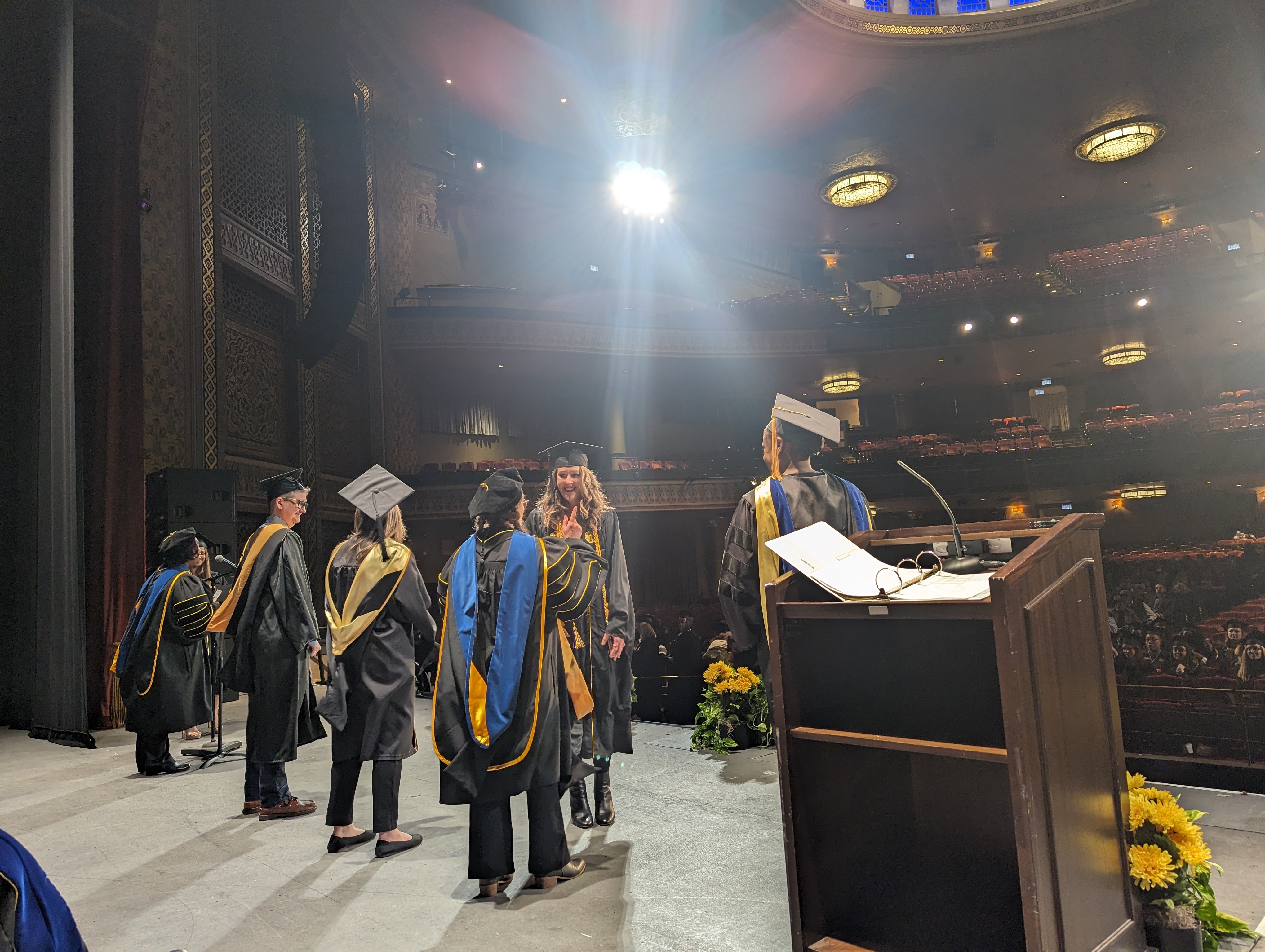
Today, we’re marking the threshold of a new beginning: the commencement of something you’ve been working for not only for several years of formal education, but for your whole lifetime. Commitment, colleagues and community: These are three essentials to living out the vocation of social work with each step that you take, wherever you choose to go in this world. The world needs us. This world needs YOU to be a social worker, wherever you are. Each of you is a unique gift to this profession and you will help social work shift, change and adapt to the needs of an ever changing world in ways uniquely suited to you. Congratulations, social workers. You have earned this day. Now, let’s go change the world!




 small points of light